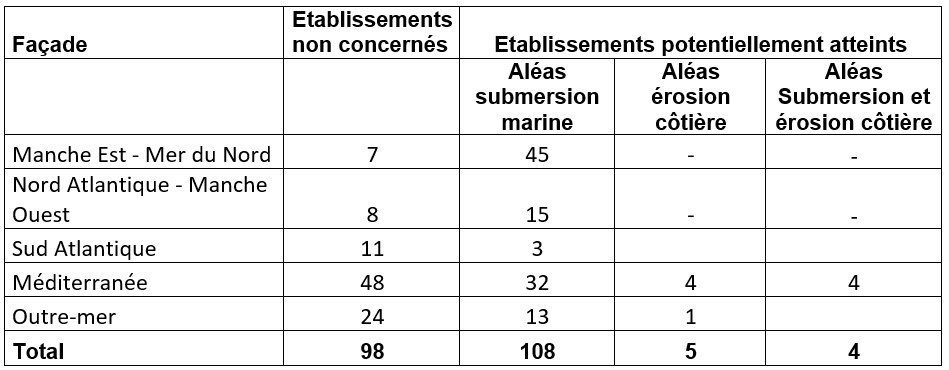
Enjeux industriels (établissements Seveso) en zones de submersion marine et dans les secteurs en érosion
Suite à l’accident de Fukushima, les interactions entre les aléas naturels et les installations industrielles à risque font l’objet d’une attention (…)
Following the Fukushima accident, the interactions between natural hazards and industrial installations at risk have received particular attention (…)
3 chapters
- Key figures 2021Coastal facilities207 Seveso facilities located on the French coastMarine flooding108 Seveso facilities potentially affected by marine flooding hazardCoastal erosion5 Seveso facilities potentially affected by coastal erosion hazard
- Overall analysisNational distribution of Seveso sites• In 2021, France has 1,369 "Seveso" facilities, of which 727 are classified as high-threshold and 642 as low-threshold (see definition below). They are distributed across 882 municipalities. • Coastal municipalities account for 207 Seveso facilities (15% of the total: 11% of all low-threshold facilities and 19% of high-threshold ones). 7% of coastal municipalities (53 in mainland France and 15 in overseas territories) have at least one Seveso site on their territory. On the French coast, the density of industrial facilities classified as Seveso is twice as high as across mainland France as a whole.Historical coastal settlementHistorically, many industries (steel production, refineries, etc.) established themselves in port areas to process imported raw materials directly. Seveso sites located on the mainland coast are concentrated primarily on the Mediterranean (80 sites) and English Channel-North Sea (52 sites) coastlines, specifically in the major industrial and port sectors of the northern coast, the Seine estuary, and the Fos-Marseille area.Overseas territoriesIn overseas territories, Seveso sites are mainly located in French Guiana (22 sites), particularly in the municipality of Kourou (16 sites).
- Seveso facilities affected by coastal hazardsMarine flooding• Following the Fukushima accident, the interactions between natural hazards and industrial installations at risk have received particular attention from public authorities. For industrial facilities exposed to natural hazards (flooding, marine submersion, earthquakes, ground movements, storms, lightning), prevention and protection measures must be put in place to prevent these hazards from triggering a major industrial accident. • Flooding of an industrial site, and especially a Seveso facility, can indeed cause releases of hazardous substances, water pollution, and fires triggered by electrical short circuits in the presence of water in electrical installations. • Among the 1,369 Seveso facilities located on French territory, 156 (105 classified as high-threshold and 51 as low-threshold) are potentially affected by marine submersion flooding (see methodology); 108 are located in coastal municipalities (95 sites in mainland coastal municipalities and 13 sites in overseas coastal municipalities). The English Channel-North Sea coastline accounts for the highest number in this category of sites (42%). • Other Seveso facilities affected by marine submersion hazard are located in estuarine municipalities, not subject to coastal law, situated mainly on the shores of the Gironde, Loire, and Seine estuaries. • The main business sectors of Seveso facilities potentially exposed to marine submersion hazard are: storage and warehousing non-refrigerated (22% of sites), manufacture of basic chemical products, nitrogen products and fertilizers, basic plastic materials and synthetic rubber (17% of sites), electricity production (7%), and petroleum refining (7%). • Prevention of flooding in industrial facilities must be taken into account in the hazard studies of Seveso facilities, as with all other factors and events that could cause an accident at such sites. Furthermore, for new installations, authorization to operate a Seveso facility is at minimum subject to compliance with the requirements of the flood risk prevention plan (PPRI) when it exists.Coastal erosion• In mainland France as well as overseas, coastal retreat can pose a more or less significant risk depending on the territory. According to the national coastal erosion indicator (Cerema, MTE, 2018), this phenomenon affects approximately 20% of the French coastline. • Following the method developed by Cerema (see methodology), of the 207 Seveso facilities located on the French coast, five (3 classified as high-threshold and 2 as low-threshold) could potentially be threatened in the future by coastal retreat. These facilities are located in the Mediterranean (4) and in Guiana (1).For both coastal hazardsCross-analysis of Seveso facilities exposed to both marine submersion and coastal erosion hazards shows that few facilities are potentially affected by both. The affected sites are located in mainland France on the Mediterranean coast: 3 sites in the municipality of Fos-sur-Mer and one site in Ajaccio.
Further reading
- La mobilité des côtes françaises en 2018 (site Notre-environnement)notre-environnement.gouv.fr
- Indicateur national de l’érosion côtière (site GéoLittoral)geolittoral.developpement-durable.gouv.fr
- Étude prospective sur les enjeux atteints par le recul du trait de côte (site Cerema)cerema.fr
- Risques technologiques : la directive SEVESO et la loi Risques (site Ministère de la Transition écologique)ecologie.gouv.fr
- Installations classées (site GéoRisques)georisques.gouv.fr