
Le phytoplancton dans les eaux littorales métropolitaines de 2007 à 2012
Le phytoplancton est à la base des chaines alimentaires en domaine marin. Les développements importants de phytoplancton (bloom) se produisent souvent au débouché des fleuves ou dans les lagunes. Les données sur le phytoplancton contribuent à évaluer la qualité des masses d’eau côtières dans le cadre de la Directive-cadre sur l’Eau. Entre 2007 et 2012, 300 blooms par an ont été recensés. Les diatomées sont responsables de la majorité des blooms sur l’ensemble du littoral français.
Phytoplankton forms the base of marine food chains. Major phytoplankton developments (bloom) often occur at river outlets or in lagoons. Phytoplankton data contributes to assessing the quality of coastal water bodies under the Water Framework Directive. Between 2007 and 2012, 300 blooms per year were recorded. Diatoms are responsible for the majority of blooms along the entire French coast.
- General AnalysisTaxon Distribution and Blooms• The number of major phytoplankton proliferations (blooms) varies considerably from year to year within the same coastal area, but remains in comparable orders of magnitude. • Species belonging to diatoms (Bacillariophyta) are responsible for the majority of blooms along the entire French coast, accounting for three quarters of episodes. They proliferate mainly in late spring, benefiting from significant nutrient inputs following winter rainfall. • Other non-siliceous species, dinoflagellates (Dinophyceae) and species from other groups, share the second position depending on the coastal area and month considered. These proliferations alter the balance of flora to the detriment of diatoms, essential species in marine food chains. • The four dominant taxa (generic term for a species or group of species) at the national level are Pseudo-nitzschia, Chaetoceros, Skeletonema costatum and Cryptophyceae including Cryptomonadales. The first three are diatoms. They are also the most dominant in each of the three maritime coastlines, reinforcing their ubiquitous role along the French coast.Water Body QualityPhytoplankton data contributes to assessing the quality of coastal water bodies under the Water Framework Directive. An evaluation conducted over 2007-2012 shows that the quality of coastal water bodies in metropolitan France is generally good for the phytoplankton element, with 95 out of 116 evaluated water bodies, or 82%, rated as in good or very good condition.Toxic TaxonsAnalysis of data on the three main toxic phytoplankton taxa, leading to recurring shellfish contaminations, reveals very different patterns concerning their spatial and temporal distribution, and observed maximum concentrations.Blooms per Year and Coastline• Between 2007 and 2012, an average of 300 blooms per year (annual total of monthly bloom occurrences) were recorded without any discernible trend being identified. • Blooms with cell concentrations exceeding one million cells per litre represent about one quarter of the total, on average, over the studied period. • For each coastline, the number of blooms varies considerably from year to year. However, it remains in comparable orders of magnitude, with no visible trend at this temporal scale. The apparent decrease in bloom numbers since 2009 on the English Channel–North Sea coast is very likely linked to the large number of blooms recorded in 2009 and 2010. Insofar as sampling effort is not identical from one coast to another, results cannot be compared between coastlines.
- Seasonal Evolution of BloomsPhytoplankton Groups Studied• The figures below describe the seasonal evolution of bloom numbers over 2007-2012, detailing the three main phytoplankton groups: Bacillariophyta (diatoms), Dinophyceae (dinoflagellates), with other classes (Cryptophyceae, Chlorophyceae, Prymnesiophyceae, …) grouped together as "Others". • These graphs show that diatoms are responsible for the majority of blooms along the entire French coast, approximately three quarters, regardless of the coast studied. Dinoflagellate species and species from other groups share the second position depending on the coast and the month considered.Spring Blooms and DiatomsGenerally, maximum abundances are observed in late spring. These are mainly diatom blooms, a group consisting of species with an external siliceous skeleton and no flagella. They benefit from significant nutrient inputs from rivers following the leaching of watersheds by winter rainfall and from the lengthening of daylight hours favouring photosynthesis. Non-motile, these species are highly dependent on nutrient inputs. They form the base of marine food chains.Dinoflagellates in SummerDinoflagellates are more motile thanks to their flagella which allow them to move through the water column. These species benefit from a more limited amount of nutrients which have been largely consumed in spring during diatom blooms. Dinoflagellate blooms are therefore more often observed during summer. They alter the balance of marine flora in favour of non-siliceous species.Autumn, Winter and Coastlines• In autumn, the persistence of blooms can be observed, generally in smaller numbers than in spring, with new nutrient inputs following autumn rainfall. • Finally, the winter period is a period of lower abundance. Regardless of the coast studied, the month with the lowest number of blooms is December. • Seasonality is markedly less pronounced in the Mediterranean. The ratio between the maximum number of blooms per month and the minimum is 2.5. It is close to 50 in the English Channel–North Sea and nearly 18 in the Atlantic.
- Dominant TaxonsConcept of DominanceTo understand the contribution of each species to blooms, and more generally to determine which species are most present in phytoplankton populations, it is necessary to focus on dominant taxa. The concept of dominance used here makes it possible to account for the importance of each taxon, both in terms of cell concentration and observation frequency in samples, even if at low concentrations. A national aggregation of these dominant taxa results over 2005-2010 is presented in table 2.Dominant National TaxonsThe four dominant taxa at the scale of the entire metropolitan coast are Pseudo-nitzschia, Chaetoceros, Skeletonema costatum and Cryptophyceae including Cryptomonadales. They are also the most dominant on each of the three maritime coastlines. This confirms their ubiquitous role along the French coast.Concentrations and ToxicityThese taxa are sometimes observed at very high concentrations, sometimes exceeding one million cells per litre. Some species of the genus Pseudo-nitzschia are capable of producing amnesic toxins. However, with current observation means, it is not possible to quantify the percentage of their contribution in blooms compared to non-toxic species.Regional Taxons• Some taxa are more particularly associated with one or two coastlines, such as Asterionellopsis glacialis (English Channel and Atlantic), Phaeocystis and Guinardia (English Channel) or Nitzschia longissima (Mediterranean). • Almost all these taxa are diatoms, with the notable exception of Phaeocystis (Prymnesiophyceae class), ranked fourth in the English Channel in order of dominance. This taxon proliferates regularly from the Belgian border to the Bay of Seine. It is considered harmful due to the characteristic formation of foam that can lead to asphyxia by mechanical effect in fish.
- Contribution of Phytoplankton Data to Water Quality AssessmentWFD Assessment Method• Phytoplankton data contributes to assessing the quality of coastal water bodies under the Water Framework Directive (WFD), according to a five-class system: very good condition, good, moderate, poor or bad. • An evaluation was conducted over 2007-2012. It integrates results obtained from chlorophyll data representative of phytoplankton biomass, and data relating to bloom frequency qualifying its abundance. A single indicator was constructed to provide an overall assessment of water body quality for the phytoplankton quality element.Results by Status• The quality of coastal water bodies is generally good for this element. More than 8 out of 10 evaluated water bodies, 95 out of 116, are rated in good or very good condition. • Assessment in moderate condition concerns 11 water bodies on the coast of Nord – Pas-de-Calais and Picardy, near major estuaries (south of the Bay of Seine, outlet of Vilaine Bay in southern Brittany), and some Mediterranean lagoons. • Assessment in poor condition concerns Somme Bay and four Mediterranean lagoons. • Finally, assessment in bad condition concerns only Mediterranean lagoons (5 water bodies): three lagoons in Languedoc-Roussillon, Étang de Berre in the Bouches-du-Rhône and Étang de Biguglia, south of Bastia, in Upper Corsica.Coast and Lagoon ContrastThere is a clear contrast between coastal water bodies and lagoons on the Mediterranean coast. The former are all in good or very good condition concerning the phytoplankton quality element, while many lagoons are in moderate or poor condition for this parameter.
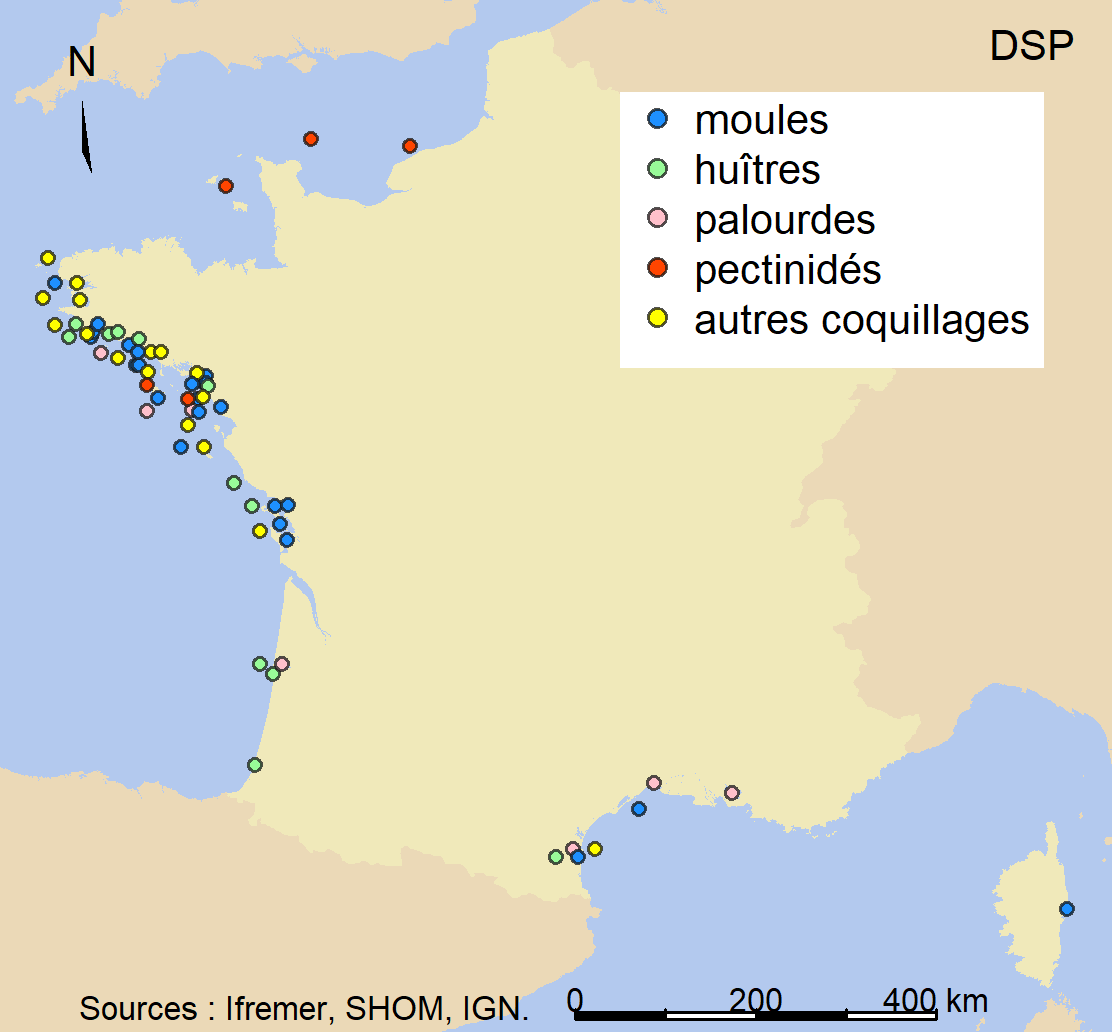
- Toxic Phytoplankton Special CaseThree Main Toxic Taxons• Among species capable of producing toxins present regularly on the metropolitan coast, three taxa play a particularly important role, as they are at the origin of contaminations observed recurrently every year in shellfish that can lead to consumption bans. • These are Dinophysis (diarrhetic toxins or DSP), Alexandrium (paralytic toxins or PSP), and Pseudo-nitzschia (amnesic toxins or ASP). Each of these taxa consists of several species, more or less toxic. • See detail maps by area, by toxic phytoplankton species • See detail maps by area, by toxin type and shellfish type • Analysis of data on these three toxic taxa reveals very different patterns concerning their spatial and temporal distribution and observed maximum concentrations.DinophysisDinophysis is observed every year in the Bay of Seine and Calvados from July-August, in western and southern Brittany from March-April, and in Languedoc-Roussillon and Corsica lagoons year-round. It is more rarely observed on the northern coast of France, in western Cotentin, in northern Brittany. Annual maxima are almost always below 10,000 cells per litre, in all regions.AlexandriumAlexandrium is observed every year along the entire metropolitan coast, mainly in summer in the English Channel–North Sea and Atlantic, and in autumn-winter in the Mediterranean. Annual maxima are generally below 100,000 cells per litre, with the exception of a few regions where they have been several times higher: Rance and Morlaix Bay in northern Brittany, off the Loire, and in Thau Pond in Languedoc.Pseudo-nitzschiaPseudo-nitzschia is observed every year along the entire metropolitan coast, at significant concentrations, with annual maxima always above 100,000 cells per litre, and often above one million. Bloom periods are mainly between April and June in all regions.
- Learn More...Phytoplankton, Proliferation and Impacts• Phytoplankton forms the base of marine food chains. Its production depends on many parameters such as available nutrient quantities, light, temperature, currents… • Major phytoplankton developments (bloom) often occur at river outlets or in lagoons, where conditions are optimal. Several million cells of the same species per litre of water can be counted. • Blooms can have more or less significant impacts on the natural environment or humans. Some proliferations only cause water discoloration due to the presence of pigments in several species. In the most serious cases, the degradation of excess organic matter produced involves significant oxygen consumption and asphyxia of the affected area. • Furthermore, phytoplankton proliferation can alter the balance of flora in favour of species releasing toxins. These can be harmful to fauna but also to humans, if they consume infected shellfish, as shellfish feed mainly on phytoplankton. • Author: French Research Institute for Exploitation of the Sea (Ifremer).
Further reading
- Phycotoxines sur le littoral métropolitain en 2020, évolution depuis 2010notre-environnement.gouv.fr
La contamination des produits de la mer par des toxines produites par certaines espèces de micro-algues, ou phytoplancton, constitue un enjeu de santé publique. En France, la surveillance des risques liés au toxines algales, appelées également phycotoxines, porte principalement sur les coquillages se nourrissant de phytoplancton.