Phycotoxines sur le littoral métropolitain en 2020, évolution depuis 2010
La contamination des produits de la mer par des toxines produites par certaines espèces de micro-algues, ou phytoplancton, constitue un enjeu de santé publique. En France, la surveillance des risques liés au toxines algales, appelées également phycotoxines, porte principalement sur les coquillages se nourrissant de phytoplancton.
Contamination of seafood products by toxins produced by certain species of micro-algae, or phytoplankton, constitutes a public health concern. In France, monitoring of risks related to algal toxins, also called phycotoxins, focuses mainly on shellfish that feed on phytoplankton.
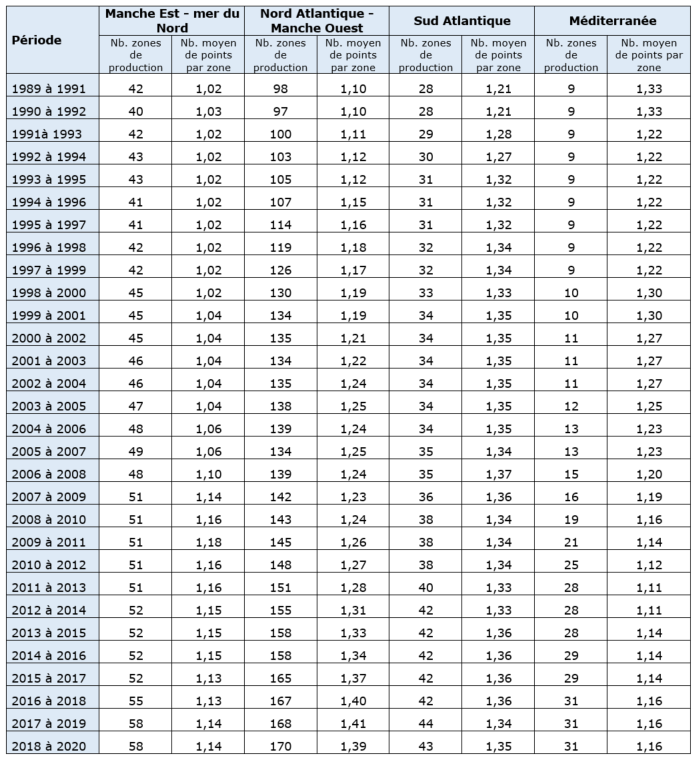
- General AnalysisPhycotoxin Overview• Several species of micro-algae (phytoplankton) are capable of producing algal toxins, also called phycotoxins. These substances accumulate in shellfish that feed on these micro-algae and can pose a risk to human health if ingested. • Beyond their health impacts, their presence in shellfish can have economic consequences (financial losses for shellfish farmers and fishermen during periods when consumption of affected products is prohibited) and environmental effects (sometimes massive die-offs of marine animals). • In France, monitoring of phycotoxins in shellfish is carried out by the Network for Monitoring PHYcoTOXins in Marine Organisms (REPHYTOX) across 103 marine zones (see methodology).Three Regulated Families• Three families of phycotoxins are currently subject to mandatory monitoring under European legislation with the application of a regulatory threshold above which production zones (shellfish farming or shellfish harvesting) may be closed by state authorities: • Lipophilic toxins, including diarrhetic toxins, or DSP (Diarrhetic Shellfish Poisoning); • Paralytic toxins or PSP; • Amnesic toxins or ASP. They are observed in French coastal shellfish on a recurring basis.Situation by Toxin Type• Across the metropolitan coast, diarrhetic toxins (DSP), essentially associated with the development of phytoplankton species of the genus Dinophysis, affect numerous marine zones and a wide variety of shellfish each year. DSP contamination episodes constitute the majority of contaminations observed on the metropolitan coast, thus disrupting the operation of shellfish farming businesses on different maritime fronts. • Amnesic toxins (ASP), associated with the development of phytoplankton species of the genus Pseudo-nitzschia, affect a variable number of zones from year to year. The affected marine zones, located primarily in the Atlantic and the English Channel, are mainly scallop harvesting areas. • Episodes related to paralytic toxins (PSP), associated predominantly with the development of species of the genus Alexandrium, are rare each year; since 2018, no contamination above the regulatory threshold has been observed across the entire coast. However, their high hazard level means these toxins must be kept under close surveillance.
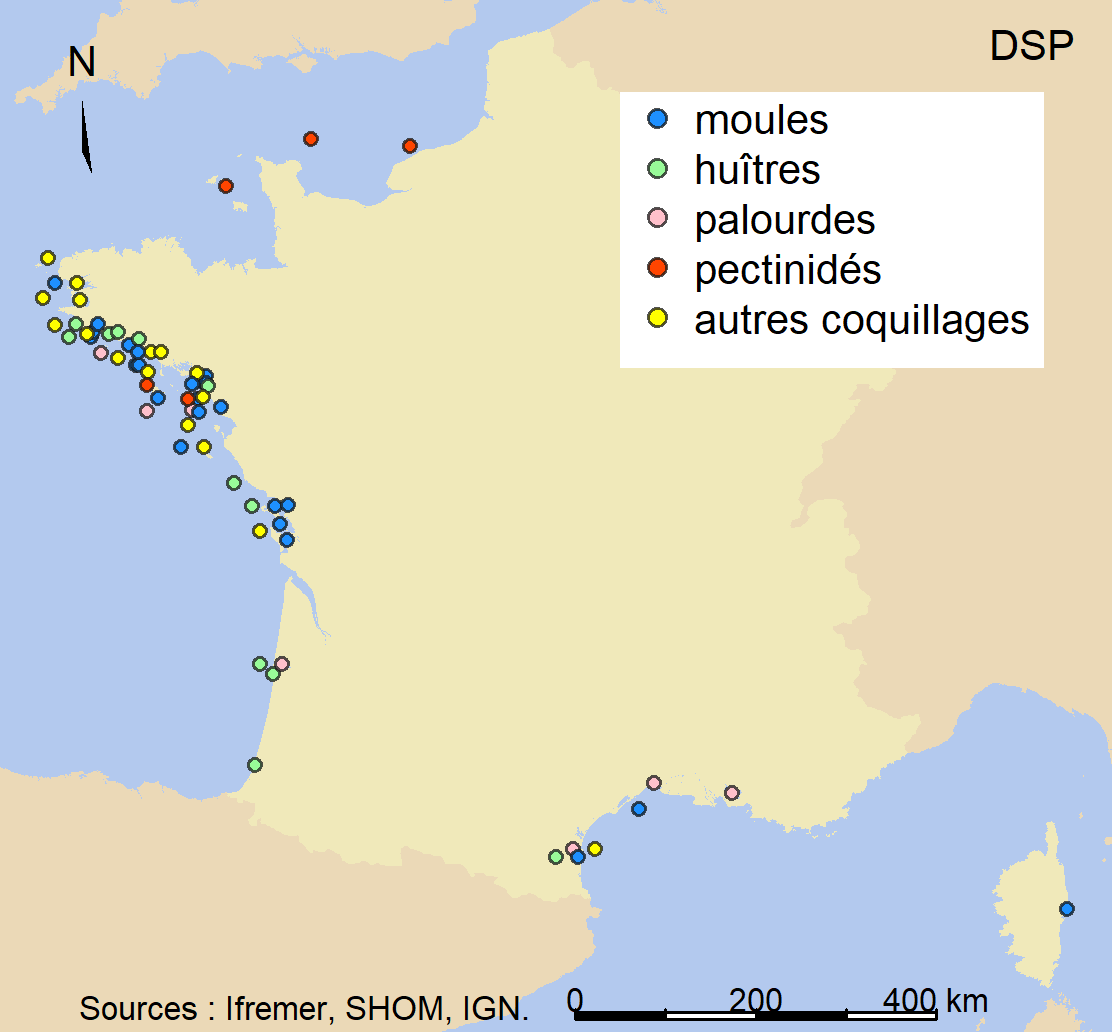
- Assessment of Shellfish Toxicity Episodes in 20202020 Monitoring FrameworkOn the metropolitan coast, 308 sampling locations distributed across 103 marine zones are evaluated each year for toxicity from phycotoxins on 23 shellfish taxa (mussels, oysters, scallops, clams, cockles, etc.), harvested from natural beds (commercial fishing) or farmed using various methods (flat beds, tables, rope culture, longlines, etc.).2020 DSP Episodes• In 2020, toxicity episodes related to DSP constitute the majority of contaminations observed on the metropolitan coast, with 40% of monitored marine zones affected over periods ranging from 1 to 8 months. The Atlantic coast is most affected by these contaminations with 32 marine zones impacted (31% of all zones monitored on the metropolitan coast), followed by the Mediterranean (5% of zones monitored) and the English Channel (4% of zones monitored). • DSP contamination episodes (with regulatory threshold exceedance) on the metropolitan coast in 2020 by shellfish type • DSP toxicity episodes were observed in various shellfish (notably mussels, oysters, clams and scallops) and at different times of the year. The most frequently affected zones are: Douarnenez Bay (affected by contamination episodes of donax or tellin clams, in various seasons), Petite Mer de Gâvres and Aven-Belot-Laïta (mussels, oysters and cockles, June to August), Vilaine Bay to Loire (mussels and cockles, May to September), Ré and Oléron islands (donax, May to November), Pertuis d'Antioche strait (mussels, May to June), Salses-Leucate pond (mussels and oysters, various seasons) and Palavas ponds (mussels and clams, October to December).2020 ASP and PSP Episodes• Toxicity episodes related to ASP were rare in 2020. Only 2 marine zones located in Brittany were affected by regulatory threshold exceedances: Douarnenez Bay and off Concarneau - the Glénan archipelago. The shellfish affected by these toxicity episodes are scallops. • ASP contamination episodes (with regulatory threshold exceedance) on the metropolitan coast in 2020 by shellfish type • Conversely, no monitored zone experienced a contamination episode related to paralytic toxins (PSP) in shellfish in 2020. Paralytic toxins in France are associated exclusively with the phytoplankton genus Alexandrium. Shellfish become toxic only if one or more species of this genus are present at significant concentrations.
- Evolution of Shellfish Toxicity Episodes Between 2010 and 2020DSP 2010-2020• Over the period 2010-2020, DSP toxicity episodes are recurrent and constitute the majority of confirmed toxic episodes on the metropolitan coast. In total, 54 zones (52% of monitored marine zones) were affected by one or more DSP toxicity episodes; of these, 7 zones were affected every year (all located on the Atlantic coast), 6 zones affected with an occurrence of 9 to 10 years, 14 zones affected by episodes more sporadically (occurrence of 1 or 2 years). The absence of toxic episodes in certain zones (49 zones over 2010-2020) can be explained by the absence of Dinophysis proliferations (northern France, western Cotentin and northern Brittany), or by the absence of shellfish production zones such as on the East Mediterranean coast. • Evolution of the number of marine zones affected by phycotoxicity episodes 2010-2020 • In total 54 zones were affected by one or more DSP toxicity episodes; • In total 32 zones were affected by one or more ASP toxicity episodes; • In total 6 zones were affected by one or more PSP toxicity episodes.ASP and PSP 2010-2020• Since 2010, ASP toxicity episodes have affected 32 marine zones. The number of affected zones has decreased over the period. Over the entire study period, 60% of zones affected by these episodes are affected sporadically (occurrence over 1 or 2 years). The geographical distribution of affected zones is heterogeneous across the coastal territory: 75% of affected zones are located in the Atlantic versus 25% in the English Channel, and zero in the Mediterranean. • PSP toxicity episodes have affected very few zones each year. Thus, between 2010 and 2017, in total, 6 marine zones were affected by these toxins across the entire metropolitan coast. Since 2018, no episodes have been recorded.Occurrence by Toxin Family• Number of years and zones affected by confirmed phycotoxicity episodes over 2010-2020, by toxin family (ASP, DSP and PSP) • ASP toxicity episodes: 19 marine zones affected with an occurrence of 1 to 2 years; 9 marine zones affected with an occurrence of 3 to 5 years; 4 marine zones affected with an occurrence of 6 to 8 years; 0 marine zones affected with an occurrence of 9 to 10 years; 0 marine zones affected every year. • DSP toxicity episodes: 49 marine zones affected with an occurrence of 1 to 2 years; 14 marine zones affected with an occurrence of 3 to 5 years; 14 marine zones affected with an occurrence of 6 to 8 years; 6 marine zones affected with an occurrence of 9 to 10 years; 7 marine zones affected every year. • PSP toxicity episodes: 4 marine zones affected with an occurrence of 1 to 2 years; 2 marine zones affected with an occurrence of 3 to 5 years; 0 marine zones affected with an occurrence of 6 to 8 years; 0 marine zones affected with an occurrence of 9 to 10 years; 0 marine zones affected every year
- Detail by Toxin TypeLipophilic Toxins (Diarrhetic – DSP)• In France, the first toxic episodes clearly associated with diarrhetic toxins were observed in 1983 with approximately 4,000 poisonings recorded in southern Brittany. To date, no deaths have been associated with these toxins worldwide. DSP toxins have no known harmful effect on shellfish in which they accumulate: thus shellfish prohibited from consumption can be consumed again once the toxic episode has ended. • Over the period 2010-2020, the number of marine zones affected by DSP phycotoxicity episodes across the entire metropolitan coast increased by 64% (25 zones in 2010 versus 41 zones in 2020). On average, 76% of marine zones monitored on the Atlantic coast are affected by this toxicity compared to 12% in the English Channel and 12% in the Mediterranean. Among the three coasts, the Atlantic coast is the only one showing an increasing trend in zones affected by DSP toxicity. • Evolution of the number of marine zones affected by DSP phycotoxicity episodes in shellfish, by maritime coast • Among zones affected by DSP toxicity, some are systematically or more frequently affected; this is the case for zones located in western and southern Brittany, in the Arcachon basin, in the Salses-Leucate pond and in the Palavas ponds in Languedoc-Roussillon. Other regions such as Normandy are affected more sporadically. • Between 2010 and 2020, 59.2% of DSP regulatory threshold exceedances concerned mussels, 19.6% donax clams, 5.4% oysters, 4.0% cockles and 3.9% scallops. • Mussels generally constitute the majority of shellfish affected by DSP contamination. Given that this bivalve contaminates more quickly than others, this has led to their designation as sentinels for monitoring DSP toxins. • Share of different shellfish types affected by DSP phycotoxicity episodes between 2010 and 2020 • Mussel: 59.2% • Scallop: 3.0% • Cupped oyster: 5.4% • Cockle: 4.0% • King scallop: 3.9% • Clam: 2.0% • Donax clam: 19.6% • Pink clam: 1.5% • Amande and Speckled clam: 1.4% • The highest DSP contamination records were observed in the Arcachon basin in spring 2012, with maximum levels reaching approximately 37,300 μg/kg in mussels, 11,800 μg/kg in cockles, and 2,300 μg/kg in clams (compared to the regulatory food safety threshold of 160 μg per kilogram of shellfish meat above which shellfish are considered unfit for consumption). Other high concentration levels were noted, such as in mussels from Concarneau Bay in 2013 (14,100 μg/kg), in donax clams in Iroise – Camaret (6,500 μg/kg), in Douarnenez Bay (9,900 μg/kg) and in Etel Bay (5,100 μg/kg) in 2020, in scallops in Seine Bay and Orne in 2018 (2,300 μg/kg), in oysters in the Salses-Leucate pond in 2012 (1,000 μg/kg).Amnesic Toxins (ASP)• ASP toxins were observed for the first time in France in the Iroise Sea and Douarnenez Bay in 2000, then in the Mediterranean in 2002. No ASP poisoning cases associated with shellfish from French zones have been reported to date. On French coasts, these toxins are associated exclusively with the genus Pseudo-nitzschia. Shellfish become contaminated by one or more species of this genus when they are present at significant concentrations and if these species produce toxins, which is not the case for all. The regulatory health threshold above which shellfish are considered unfit for consumption is 20 mg per kilogram of shellfish meat. • Over the period 2010-2020, the number of marine zones affected by ASP toxicity episodes varies from year to year; however, a downward trend is observed. Thus, the number of affected zones decreased from 18 in 2010 to 2 in 2020. • Affected zones are concentrated mainly in the Atlantic. In the English Channel, episodes are much rarer, with the number of zones never exceeding 6% of all monitored marine zones. In the Mediterranean, no threshold exceedance occurred during the study period. This unequal distribution of affected zones between coasts is explained essentially by the inclusion in shellfish monitoring of offshore harvesting, which is absent or not exploited in the Mediterranean. • Evolution of the number of marine zones affected by ASP phycotoxicity episodes in shellfish, by maritime coast • King scallops constitute the majority of shellfish affected by ASP contamination since 2010 (88% of episodes); this shellfish has the characteristic of decontaminating very slowly compared to other shellfish. The zones most frequently affected by these toxicity episodes are Seine Bay and Orne (2011 to 2014), Brest Roads (between 2014 and 2018) and off Concarneau – the Glénan archipelago (2010 to 2014, 2019 and 2020). The absolute toxicity record was observed in Brest Roads in spring 2014, with values in king scallops exceeding the health threshold by nearly 43 times (20 μg/kg). • Share of different shellfish types affected by ASP phycotoxicity episodes between 2010 and 2020 • King scallop: 87.5% • Mussel: 4.6% • Donax clam: 2.1% • Cupped oyster: 2.0% • Clam: 1.6% • Scallop: 1.4% • Pink clam: 0.7% • Amande: 0.3%Paralytic Toxins (PSP)• The first observations of PSP toxins occurred in 1988 for the Atlantic coasts (Abers, northwestern Brittany) and in 1998 for the Mediterranean region (Thau pond). However, no PSP poisoning cases associated with shellfish from French zones have been reported to date. • Shellfish become toxic only if one or more species of this genus are present at significant concentrations. PSP poisonings can, however, affect many consumers high in the food chain, not only humans, but also marine mammals, birds, etc. The regulatory health threshold above which shellfish are considered unfit for consumption is 800 μg per kilogram of shellfish meat. • PSP toxicity episodes are rare between 2010 and 2017 and nonexistent between 2018 and 2020. The majority of marine zones affected by at least one PSP toxic episode are located in the English Channel (Rance, Morlaix river, Penzé and Ouessant - Abers). In the Atlantic and Mediterranean, zones affected during the study period are Brest Roads and Thau Pond respectively. • Evolution of the number of marine zones affected by PSP phycotoxicity episodes in shellfish, by maritime coast • Affected shellfish are notably mussels (84% of episodes) but oysters (15% of episodes) and cockles (1% of episodes) are also sometimes concerned. Over the period 2010-2017, the absolute toxicity records were observed in Brest Roads in summer 2012, with maximum levels reaching 15 times the regulatory health threshold in mussels and 2 times in oysters. Apart from this episode, very high levels above the regulatory threshold were observed in Thau pond (mussels and oysters) in autumn 2015, 2016 and 2017, in Brest Roads (mussel) in summer 2014 and 2015, in Rance estuary in summer 2010 (cockles) and in Morlaix river (mussels) in summer 2010.
- Maximum Toxin Concentration by Marine ZoneMaximum DSP ConcentrationMaximum concentration of diarrhetic toxins (DSP) in shellfish, by marine zoneMaximum ASP ConcentrationMaximum concentration of amnesic toxins (ASP) in shellfish, by marine zoneMethodology and Definitions• Methodology: NRL (National Reference Laboratory) "marine biotoxins" of ANSES. Lipophilic toxins. Dinophysis. Paralytic toxins (PSP). Alexandrium. Amnesic toxins (ASP). Pseudo-nitzschia. Dinophysis. SURVAL • Definitions: Toxicity episodes: period during which the presence in shellfish of a toxin belonging to one or another of the three families of regulated toxins at a concentration above the regulatory threshold. • Marine zones: division of the coast according to the Quadrige database of Ifremer. • Information on the indicator: Processing. Author. Review. Date of writing
Further reading
- Le phytoplancton dans les eaux littorales métropolitaines de 2007 à 2012notre-environnement.gouv.fr
Le phytoplancton est à la base des chaines alimentaires en domaine marin. Les développements importants de phytoplancton (bloom) se produisent souvent au débouché des fleuves ou dans les lagunes. Les données sur le phytoplancton contribuent à évaluer la qualité des masses d’eau côtières dans le cadre de la Directive-cadre sur l’Eau.
- Réseau de surveillance des PHYcoTOXines dans les organismes marins (REPHYTOX)notre-environnement.gouv.fr
Réseau de surveillance des PHYcoTOXines dans les organismes marins (REPHYTOX)
- Les biotoxines marines : les toxines lipophiles ou DSPnotre-environnement.gouv.fr
Les biotoxines marines : les toxines lipophiles ou DSP
- Surval : Accès aux données d’environnement marin et littoralnotre-environnement.gouv.fr
Surval