L’agriculture
L’agriculture est à la croisée de multiples enjeux écologiques. Par ses impacts sur l’environnement et la biodiversité, mais aussi parce qu’elle contribue à la séquestration du carbone ou à la production d’énergies vertes pour lutter contre le réchauffement climatique. Penche-t-elle du côté des problèmes ou des solutions ? Tour d’horizon.
Agriculture sits at the crossroads of multiple ecological challenges. Through its impacts on the environment and biodiversity, but also because it contributes to carbon sequestration or renewable energy production to combat climate warming. Does it lean toward problems or solutions? Here's an overview.
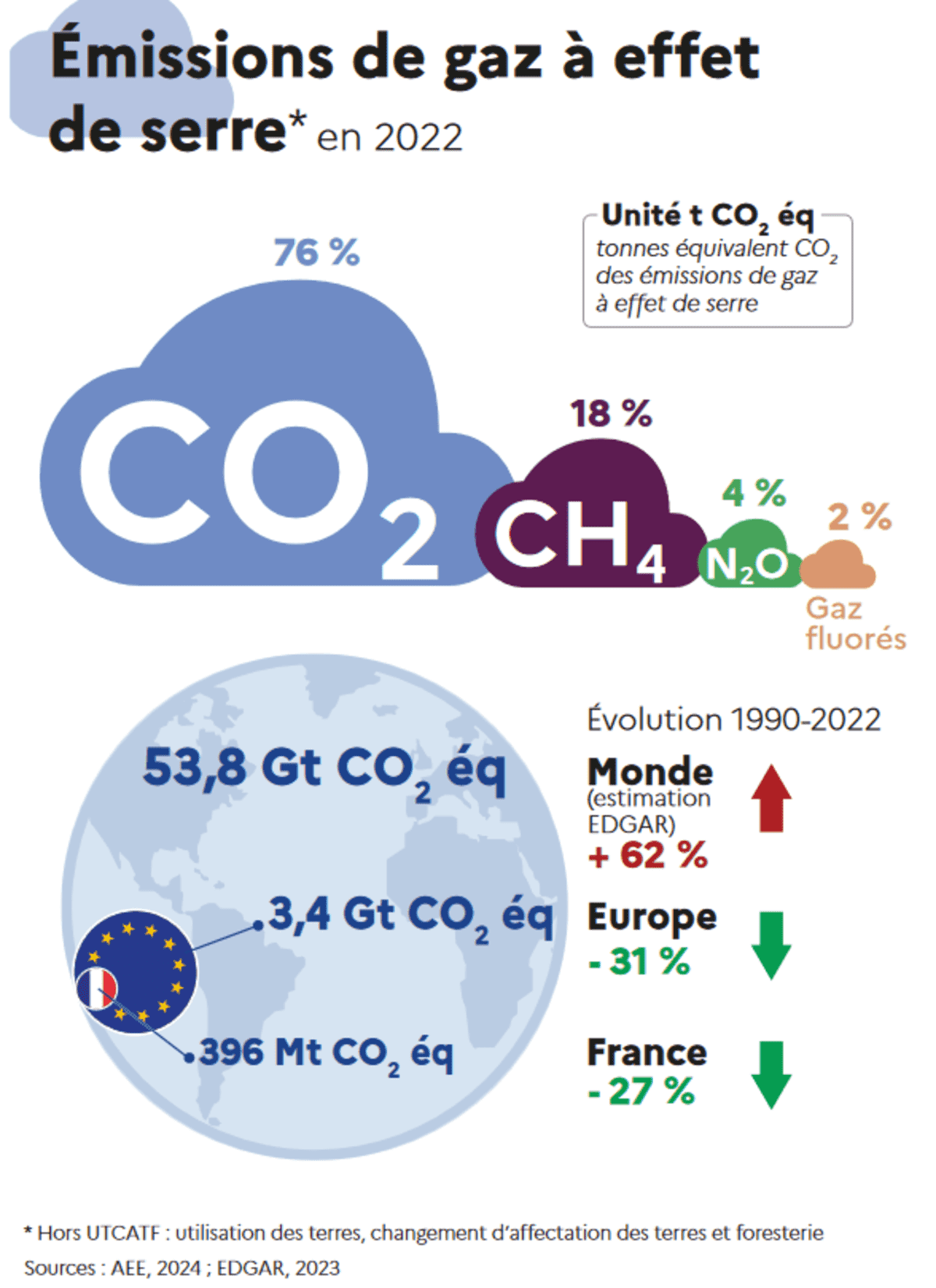
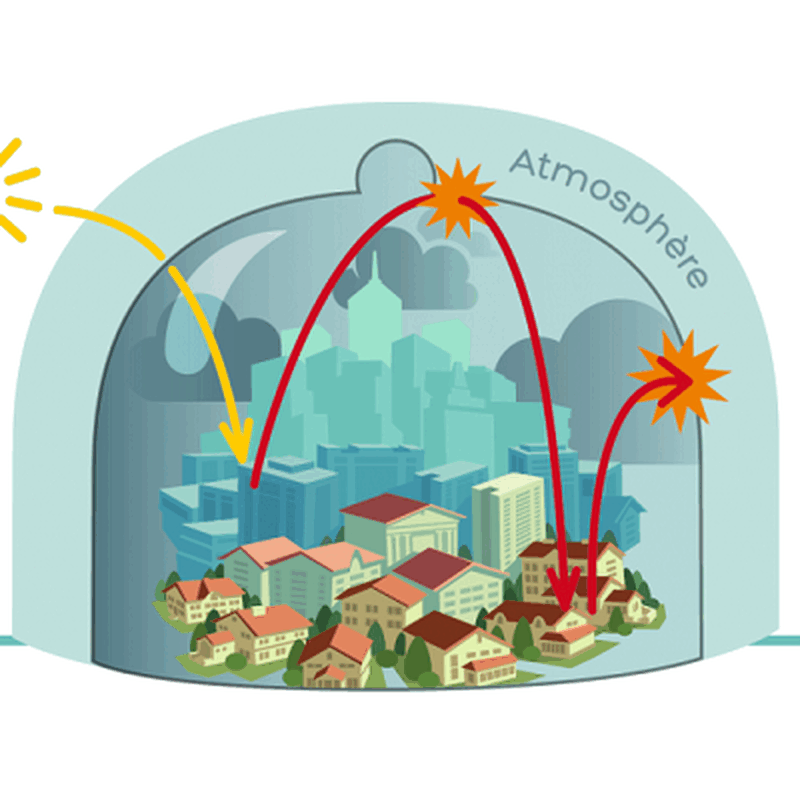
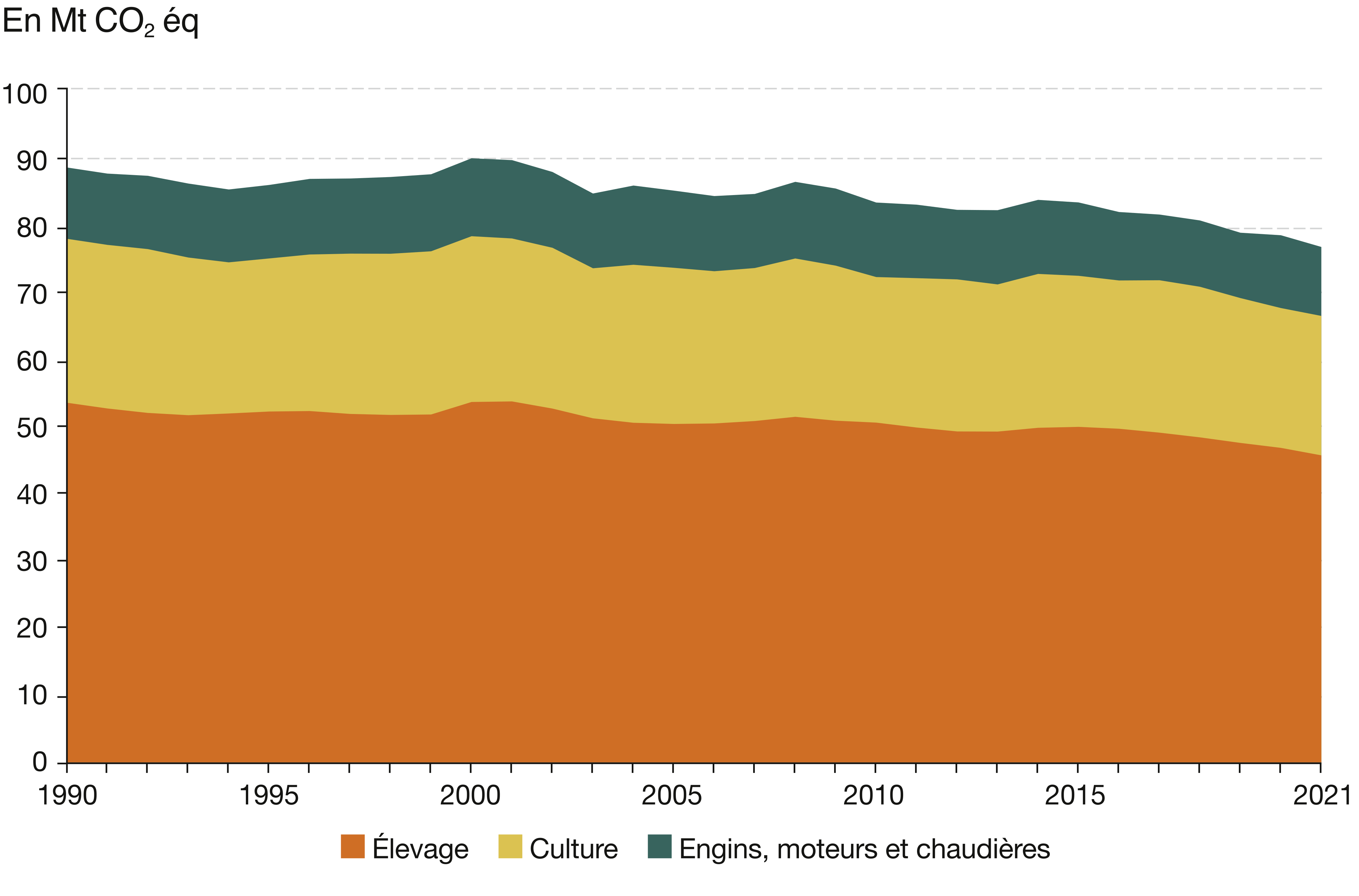
- The effects of agriculture on the environmentAgriculture and greenhouse gas emissions• Agriculture is France's second-largest source of greenhouse gas (GHG) emissions, behind transportation. • The main source of agricultural GHGs is not energy consumption, but biological processes. For example, animal rumination, microbial processes in soils, and effluents produce methane (CH4) and nitrous oxide (N2O) emissions that exceed CO2 emissions. • Livestock farming is the primary source of greenhouse gases in the agricultural sector, followed by synthetic fertilizers, whose production relies on fossil fuels. • France, through its National Low Carbon Strategy, aims to reduce agricultural sector greenhouse gas emissions by 18% between 2015 and 2030 and by 46% by 2050.Agricultural pollution sources• The use of nitrogen fertilizers, for example, causes air pollution in the form of ammonia or nitrous oxide. However, ammonia emissions have decreased by 23% since 1990 due to the decline in cattle herds and the adoption of new practices in the pork and poultry sectors. • Agriculture is also the primary emitter of non-volatile organic compounds (NVOC), another air pollutant. These emissions have been cut in half since 2000. • Nitrogen released into water as nitrates affects soil and water quality, both in groundwater and surface waters. Phosphate fertilizers cause oxygen depletion in surface waters and are responsible for algal blooms. • Pesticides are used to protect crops from insects, weeds, fungi and other pests. In France in 2022, 68,500 tonnes (t) of active substances were sold in total, roughly equivalent to the average sales between 2009 and 2021 (67,700 t). However, the share of sales of CMR active substances (carcinogenic, mutagenic and reprotoxic), the most toxic to human health, halved between 2009-2011 (30%) and 2020-2022 (15%). • They are found in all environments, whether air, water or soil.Biodiversity impacts• Agriculture uses nearly 47% of France's 63.8 million hectares of land. With increasing soil artificialisation, it is one of France's main sources of pressure on biodiversity. • The trend observed since the 1950s in France is toward larger average farm sizes, reduction in the number of cultivated species, and simplification of landscape structures. All these factors lead to a decline in biological diversity and abundance of species associated with agricultural ecosystems. • Phytosanitary products (fungicides, herbicides, insecticides, etc.) used in crops affect all terrestrial, aquatic and even marine ecosystems. In agricultural areas, they are involved in the decline of terrestrial invertebrate populations (such as pollinating insects and predatory beetles that control certain crop pests), aquatic invertebrates and common birds. • Agricultural mechanisation also causes soil compaction which, apart from impacts on biodiversity, makes it more vulnerable to erosion and runoff.Water use for irrigation• In mainland France, irrigable agricultural land totalled more than 2.8 million hectares in 2020, up 23% compared to 2010. It represents 11% of UAA (useful agricultural area). That same year, 64% of irrigable land was irrigated at least once. This represents 1.8 million hectares of irrigated UAA. • For optimal growth and thus satisfactory yield, plants need water in quantities that vary depending on crop types. In some years and/or certain times of year, to compensate for a rainfall deficit relative to these needs, farmers irrigate their fields. Water withdrawals for irrigation can cause significant local pressure on water resources, particularly in summer when availability is lowest.
- Agriculture: fighting climate changeAgroecological transition• Agricultural activities are directly exposed to the consequences of climate warming: extreme weather events, water shortages, droughts, rising temperatures have immediate impacts on yields. Agricultural practices based on agroecology principles are more sustainable and resilient because they combine climate change adaptation with measures that mitigate its effects. • Reconciling agricultural production, biodiversity conservation, GHG reduction and climate change adaptation, while maintaining a viable agricultural enterprise base on the territory, is a challenge for French agriculture. • To meet it, agroecology proposes to rely on natural ecosystems. This practice involves reintegrating crop systems into their environment to consider interactions: how to better protect soils by maintaining vegetation cover in winter, reduce treatments by promoting biodiversity, improve livestock resilience by opting for grazing. The main practices are: • crop diversification and long crop rotations, i.e. an alternation of varieties cultivated over a cycle of several years, which promotes resistance to pests, reduces reliance on inputs and improves soil; • permanent soil cover: by inserting intermediate crops between annual crops, year-round vegetation cover is ensured, which nourishes soils and protects them from erosion; • outdoor livestock and grazing in grassland systems contribute to animal welfare and conservation of pastures beneficial to the entire ecosystem; • presence of a landscape network favourable to biodiversity ensured by hedges, swales or ponds for example.Limiting phytosanitary productsLaunched in 2008, the Ecophyto plan aims to reduce the use of phytosanitary products in France while maintaining economically productive agriculture. It pursues actions such as the "Dephy" pilot farm network, which aims to promote practices that are both productive and low in inputs. A new Ecophyto 2030 strategy is being developed.Organic farming• Organic farming is the only recognised European label based on agroecology principles. Its specifications, which apply to all operators—farmers, processors and distributors—guarantee positive environmental and health impacts and provide healthy, sustainable and resilient food systems. • Organic farming: • excludes the use of synthetic chemical inputs (pesticides and fertilizers); • excludes GMO use; • prioritises natural and renewable resources; • guarantees practices respecting animal welfare; • is based on good practices from agroecology: longer and more diverse rotations, soil cover. • By end of 2022, 10.7% of France's useful agricultural area (UAA), or 2.8 million hectares, were farmed organically.Sustainable agricultural practices• Regulated at European level, organic farming is subject to strict controls. But other practices aim for a sustainable agricultural system. Among these: • Agroforestry places trees at the heart of the production system, combining them with livestock and crops on the same plots. • Soil conservation agriculture proposes to eliminate ploughing and maintain vegetation cover. When it leads to diversifying crops to protect soils, their biodiversity and ecological functions, it can constitute an agroecological practice. • In field crops, while the share of no-till areas rose from 21% in 2001 to 34% in 2006 then 47% in 2017 (source: Agreste 2020), it is still difficult to assess the implementation of all these practices (no-till, soil cover and crop diversification). • INRAE emphasises that no-till systems are heavy herbicide consumers and that work is underway to limit their use in these systems.Sequestering carbon• While it emits greenhouse gases, agriculture is also able to absorb them by sequestering them in natural carbon sinks: soils, pastures, agroforestry. • Launched by France in 2015, on the occasion of COP21, the international 4 per 1000 initiative aims to show that agriculture, and in particular agricultural soils, can play a crucial role in increasing the quantities of carbon stored in soil, by 4‰ per year, through agroecological practices. The potential of mainland soils was assessed in 2019 and that of overseas territories in 2023.Producing renewable energy• Agriculture is the primary producer of renewable energy in France. It therefore represents a powerful lever for energy decarbonisation.Wood energyOne in four French people heat with wood! Through agroforestry, planting and management of bocage hedgerows, agriculture can contribute to substituting renewable energy for fossil fuels for energy use, particularly by supplying community heating plants.Anaerobic digestionAnaerobic digestion converts agricultural waste into biogas. By 2030, according to Ademe, this renewable biomethane could represent 10% of gas consumption.BiofuelsThe agricultural sector has been identified as a priority for accessing biomass-based fuels, which it will help produce. Second-generation biofuels, mainly derived from agricultural residues and whose production does not compete with food, benefit from the momentum of the roadmap for sustainable aviation biofuels in French air transport, launched in 2020. This sets an objective to substitute 50% of conventional fossil fuel with sustainable aviation biofuels by 2050.Agrivoltaics• The law of 10 March 2023 on accelerating renewable energy production encourages agrivoltaics, defined as "an installation producing electricity using the sun's radiant energy and whose modules are located on an agricultural plot where they contribute durably to the establishment, maintenance or development of agricultural production". Experiments conducted in vineyards and duck farms have shown that the presence of solar panels could provide effective frost protection in winter and shading in summer. A national research, innovation and education hub on agrivoltaics, coordinated by INRAE, was established in February 2023. • Acting for transition | Food: It is possible to support the agroecological transition by reducing the environmental impact of your food consumption, with a more plant-based diet, preferably organic. • Food and environment: the challenges of meat consumption in France: In France, meat consumption has been declining for over 20 years. Globally, consumption is rising and livestock has significant environmental impacts. • How to reduce food waste?: To combat the scourge of food waste, which affects 17% of global food production and 30 kilos per person per year in French households alone, the UN designated 29 September as the International Day of Awareness of Food Loss and Waste.
Further reading
- Les émissions de gaz à effet de serre de l’agriculturenotre-environnement.gouv.fr
L’agriculture a émis 19% des émissions de gaz à effet de serre (GES) de la France en 2019, soit le 2ème poste d’émissions (…)
- Qu’est-ce que la fertilisation des terres agricoles ?notre-environnement.gouv.fr
L’apport régulier de fertilisants dans les parcelles agricoles est nécessaire afin, non seulement d’améliorer ou de conserver (…)
- Les cycles biologiques des engrais azotés et phosphorésnotre-environnement.gouv.fr
L’azote et le phosphore existent sous différentes formes grâce à des processus de transformations cycliques entre les grands (…)
- Les livraisons d’engrais en Francenotre-environnement.gouv.fr
En 2018, selon l’Observatoire pour la fertilisation minérale et organique, 18 millions de tonnes de fertilisants minéraux et (…)
- Le cadre réglementaire concernant l’azote et le phosphorenotre-environnement.gouv.fr
L’azote et le phosphore sont deux éléments nutritifs indispensables au développement des cultures. Ce sont uniquement les (…)
- État des lieux des ventes de produits phytosanitaires en Francestatistiques.developpement-durable.gouv.fr
- Les menaces sur la biodiversiténotre-environnement.gouv.fr
Canicules et vagues de froid : l’influence des températures extrêmes sur la santé et les mesures prises en France pour s’adapter.
- Des sols et des sous-sols fragilisésnotre-environnement.gouv.fr
Le sol joue un rôle déterminant dans nos écosystèmes. C’est un habitat pour la faune et la flore qu’il est nécessaire de protéger.
- L’eau en France~: ressource et utilisation – Synthèse des connaissances en 2022statistiques.developpement-durable.gouv.fr
- le plan Écophytoagriculture.gouv.fr
- les fermes Dephyagriculture.gouv.fr
- agroforesterieagriculture.gouv.fr
- Les pratiques culturales : couvert hivernal sur les sols agricoles en Francenotre-environnement.gouv.fr
En hiver, les sols nus peuvent être soumis à des phénomènes de dégradations physiques (semelle de labour, tassement, (…)
- les chiffres clés du bois énergiestatistiques.developpement-durable.gouv.fr
- Méthanisation : où en est-on en France ?notre-environnement.gouv.fr
La consommation primaire d’énergies renouvelables en France a augmenté de 92 % depuis 1990. Parmi ces énergies figure le biogaz, issu du processus de méthanisation. Comment est-il fabriqué ? (…)
- Biocarburantsecologie.gouv.fr
- Un cadre pour l’agrivoltaïsmeagriculture.gouv.fr
- Les enjeux environnementaux de l’agriculture et de l’agroalimentaireagirpourlatransition.ademe.fr
par ADEME
- Changer nos habitudes alimentaires et accompagner les filières agricoles dans leur transformation agroécologiquegouvernement.fr
un chantier du Secrétariat général à la planification écologique.
- L’actualité de la transition agroécologiqueagriculture.gouv.fr
sur le site ministère de l’agriculture
- Institut national de recherche pour l’agriculture, l’alimentation et l’environnement (INRAE)inrae.fr
- L’agence Bioagencebio.org
Agence française pour le développement et la promotion de l'agriculture biologique.