Les dépenses pour la protection de l’environnement
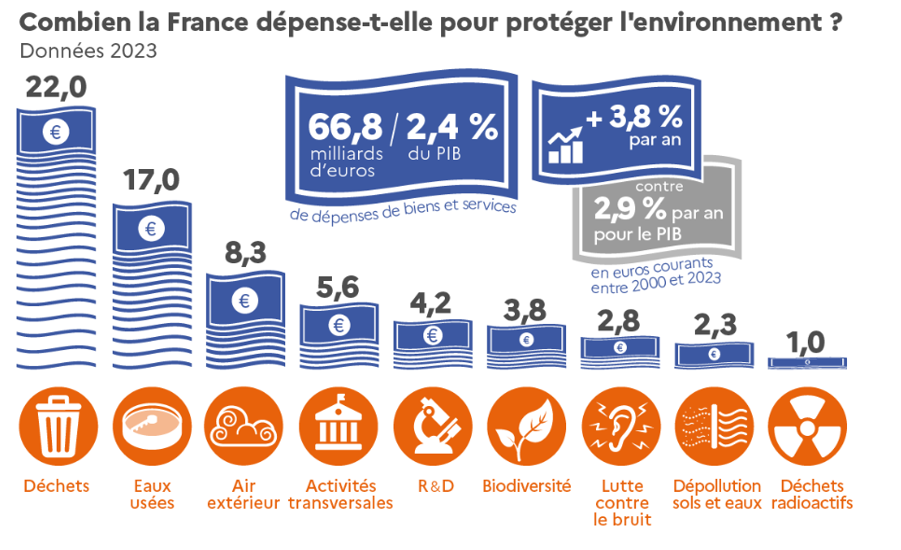
Préserver la qualité de l’air extérieur, gérer les déchets, traiter les eaux usées, protéger la biodiversité ou encore dépolluer les sols nécessitent des moyens humains et financiers importants. En 2023, la France a consacré 67 milliards d’euros à la protection de l’environnement, dont plus de la moitié à la gestion des déchets et des eaux usées. À quoi servent ces dépenses ? Qui les finance ? Comment évoluent-elles ?
Preserving outdoor air quality, managing waste, treating wastewater, protecting biodiversity and remediating contaminated soil require substantial human and financial resources. In 2023, France devoted 67 billion euros to environmental protection, with over half dedicated to waste and wastewater management. What are these expenditures for? Who finances them? How are they evolving?
- What are environmental protection spending used for?Waste and wastewater management• Waste management: collection, sorting and processing of waste produced by public administrations, households and businesses, accounting for 22 billion euros. • Wastewater management: collection and treatment of wastewater, installation and maintenance of treatment plants or decentralized sanitation systems, accounting for 17 billion euros.Air, biodiversity, soil and noise• Outdoor air protection: reduction of atmospheric emissions, acquisition of electric or plug-in hybrid vehicles, deployment of charging stations, installation of fume treatment systems in businesses, accounting for 8.3 billion euros. • Biodiversity and landscape protection: preservation and restoration of natural habitats, rehabilitation of degraded areas, programs to reintroduce endangered species, management of protected areas, accounting for 3.8 billion euros. • Soil and water protection and remediation: pollution prevention, monitoring of soil and water quality, remediation of polluted sites and soils, accounting for 2.3 billion euros. • Noise and vibration control: acoustic insulation of buildings, installation of noise barriers, accounting for 2.8 billion euros.Radioactive waste, R&D and cross-cutting activities• Management of radioactive waste from civil sources: management of spent fuel, conditioning, storage and disposal of radioactive waste, monitoring and information, accounting for 1 billion euros. • Research and development (R&D) for environmental protection: research work, development of technologies and innovations aimed at preventing, measuring, reducing or eliminating various forms of pollution, accounting for 4.2 billion euros. • Cross-cutting environmental protection activities: general administration expenses incurred by the State, local authorities and public institutions, expenses of environmental protection associations, accounting for 5.6 billion euros.
- Who finances environmental protection actions?Funding sources• State and local authorities (34%) Public administrations finance a significant portion of environmental protection spending. Public institutions such as ADEME (Agence de la Transition écologique), the French Office for Biodiversity (OFB) and water agencies provide financial support to actions carried out by local authorities, businesses or associations. • Businesses (36%) Businesses contribute to financing environmental protection through the purchase and installation of dedicated equipment, as well as payment for waste management and wastewater treatment services. • Households (29%) Households participate in financing environmental protection through payment for waste management and wastewater services, through their purchases of environmentally friendly goods and through their contributions and donations to associations. • European Union (1%) The European Union contributes in the form of subsidies to public administrations or businesses, particularly in the agricultural sector.Current and capital spendingThis distribution has changed little since 2000, despite a constant increase in spending. Environmental protection spending includes current spending (operation of specialized public institutions, staff salaries, equipment maintenance, payment for wastewater treatment services by households and businesses) and capital spending (construction of infrastructure by local authorities, acquisition of equipment by businesses, etc.). Approximately two-thirds of spending is current spending, particularly operating costs.Funding by sector• The breakdown of spending financing varies by sector: • biodiversity protection is mainly financed by local public actors (local authorities and water agencies); • wastewater treatment and noise control are financed primarily by households; • research and development in environmental protection and waste management (including radioactive waste) are financed essentially by businesses.
- Environmental protection: avoid, reduce and offsetSteadily increasing spending• Human activities place increasing pressure on the environment. Public administrations, businesses and households devote significant resources each year to environmental protection, to prevent harm, limit its effects or repair damage when it cannot be avoided. • Between 2000 and 2023, spending on goods and services for environmental protection increased at an average rate of 3.8% per year (in current prices), a rate higher than GDP growth (2.9% per year over the same period).France's position in the European UnionIn 2022, spending on environmental protection services (excluding purchases of environmentally friendly goods such as electric cars) represents 2% of GDP in France. With this share, France ranks 9th among the 27 EU member states, at a level close to the European average.
Further reading
- Consultez les articles sur chaque domaine de dépenses de protection de l’environnementstatistiques.developpement-durable.gouv.fr
Retrouvez une série d’articles sur le site du service des données et études statistiques pour en savoir plus sur les dépenses de protection de la biodiversité et des paysages, les actions transversales, la protection de l’air extérieur, la lutte contre le bruit, la gestion des déchets et des déchets radioactifs, la gestion des eaux usées la protection et la dépollution des sols et des eaux et la recherche et développement (R&D) pour la protection de l’environnement en 2023.
- Les dépenses de protection de l’environnement en 2023 : vue d’ensemblestatistiques.developpement-durable.gouv.fr
Article Web - Service des données et études statistiques - Juin 2026.
- Bilan environnemental de la France - Édition 2025statistiques.developpement-durable.gouv.fr
Publication du Service des données et études statistiques – mai 2026