L’économie de la fonctionnalité et de la coopération
L’économie de la fonctionnalité et de la coopération (EFC) est une voie pertinente pour soutenir la transition écologique, car elle propose un nouveau modèle économique visant à réduire la consommation matérielle de biens et de ressources. Pour atteindre cet objectif, le concept de l’EFC repose sur la mise à disposition d’un usage plutôt que la possession d’un bien. Autrement dit, il ne s’agit plus d’acheter un bien et d’être propriétaire de ce bien, mais de payer un service qui est rendu à l’aide du bien en question.
The functional and cooperative economy (EFC) is a relevant path to support ecological transition, as it proposes a new economic model aimed at reducing material consumption of goods and resources. To achieve this objective, the EFC concept relies on providing access to usage rather than ownership of a good. In other words, it is no longer about buying a good and owning it, but about paying for a service provided through the good in question.
1 chapter
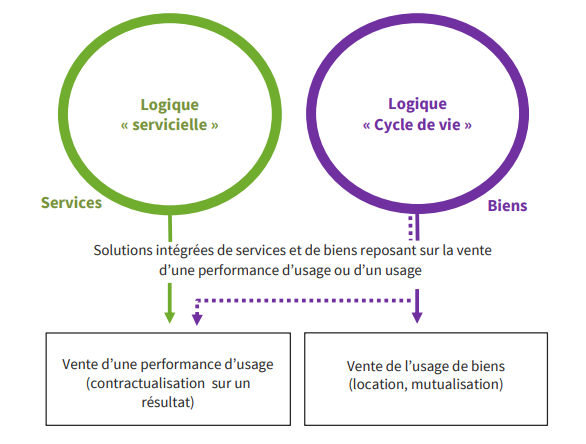
- What is the functional economy?Functional economy in practice• With eco-functionality, the seller remains the owner of the good throughout its lifecycle, but offers usage accompanied by a contract that ensures the performance and durability of the good over the long term. • This approach meets sustainable development objectives, as it allows the offer to be adjusted to match customer needs as closely as possible while promoting the reuse, repair and maintenance of goods used by the customer. • For example, an electric bike rental service with a contract for regular maintenance and upkeep fits within an EFC approach. Another example is a specialized maintenance company providing professional clothing to other businesses, with a cleaning service included (repair, laundering, etc.) after each use of the garment. • This business model targets companies, but also local authorities seeking to engage with economic actors in a resilient territorial development approach.Functional economy requires change• The EFC approach requires an in-depth transformation of business models and employee skills within the organization, whether a company or local authority. Since these offerings are co-created with the client, they require "providers" to develop a deep understanding of needs to achieve a long-term contractual commitment, moving beyond the traditional transactional format of simply selling more. In other words, this contractualization is based on useful effects (social and environmental benefits) and the offer adapts to the real needs of individuals, businesses and local authorities while accounting for sustainable development challenges in creating the offer. • To create such a contractual commitment, the organization must adapt its structure and skills to respond to changing contexts and adjust its offerings based on customer needs. This personalized customer support now takes priority and becomes the main source of value for the company. However, this approach requires strong collaboration among the various stakeholders within the company to avoid "silo work."Three core principles• The functional and cooperative economy is an economic model focused on service and cooperation and is based on three core guiding principles: • Move away from volume-driven logic and act by taking environmental and social aspects into account (material sobriety, quality of life, job creation, extending product lifespan, reuse, reconditioning, etc.). • Develop services provided to users and link wealth creation to the development of intangible resources (skills, health, knowledge, relationship quality, etc.). • Develop cooperation among actors in a territory (citizens, local authorities, companies, etc.) to generate a positive impact on their organizational models and territorial dynamics that integrate sustainable development challenges. • Service logic and "lifecycle" logic are the two approaches on which an EFC reference framework was built by Ademe.How it differs from rental• The functional and cooperative economy distinguishes itself from the rental concept, as it is part of a long-term commitment perspective with an environmental and social dimension. • Several examples illustrate this distinction well: • Providing refurbished and secondhand clothing and shoes through a monthly subscription. • Creating a mobility service that aims to support users throughout their journey from route calculation, to purchasing and validating transport tickets, to analyzing the trip by proposing pooling solutions to reduce the environmental impact of transportation. • Providing benches and bus shelters through a subscription. The benches benefit from regular maintenance and upkeep services and are equipped with power outlets powered by solar panels on the roofs of the bus shelters. • Selling a lighting solution as a lighting service operated by a company responsible for lamp and bulb design, installation, maintenance and end-of-life management. The contract is based in particular on achieving energy consumption indicators.Why mention cooperation?• The term cooperation, recently combined with "functional economy," underscores the importance of transforming interactions between multiple activities in the same territory. • Ademe uses the term cooperative ecosystems to illustrate this approach. In other words, economic actors (local authorities and companies) cooperate by pooling usages to meet a need while integrating sustainable development challenges.
Further reading
- Définition de l’économie de la fonctionnalité et de la coopération selon l’Ademenotre-environnement.gouv.fr
- Exemples concrets de collectivités engagées dans l’EFC au travers du programme d’accompagnement COPTEER lancé par l’Ademenotre-environnement.gouv.fr
- Un exemple concret d’entreprises et de collectivités engagés dans l’EFCnotre-environnement.gouv.fr
- Un autre exemple concret d’entreprises et de collectivités engagés dans l’EFCnotre-environnement.gouv.fr
- L’économie de la fonctionnalité et de la coopération, un nouveau modèle économique ?notre-environnement.gouv.fr
Afin de préserver les ressources, l’EFC (économie de la fonctionnalité et de la coopération) s’érige comme une solution pertinente pour appuyer la transition écologique de l’économie.