L’économie circulaire
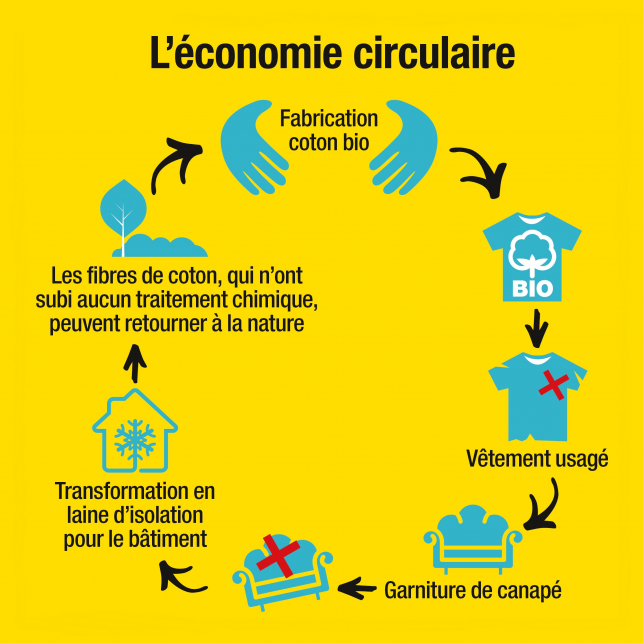
L’économie circulaire désigne un modèle économique dont l’objectif est de produire des biens et des services de manière durable, en limitant la consommation et les gaspillages de ressources (matières premières, eau, énergie) ainsi que la production des déchets. Il s’agit de rompre avec le modèle de l’économie linéaire (extraire, fabriquer, consommer, jeter) pour un modèle économique « circulaire ». C’est en ce sens que le gouvernement s’est engagé avec la loi anti-gaspillage pour une économie circulaire.
Circular economy designates an economic model whose goal is to produce goods and services sustainably, by limiting resource consumption and waste (raw materials, water, energy) as well as waste production. It means breaking with linear economy model (extract, manufacture, consume, discard) for a "circular" economic model. It is in this sense that the government committed with the anti-waste law for circular economy.
- What is circular economy?Origins and challenges• The emergence of circular economy reflects growing awareness of the planet's finite resources and the need to conserve them. • This concept also embodies the idea that new production and consumption models linked to circular economy can generate sustainable activities and non-relocatable job creation. Circular economy is part of green economy. Thus, circular economy challenges are simultaneously environmental, economic, and social. • In France, the transition to circular economy is officially recognized as one of the objectives of energy and ecological transition and as a commitment to sustainable development.Areas for progress• The transition to circular economy requires progress in several areas: • sustainable sourcing: account for environmental and social impacts of resources used, particularly those associated with their extraction and exploitation; • ecodesign: consider environmental impacts across a product's entire life cycle and integrate them from the design stage; • industrial and territorial ecology: create synergy and pool flows of materials, energy, water, infrastructure, goods, and services among multiple economic actors to optimize resource use across a territory; • functional economy: prioritize use over ownership, sell usage performance rather than a service or good, develop cooperation among actors; • responsible consumption: account for environmental and social impacts across all product life cycle stages in purchasing decisions, whether the buyer is public or private; • extending product lifespan through repair, secondhand sales or purchases, donation, within reuse and remanufacturing frameworks; • improving waste prevention, management, and recycling, including reinjecting and reusing materials from waste back into the economic cycle.
- Anti-waste law for circular economyLaw context and goalsThe anti-waste law for circular economy of February 10, 2020 addresses citizen expectations on environmental matters through everyday life measures, via concrete ecology that preserves resources, health, and purchasing power, while enabling economic and industrial development in territories. The law is the outcome of stakeholder consultation (local authorities, businesses, NGOs) launched in October 2017.The law contains over hundred measures providing:• new obligations with creation of new polluter-pays streams to include new product families in circular economy (toys, sporting goods, DIY items, construction materials, cigarette butts, diapers and wipes, etc.) and transparency requirements on products' health and environmental impacts, on waste management; • new prohibitions to set irreversible ecological ambitions particularly on single-use plastics and to combat unsold product waste, food or otherwise; • new tools to better monitor and penalize environmental crimes (strengthened mayoral powers to combat illegal dumping, etc.), support businesses in ecodesign efforts (with incentive systems like bonus-malus for example) and guide citizens toward new consumption practices (repairability index, information on endocrine disruptors, simplified sorting, development of deposit schemes or bulk purchasing). • All these measures will profoundly change citizens' production and consumption patterns.Planned obsolescence and repairability index• In particular, combating planned obsolescence and promoting extended product lifespan are intimately linked. • Thus article 99 of law no. 2015-992 of August 17, 2015 on energy transition for green growth defines planned obsolescence and makes it a punishable offense: • > "I. – Planned obsolescence is defined as the set of techniques by which a market operator deliberately aims to reduce a product's lifespan to increase its replacement rate. II. – Planned obsolescence is punished with two years imprisonment and €300,000 fine." • Following this provision, article 16 of the AGEC law sets an important milestone by making repairability index display mandatory for certain electrical and electronic equipment starting January 1, 2021. • This contributes to promoting extended equipment lifespan through ecodesign efforts by manufacturers and more repairable product choices by consumers. • The repairability index will be replaced on January 1, 2024, as provided in this same article by a durability index. This final step will account for reliability and robustness dimensions alongside repairability. • The anti-waste law in French daily life (1.7 Mio, PDF)
- Economic actors: commitment to green growthInnovation inspired by Green dealsTo encourage industrialists and economic actors to develop new models based on circular economy, the ministries responsible for environment and industry established an innovative scheme inspired by Dutch "Green deals". These are commitments to green growth.Mutual contractual commitmentsIndustrialists and economic actors propose to public authorities, for a specific sector or activity, to accelerate the transition to circular economy by identifying obstacles they face and means to overcome them. Industrialists and public authorities then enter into mutual contractual commitments, which can generate significant advances in environmental protection and economic development.
Further reading
- L'économie circulaire, combien d'emplois ? (www.strategie.gouv.fr)strategie.gouv.fr
- 10 indicateurs clés pour le suivi de l’économie circulaire (www.statistiques.developpement-durable.gouv.fr)statistiques.developpement-durable.gouv.fr
- L'agence de l’environnement et de la maîtrise de l’énergie (www.ademe.fr)ademe.fr
- L'institut de l'économie circulaire (www.institut-economie-circulaire.fr)institut-economie-circulaire.fr
- La fondation Ellen MacArthur (www.ellenmacarthurfoundation.org)ellenmacarthurfoundation.org
- L'agence européenne pour l’environnement (www.eea.europa.eu)eea.europa.eu
- Le portail de l’Union européenne sur l'économie circulaire (ec.europa.eu)ec.europa.eu
- Rapport « Accelerating circular economy in Europe — state and outlook 2024 » (Accélérer l’économie circulaire en Europe – état et perspectives 2024)eea.europa.eu
Rapport complet (anglais), Agence européenne pour l’environnement - Avril 2024.
- La plateforme française de l’économie circulaireeconomiecirculaire.org
Economiecirculaire.org vous permet de découvrir, d’activer, de partager ou de réaliser des projets d’économie circulaire dans les domaines de l’entreprise : mobilité, énergie, synergies, services, etc.
- Décret n° 2022-748 du 29 avril 2022 relatif à l’information du consommateur sur les qualités et caractéristiques environnementales des produits générateurs de déchetsnotre-environnement.gouv.fr
Décret du 29 avril 2022 publié au Journal Officiel du 30 avril 2022.
- L’Europe progresse-t-elle en matière d’économie circulaire ?notre-environnement.gouv.fr
Selon l’Agence européenne pour l’environnement (AEE), il est important d’accélérer la transition de l’Europe vers une économie plus circulaire.
- Banque mondialebanquemondiale.org
Site de la Banque mondiale fournissant des ressources et solutions pour promouvoir l'économie circulaire et la gestion durable des ressources
- Eurostat - Économie circulaireec.europa.eu
Site d'Eurostat fournissant des données et indicateurs sur l'économie circulaire en Europe