L’utilisation des ressources naturelles
Pour faire tourner l’économie et répondre à tous nos besoins (se loger, se nourrir, se déplacer, s’équiper…), il faut utiliser des ressources naturelles. Il en existe de plusieurs types : l’eau, l’énergie (comme le pétrole ou le soleil), les plantes et animaux (biomasse), ou encore les minéraux (métalliques ou non). Ces ressources sont renouvelables ou non, mais toutes ont un impact sur l’environnement. C’est pourquoi il est important de faire preuve de sobriété, c’est-à-dire de les utiliser avec modération.
To run the economy and meet all our needs (housing, food, transportation, equipment…), we must use natural resources. There are several types: water, energy (such as oil or sunlight), plants and animals (biomass), and minerals (metallic or non-metallic). These resources are renewable or not, but all have an environmental impact. That is why it is important to practice sobriety, that is, to use them in moderation.
- Rising consumption of raw materials, dwindling natural resourcesGlobal material consumption explosion• In 2024, the "global overshoot day" fell on August 1st. This date is calculated by the Global Footprint Network. It marks the moment in the year when humanity has consumed all the resources that Earth can produce in one year. In 1970, this day fell on December 29th. Since then, it arrives progressively earlier. This shows that we are consuming increasingly more natural resources worldwide. According to UN Environment and the International Resources Panel, 30 billion tonnes of raw materials were extracted globally in 1970, compared to 107 billion tonnes in 2024. This figure has tripled in 50 years and could increase by 60% by 2060. This sharp rise is linked to population growth, but especially to rising per-capita consumption. Since 1970, the global population has doubled, and global wealth measured by gross domestic product (GDP) has quadrupled. With this very high consumption, it is increasingly difficult to achieve global objectives to protect the climate, reduce pollution and preserve biodiversity. There can also be negative effects on countries' economies and on population quality of life. The use of natural resources is thus responsible for: • more than 55% of greenhouse gas emissions, which accelerate climate warming; • and 40% of fine particles, which are very dangerous to health.France: import dependency and resource depletion• France consumes approximately 760 million tonnes of raw materials annually, or 11.2 tonnes per inhabitant. This 2022 figure is down 5% compared to 2021 and 2019. It is also lower than the European average of 14.2 tonnes per inhabitant. More than half of this consumption concerns construction materials, used for roads, buildings and other infrastructure. • Of these 760 million tonnes, 615 million tonnes come from France. These are mainly non-metallic minerals (sand, gravel), biomass (organic matter, such as wood or agricultural crops) and water. Although these resources are available in France, there are constraints. For example: • freshwater is becoming scarcer over the past twenty years; • opening new quarries or marine sand extraction zones is often contested; • biomass is renewable but regenerates at varying rates and its production also has environmental effects. • France also imports many natural resources. Half of these imports concern fossil fuels (oil, coal and natural gas), which emit large amounts of greenhouse gas. Moreover, these imports can represent risks in case of instability in supplier countries, or with rising prices and trade imbalances. • French economic consumption of raw materials in 2022
- Energy resources: fossil fuels remain highly present and pollutingEnergy sources• Energy is indispensable for all human activities. It can come from: • the sun, water, wind, biomass: these are renewable energies; • oil, natural gas, coal: these are fossil fuels; • fission of one or more radioactive elements: this is nuclear energy. In 2022, in France, 63% of energy consumption came from fossil resources such as oil, coal and gas).Fossil fuel impactHowever, fossil resources are not infinite, are essentially imported and are the principal sources of two-thirds of global greenhouse gas emissions.
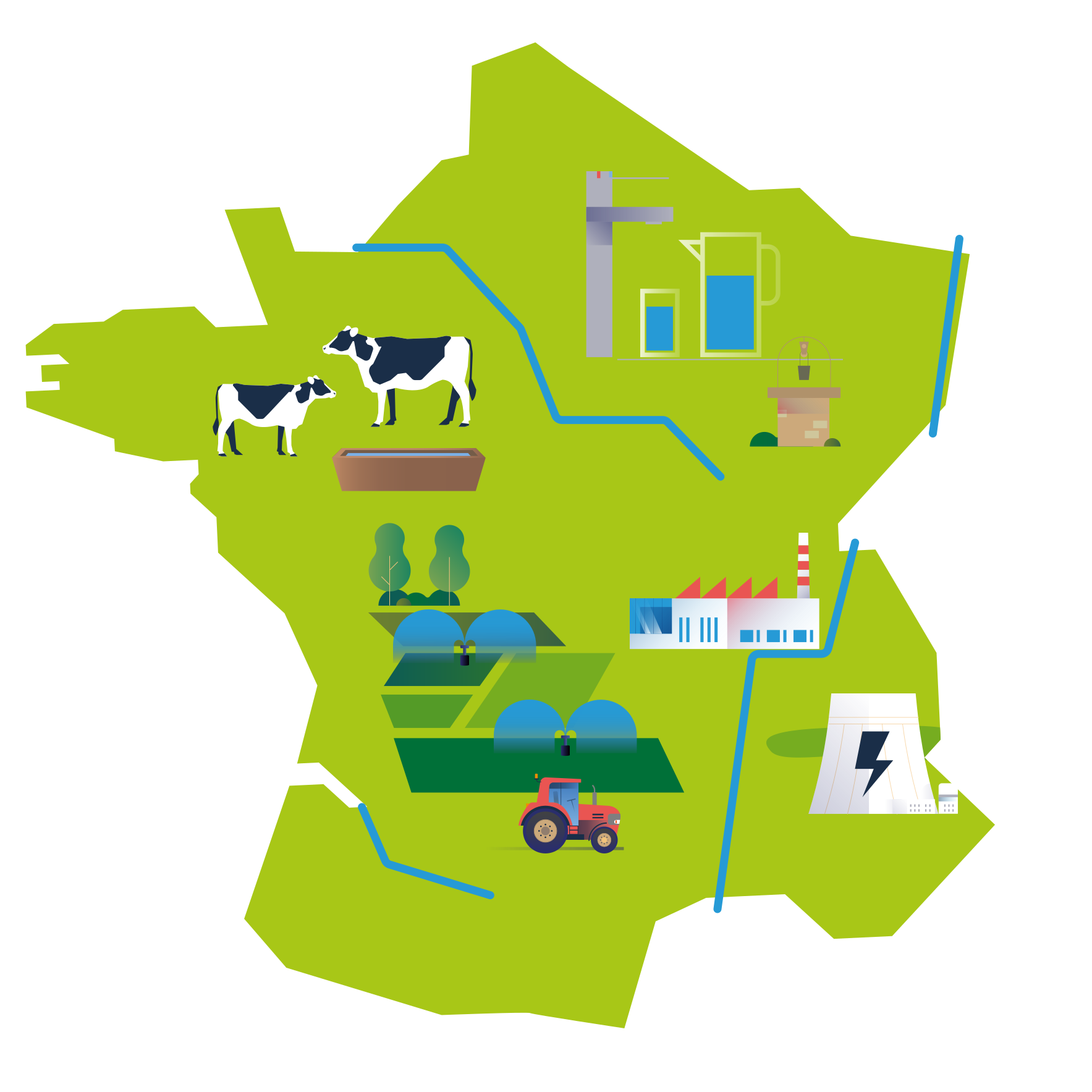
- Water: an increasingly scarce resourceFreshwater uses• In France, freshwater is used for: • daily uses (drinking water); • economic activities (agriculture, industry, leisure, cooling power plants, etc.).Dwindling resourceTo meet these needs, we have been using less freshwater over the past twenty years. In 2022, approximately 30 billion m³ of freshwater were withdrawn, compared to 32.9 billion m³ per year on average between 2008–2023. Freshwater remains abundant in France, but it is gradually diminishing. Between 1990–2001 and 2002–2022, it declined by 14%. The risk of water shortage, called "water stress", is especially significant in summer. During this season, 60% of water is consumed, while available water is at its lowest level. This situation can create local tensions and even conflicts over water use.Consumption illustrationDifferent activities consuming water in France
- Animal and plant biomass: renewable resource with environmental consequencesBiomass composition• Biomass consists of organic matter of biological origin: • crops (cereals, nuts, vegetables, fruits, fibres, etc.); • wood; • wild animals (from fishing or hunting).Biomass in FranceIn France, biomass from agriculture and fishing represents 222 million tonnes, or 36% of extracted raw materials. It is the second most extracted natural resource in the country, after non-metallic minerals. It can be used for food, seeds, industrial uses or animal feed.Environmental impactsHowever, even though biomass is renewable, it has environmental impacts. For example, intensive agriculture can cause soil erosion or water pollution from chemicals (pesticides) or excess nutrients (fertilizers, animal waste). It also requires other resources (mineral, fossil) and especially agricultural land or forests, which are limited.Better management neededIt is therefore essential to better manage the food and energy uses of biomass and limit its environmental impacts.
- Mineral resources: different balance between metallic and non-metallic materialsNon-metallic mineralsFrance primarily extracts non-metallic minerals such as sand and gravel. 392 million tonnes were extracted in 2022. This figure is down 10% compared to 1990. These materials are mainly used locally, but they are not renewable and their extraction, processing and transport have environmental consequences.Metallic minerals and energy transitionIn France, metallic ore extraction is very low: only 0.2 million tonnes per year. The country therefore imports nearly all its metal consumption, which was 17 million tonnes in 2022. With the energy transition, global demand for metals will increase further, for example for lithium, nickel, rare earths, etc. These metals are necessary for low-carbon technologies, that is, those that emit little or no CO₂: wind turbines, electric motors, batteries… New extraction, processing and especially recycling capacities for these metals must therefore be developed.
- Priority: using fewer natural resourcesConsumption factors• A country's raw material consumption depends on: • its population; • living standards (measured by GDP); • type of economy (for example, services consume fewer materials than industry); • technological progress.Material productivityThe evolution of what is called "material productivity" allows measuring whether society is becoming more resource-efficient.National goal and circular economy• This means producing more with fewer raw materials. To address environmental, social and economic challenges, France has set the objective of increasing its material productivity by 30% between 2010 and 2030. In other words, we must produce more with fewer natural resources. This is the objective of the circular economy. • Understanding the circular economy and material productivity
Further reading
- L’énergie : au cœur de la lutte contre le changement climatiquenotre-environnement.gouv.fr
Les énergies ont un impact fort sur le changement climatique. Surtout les énergies fossiles, principales responsables des émissions de gaz à effet de serre.
- Les prélèvements d’eau douce par usage en France en 2022statistiques.developpement-durable.gouv.fr
- L’eau sous tension, surtout l’éténotre-environnement.gouv.fr
En France, chaque année la ressource en eau peut devenir problématique, principalement durant l’été. La sécheresse de 2022 a d’ailleurs été exceptionnelle.
- Quelle est la consommation des ménages en eau potable ?notre-environnement.gouv.fr
En France, chaque habitant consomme en moyenne 150 litres d’eau potable par jour. Cette consommation est stable depuis 2014. Elle varie selon les régions, sous l’influence du climat, du tourisme et des habitudes domestiques.
- Biomasse : une ressource renouvelable, avec des effets sur l’environnementnotre-environnement.gouv.fr
Première énergie renouvelable en France, la biomasse est utilisée pour de multiples usages. Renouvelable, cette ressource n’est pas sans impact sur l’environnement.
- Minéraux non métalliques : des ressources très localesnotre-environnement.gouv.fr
La France extrait de nombreux minéraux non métalliques utilisés dans l’industrie ou pour la construction. Mais les importations ne cessent de progresser.
- Les métaux face aux besoins de la transition énergétiquenotre-environnement.gouv.fr
L’usage des métaux va augmenter pour répondre aux besoins de la transition énergétique. Un défi environnemental, économique, sociétal et même géopolitique.
- L’économie circulairenotre-environnement.gouv.fr
L’économie circulaire est un modèle économique visant à produire durablement des biens et services en limitant la consommation de ressources et la production de déchets.
- Bilan environnemental de la France – Édition 2024statistiques.developpement-durable.gouv.fr
Service des données et études statistiques - Mars 2025.
- Les prélèvements d’eau douce par usage en France en 2022statistiques.developpement-durable.gouv.fr
Article Web, Service des données et études statistiques, mars 2025
- Prélèvements et consommations d’eau : quels enjeux et usages ?strategie.gouv.fr
Note d’analyse 136 - France Stratégie - Avril 2024.
- L’eau en France : ressource et utilisationstatistiques.developpement-durable.gouv.fr
Article web - Service des données et études statistiques - Février 2025
- Consommation de matières et empreinte matières - Extrait du Bilan environnemental 2024statistiques.developpement-durable.gouv.fr
Suivi des consommations de matière et de l’évolution de l’empreinte matières en France - Service des données et études statistiques, janvier 2025.
- L’empreinte matières de la France en 2022 : un indicateur de notre consommation effective de matières premièresstatistiques.developpement-durable.gouv.fr
Analyse consacrée à l’empreinte matières, un indicateur qui permet de rendre compte de l’ensemble des matières premières mobilisées pour satisfaire la consommation finale d’un pays. - Commissariat général au développement durable (CGDD) - 2025.
- L’état des ressources en terres et en eau pour l’alimentation et l’agriculture dans le monde : des systèmes au bord de la rupturefao.org
Rapport de l'Organisation des nations unies pour l'alimentation et l'agriculture - 2021.
- Terres rares, aimants permanents : comment pourvoir aux besoins pour réussir la transition énergétique ?notre-environnement.gouv.fr
Le développement de l’éolien et des véhicules électriques va augmenter considérablement nos besoins en aimants permanents, ressources nécessaires pour améliorer leurs performances.