Cadmium, mercure, plomb... : quels impacts des métaux lourds sur la santé et l’environnement ?
Mercure, plomb, cuivre, etc. : ces métaux sont naturellement présents dans la nature. Mais avec les activités humaines, leurs concentrations ont fortement augmenté dans l’air, l’eau et les sols. Depuis 1990, les rejets ont beaucoup diminué en France, grâce aux réglementations. Pourtant, ces substances restent préoccupantes : elles s’accumulent dans les chaînes alimentaires et peuvent provoquer des troubles graves pour la santé, comme des cancers ou des atteintes neurologiques.
Mercury, lead, copper, etc.: these metals are naturally present in nature. But with human activities, their concentrations have sharply increased in air, water and soil. Since 1990, discharges have greatly decreased in France, thanks to regulations. Yet these substances remain concerning: they accumulate in food chains and can cause serious health disorders, such as cancers or neurological damage.
7 chapters
- What are heavy metals and metalloids?Definitions• Cadmium, mercury, lead, arsenic, copper and nickel are chemical elements naturally present in the Earth's crust. We call them metals when they share certain physical and chemical properties. Some, like arsenic, have intermediate properties: they are then called metalloids. • Heavy metals refer to metals or metalloids that are toxic in small doses and tend to accumulate in living organisms.Origins and sources• In their natural state, these substances can come from geological phenomena such as rock erosion or volcanism. But for over a century, human activities have significantly increased their presence in the environment, notably because of: • industry (metallurgy, battery or plastic production, etc.); • transport; • agriculture (fertilizers, pesticides); • mining; • etc. • Today they are found in air, water and soil. Some are toxic even at very low doses. This is the case with cadmium, mercury and lead, which are subject to strengthened health and environmental monitoring because they are detected in all ecosystems.Uses• These metals have various uses: • cadmium is used to protect alloys from corrosion, to manufacture plastics, batteries or dyes • mercury, liquid at room temperature, is still used in certain lamps, batteries or old industrial processes. It is also released during coal combustion • lead, extracted from an ore called galena, is present in batteries, old paints, ceramics or certain fuses • arsenic is naturally present in certain soils, but can also come from mining or the use of pesticides • copper is used in electrical cables, piping or as an agricultural fungicide • nickel is used to manufacture stainless steels, metal parts or batteriesEnvironmental circulationOnce released into the environment, these metals can circulate, transform or accumulate in plants, animals and humans. They have lasting effects on health and ecosystems.
- How are we exposed and what are the health risks?Hazard classification• Several metals are closely monitored because they pose known health risks. The International Agency for Research on Cancer (IARC) has classified them by hazard level: • Cadmium, arsenic, nickel and some of their compounds are recognized as carcinogenic to humans • Inorganic lead and metallic nickel are "probably carcinogenic" • Methylmercury, a form of mercury, is "possibly carcinogenic"CadmiumCadmium can have serious health effects, especially with prolonged or high-dose exposure. People are mainly exposed through food, particularly by consuming certain organ meats, shellfish or cereal-based products, but also by breathing contaminated air, especially near industrial sites or from cigarette smoke. When swallowed in large quantities, it can severely irritate the digestive system. When inhaled over a long period, it can damage the kidneys and lungs. It is notably associated with emphysema, a disease that gradually destroys lung alveoli and impairs breathing. Cadmium can also weaken bones.LeadLead is a toxic metal, even at low doses. People can be exposed by ingesting tap water from old lead pipes, by breathing contaminated dust, or by swallowing flakes of lead paint in old buildings. Once in the body, lead enters the bloodstream and then settles in various organs such as the liver, spleen, kidneys or brain. It eventually accumulates in bones. Lead is particularly dangerous for the developing brain, especially in fetuses and young children.MercuryMercury is considered by the World Health Organization (WHO) as one of the "ten chemicals of major public health concern". People are mainly exposed through food, particularly by consuming certain predatory fish such as tuna or pike, but also, more rarely, by inhalation in certain occupational settings (industry, medicine, crafts). In its inorganic form—when not bound to carbon molecules—it primarily affects the kidneys. In its most toxic form, methylmercury, it can cause disorders of the brain and nervous system when exposed over a long period. This can lead to problems with balance, walking, hearing or vision. In children, methylmercury can slow development, cause speech or growth delays. It is also dangerous for the fetus during pregnancy.Arsenic and nickel• Arsenic is a pollutant recognized as a confirmed carcinogen, meaning it can cause cancers in humans. People are mainly exposed through drinking water, certain foods, or industrial activities. Over the long term, arsenic can cause skin lesions and cancers, particularly of the skin, bladder or lungs. It is also associated with heart disease, diabetes, and developmental disorders in children. In young people exposed from childhood, arsenic can cause cognitive delays and increase the risk of premature mortality. • Nickel, present in many everyday objects, can cause allergic reactions through skin contact (contact dermatitis). Some nickel compounds are also carcinogenic to the lungs and nasal cavities, particularly in people exposed by inhalation in a professional setting (refining, welding, metallurgy).French Guiana callout• Gold mining: what mercury exposure in French Guiana? • In French Guiana, gold mining has left a heavy environmental legacy. Over 150 years, approximately 250 tonnes of gold have been extracted. To recover the gold, mercury was used, at a rate of approximately 1.3 kilos of mercury per kilo of gold. This practice has been prohibited since 2006 in France, but continues to be widely used by illegal miners. • Another aggravating factor: French Guiana's soils naturally contain mercury. With deforestation and mining, this mercury is released into rivers, where it transforms into methylmercury, a highly toxic form. This pollutant accumulates in carnivorous fish such as the aïmara, widely consumed by certain Amerindian communities. By comparison, a single fish can contain as much mercury as 20 million liters of water. • Studies conducted locally show that residents have moderate mercury levels, but much higher than those observed in mainland France.
- What emissions in outdoor air?Emissions decline• Since 1990, discharges of heavy metals and metalloids into the air have declined significantly in France. This decline is explained by stricter regulations, national and local action plans, and improvements in industrial processes (notably smoke treatment or the addition of filters in incinerators). • Progress varies by substance: arsenic emissions fell by 69%, mercury emissions by 90%.The copper caseBut copper is an exception. Its emissions come mainly from transport (brake wear, road wear, etc.). Its emissions increased by 15% between 1990 and 2019, before temporarily declining in 2020-2021 during the health crisis. In 2023, they returned to their 1990 level.Regulatory threshold compliance• France now meets its international commitments regarding cadmium, mercury and lead discharges into the air. • Concentrations of arsenic, cadmium, nickel and lead in outdoor air are monitored annually by about forty stations. They generally remain low, below regulatory thresholds set at European level. From 2013 to 2023, only one to two stations per year recorded exceedances depending on the pollutant. Nickel is the pollutant with the highest number of years with exceedances, predominantly at one measurement station. Industrial activities are responsible. For lead, regulation has always been respected over the studied period.
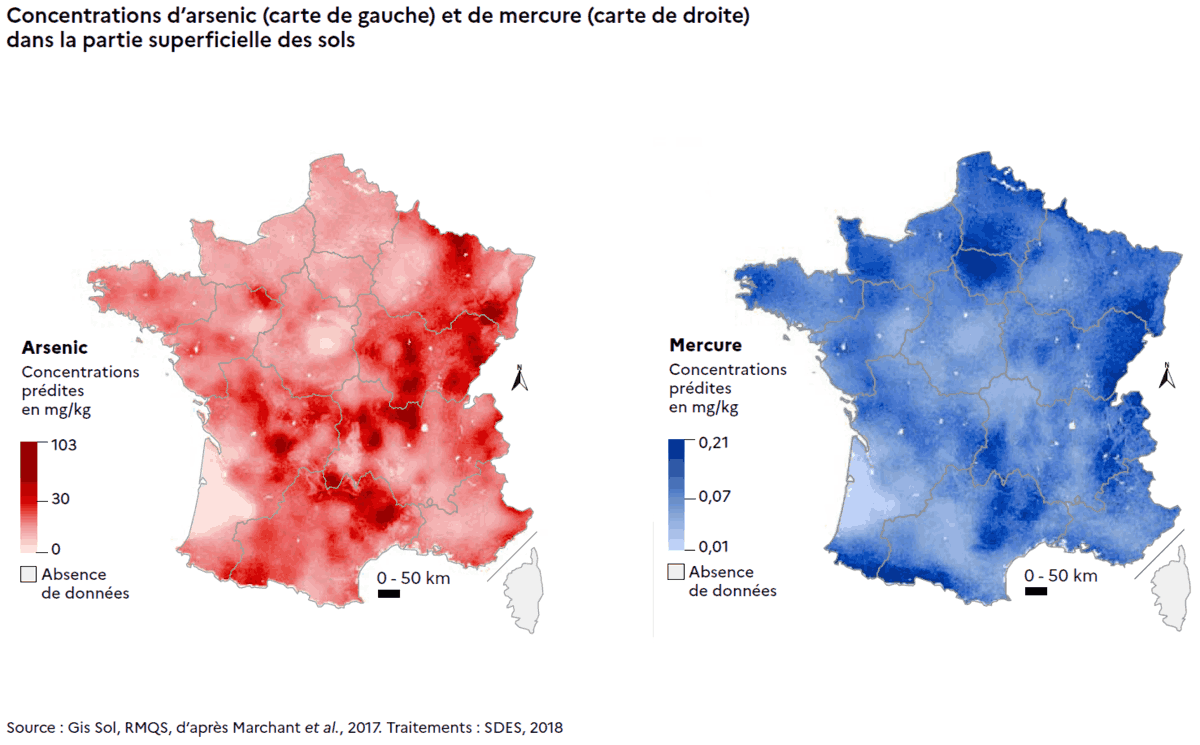
- What soil pollution from metals?Mercury in soils• Heavy metals and metalloids are naturally present in soils. But certain human activities, past or present, have increased their concentration. This is the case with mercury and arsenic, for example. • In the Île-de-France region and northern France, soils contain more mercury than in rural areas. This pollution is explained by former industrial activities and by the spreading of sludge from wastewater treatment plants. In these areas, levels often exceed 0.1 milligram of mercury per kilogram of fine soil, a value rarely reached in cultivated or forest soils in rural areas. In the Massif Central, soils are naturally more laden with mercury. But past exploitation of gold mines further increased this concentration.Arsenic in soilsRegarding arsenic, measurements showed that 16% of monitoring points exceed the alert threshold proposed by the High Council for Public Health in August 2022. This threshold is set at 25 milligrams per kilogram of soil. However, when accounting for how arsenic is absorbed by the body (referred to as bioaccessibility), this threshold would in reality only be exceeded at one site among the 2,200 studied. Some of these contaminations come from the soil itself, as in the Massif Central. Others are due to past human activities, particularly industry or pesticide use (source: SDES).Localized polluted sitesTo these diffuse pollutions are added localized contaminations near sites polluted by known industrial activities. This is the case in the Aquitaine and Paris basins, where soil is normally lightly laden with heavy metals. In 2023, more than half of the sites in France listed as polluted were so because of heavy metals. Arsenic and mercury are also often found: in nearly a quarter of sites for arsenic, and just over one in ten sites for mercury.Gard callout• Pollution around former Gard mines: what impacts for residents? • In northern Gard, two former lead and zinc mines—at Carnoulès and at Croix-de-Pallières—have left lasting pollution in the environment. These sites, closed since the 1950s, still show very high concentrations of lead and arsenic today. Significant cadmium levels have also been found at Croix-de-Pallières. • Santé Publique France conducted a study among residents living nearby. Result: one in four people has arsenic exposure above the national average, and nearly one in eight for cadmium. In contrast, blood lead levels are comparable to those of the rest of the population, and no cases of childhood lead poisoning were detected. • This study confirmed the link between soil pollution and exposure in local populations. Recommendations were made to reduce risks, particularly by improving management of pollution sources and adapting certain daily behaviors, for example in homes or diet.
- What metal discharges into waterways?Discharge sourcesHeavy metals can be found in rivers and waterways because of certain discharges linked to human activities. This notably concerns treated wastewater from treatment plants, but also polluted water that overflows during heavy rain or incidents, as well as discharges from factories.Discharge trendsBetween 2010 and 2022, the quantity of heavy metals discharged into water from these sources was reduced by five. This significant decline is explained by the reduction of certain industrial or mining activities, stricter rules on discharges and better water treatment equipment.
- How is population exposure to heavy metals monitored?National monitoringSince 2006, national studies have made it possible to monitor the exposure of French people to certain heavy metals, such as cadmium, mercury and lead. These surveys were conducted among adults, children under 6 and pregnant women.ESTEBAN study results• Santé Publique France's ESTEBAN study makes it possible to estimate population exposure to heavy metals and its evolution: • the vast majority of the population is exposed to heavy metals, both adults and children: more than 97% of participants show measurable traces in their body; • in adults, mercury levels in hair and nickel in urine remained globally stable compared to those observed in 2006-2007; • conversely, concentrations of arsenic, cadmium and chromium increased; • whether in children or adults, exposure levels measured in France are often higher than in other European or North American countries, except for nickel and copper.
- What actions have been taken to limit metal pollution?General regulatory frameworkTo protect health and the environment, the uses of certain metals and their release into nature are regulated by law. Their presence in everyday consumer products such as tap water, food or toys is also strictly regulated.Minamata ConventionRegarding mercury, France signed the international Minamata Convention in 2013. This treaty aims to reduce mercury discharges into the environment globally to limit population exposure.Fighting lead poisoningIn the 1980s, the discovery of many cases of childhood lead poisoning in old Parisian buildings containing lead paint led public authorities to act. Since then, several measures have been put in place to limit lead exposure. In 2015, new regulations made it mandatory to report any case of poisoning in children under 18 years old, whenever lead concentration in blood exceeds 50 micrograms per liter. This threshold was lowered because studies have shown that lead can harm brain development, even at low doses.
Further reading
- Arsenic et mercure dans les sols : les zones exposées en Francestatistiques.developpement-durable.gouv.fr
Datalab Essentiel - SDES (Service des données et études statistiques) - Décembre 2021.
- Exposition aux métaux de la population française : résultats de l’étude ESTEBANsantepubliquefrance.fr
Santé Publique France - 2021.