Repenser la construction de logements pour limiter les conséquences sur l’environnement
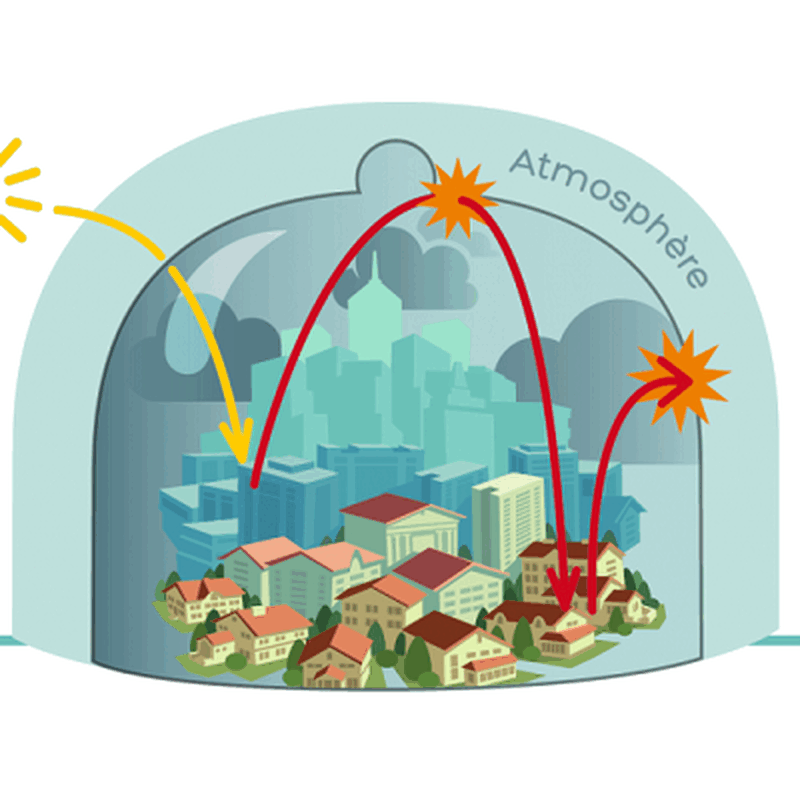
Depuis cinquante ans, l’agrandissement des villes, ou « étalement urbain », a entraîné une très importante artificialisation des sols, c’est-à-dire la transformation de terres naturelles, agricoles ou forestières en bâtiments, logements ou aménagements (routes, parkings, zones d’activités...). Face à cela, la France s’est fixée des objectifs. Mais limiter l’artificialisation a des conséquences au quotidien. Les communes et les intercommunalités, chargées de la planification et de l’urbanisme, sont en première ligne pour engager les transformations nécessaires.
For fifty years, the expansion of cities, or "urban sprawl," has led to significant soil artificialisation—the transformation of natural, agricultural, or forest land into buildings, housing, or infrastructure (roads, parking, business zones, etc.). In response, France has set objectives. But limiting artificialisation has daily consequences. Municipalities and intermunicipal authorities, responsible for planning and urban development, are on the front line for driving necessary change.
4 chapters
- Why limit urban sprawl?Land consumptionBetween 2009 and 2022, nearly 25,000 hectares—equivalent to the entire Val-de-Marne department—were "consumed" on average each year. This means these spaces changed use, shifting from agricultural land, forests, or natural areas to built-up zones (housing, roads, retail, etc. - source: Cerema).Lost natural functions• Even when land is not covered by concrete or asphalt, such as green spaces and gardens, it loses essential natural functions: • food production; • "carbon sink," meaning carbon storage in prairie and natural area soils and forests; • natural water filtration through soil; • groundwater recharge and natural water retention; • etc.Biodiversity impactsArtificialisation also affects biodiversity. Cities and roads fragment and directly destroy habitats of many animal and plant species. Fences surrounding gardens create barriers that prevent certain animals from moving freely to feed and reproduce.
- The difficult questioning of the single-family home modelLand consumption breakdown• Between 2009 and 2022, land consumption was primarily for: • housing (63%); • economic activities—logistics, retail, industry, farm buildings (23%); • roads (6%) and railways (1%).Primary residence increase• The rise in primary residences (+8.8% between 2009 and 2019) explains two-thirds of land consumption linked to housing (source: INSEE). This increase is due to: • population growth (+4.2% between 2009 and 2019); • decline in average household size (2.17 people per household in 2020, versus 2.28 in 2009). • However, the increase in secondary residences (3.1 million in 2021) and vacant housing (3.7 million in 2021) also contributes.Household projectionsAccording to INSEE, the number of households in France could reach between 32 and 36 million by 2050, compared to 30 million in 2018 (source: CGDD). This increase would be mainly explained by more adults living alone.
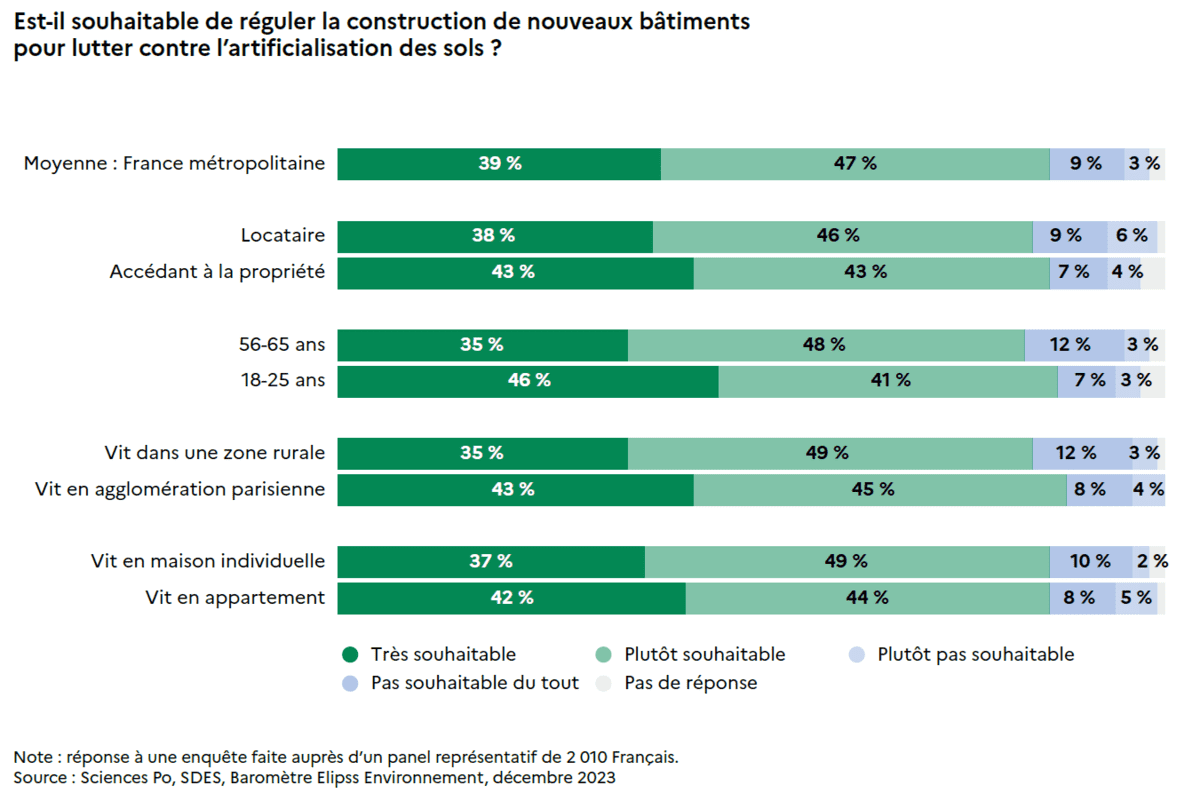
- Single-family homes and the evolution of housing needsLow construction density• The development of residential areas with single-family homes and gardens began in the 1970s and continued for a long time. Between 2009 and 2020: • 51% of land consumed for housing construction was used for projects with fewer than 8 homes per hectare; • these projects represented only 18% of all homes built; • these low-density operations were mainly located in rural municipalities (source: Cerema).Single-family home preference• The single-family home remains a highly sought-after type of housing: • three-quarters of renters wishing to become homeowners want to buy a single-family home; • one-quarter even plan to have one built; • 44% of French people consider having a garden "absolutely essential" for their home (source: 2023 habitat survey Harris Interactive). • However, proximity to retail, public services, and public transportation is also an important selection criterion, especially for elderly or low-income people.New construction evolutionIn practice, the situation is changing: in 2019, single-family homes represented only 43% of 374,000 new homes, compared to 61% of 371,000 new homes in 2000 (source: SDES).French public opinion• Furthermore, French people generally support measures that limit soil artificialisation. • French public opinion on construction regulation to combat soil artificialisation
- Rethinking urban developmentNet-zero artificialisationThe "net-zero artificialisation" target was included in the 2021 Climate and Resilience Act. It is not about preventing construction but ensuring each new building is accompanied by equivalent "rewilding." Local urban planning must now include measures to conserve land according to each territory's needs.Three solutions• Three solutions exist: • better use already-built spaces: revitalize city centers, occupy vacant homes, renovate older buildings, build on unused urban land, convert offices to housing, and reuse abandoned industrial or retail sites; • increase housing density: create attached homes and small apartment buildings rather than detached homes on large plots; • increase housing occupancy rates: combat under-occupancy, meaning homes with far more rooms than occupants need, and limit secondary residences.Municipal supportNational programs have been implemented to help municipalities reach these goals, and several organizations can provide expertise and funding: Cerema, FNAU, CAUE, ANCT, ADEME, public land institutions, public development institutions, and other public developers, etc.
Further reading
- Portail national de l’artificialisation des solsartificialisation.developpement-durable.gouv.fr
Cerema (Centre d'études et d'expertise sur les risques, l'environnement, la mobilité et l'aménagement) - Portail national de l'artificialisation des sols.