Moins de protéines animales pour réduire les conséquences de l’alimentation sur le climat
La viande, les produits laitiers, les œufs et le poisson occupent une place centrale dans l’alimentation française. Pourtant, ces aliments d’origine animale ont des conséquences importantes sur le climat à cause de leurs émissions de gaz à effet de serre. Réduire un peu leur consommation est un moyen d’action concret pour limiter le dérèglement climatique.
Meat, dairy products, eggs and fish hold a central place in French cuisine. Yet these animal-based foods have significant consequences for the climate due to their greenhouse gas emissions. Reducing their consumption somewhat is a concrete way to act to limit climate change.
3 chapters
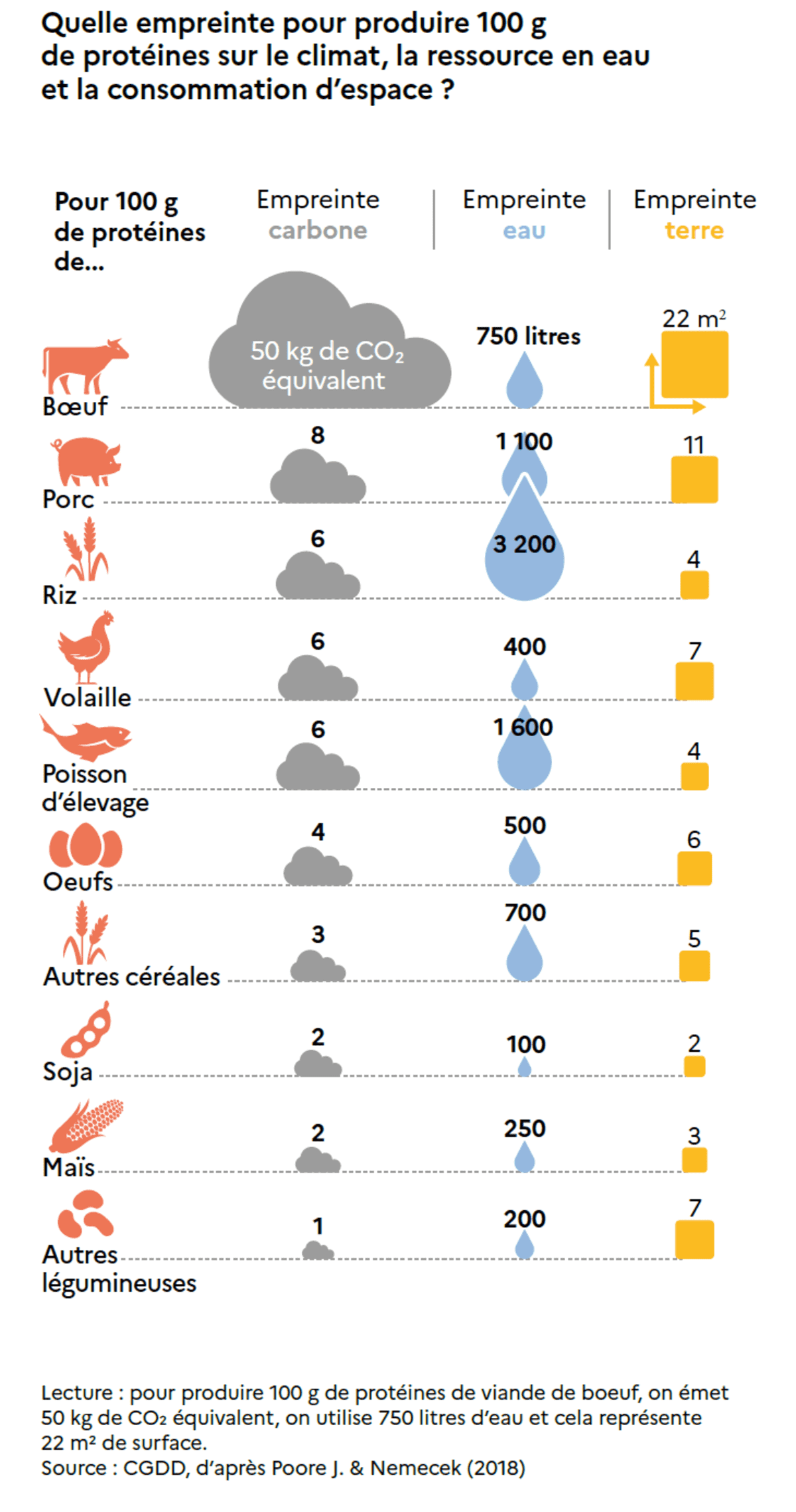
- Why eat less meat?Food and greenhouse gases• Food accounts for 21% of the carbon footprint of total French consumption. Agricultural activities produce three main greenhouse gases: • methane: produced by livestock such as cattle, sheep and goats during digestion, when manure decomposes, and when fertilizers are spread in fields. Livestock is responsible for 32% of human-caused methane emissions worldwide (source: Coalition for Climate and Clean Air); • nitrous oxide: comes from fertilizers used for agricultural crops; • carbon dioxide (CO2): resulting from energy consumption for the operation of agribusiness factories, restaurants, food transport, agricultural machinery...Animal production impactWhat we eat has more impact on the climate than how our food is transported or packaged. The production of animal-based foods, particularly meat, emits far more greenhouse gases than plant-based foods. In 2021 in France, livestock generates 59% of greenhouse gas emissions from the agricultural sector, and accounts for 10% of all human-caused emissions in the country (source: High Council for Climate).Protein impact varies• Not all proteins have the same environmental footprint: • producing 100 grams of beef protein emits an average of 50 kilograms of greenhouse gases; • a beef-based dish emits 8 times more greenhouse gases than a poultry-based dish; • the same amount of protein from cereals releases only three kilograms. • Raising animals for meat requires many natural resources. A cow drinks between 50 and 100 liters of water each day. Furthermore, livestock uses large areas of land, both to grow feed for animals, such as grains and hay, and to build shelters for them. • What is the environmental footprint for producing 100 grams of protein in terms of climate, water resources and space consumption?
- Toward changed consumption and production?Meat consumption trends• Meat consumption in France has evolved: • it increased from after World War II until peaking at 93.6 kg "carcass equivalent" per capita in 1998, compared to 75.8 kg in 1970 (source: FranceAgriMer); • it then decreased gradually until 2013; • then meat consumption increased by 3% between 2013 and 2022 (source: FranceAgriMer). • The term "carcass equivalent" refers to the total weight of slaughtered animals, including uneaten parts. This measurement allows tracking overall meat consumption trends, even if the animal is not eaten entirely. • Meat consumption remains significant in France at 85 kilos per capita in 2022. Yet increasingly, people say they have adopted a "flexitarian" diet, meaning they voluntarily reduce their meat consumption without excluding it entirely. • This gap between stated preferences and actual figures is partly explained by "hidden" meat consumption: the meat not directly visible in processed products, prepared meals, and meals eaten at restaurants or cafeterias for example. • There is also a shift in the types of meat consumed: French people eat less beef and more poultry.Dietary habits shift• More and more people are changing their eating habits and vegetarianism is gaining ground. • Vegetarianism is a diet that excludes meat and fish while retaining other animal products such as eggs or dairy products. This choice is adopted by varied profiles: employees and unemployed people typically become vegetarian when younger, while people from higher socioeconomic categories make this choice later, around age 40 (source: Sésame review from Inrae). • Motivations for eating less meat are numerous: environmental protection, health, respect for animal welfare. The high cost of meat can also limit consumption in lower-income households.New food production model• Addressing environmental, economic and health challenges related to food requires support through adapted policies. This means changing how food is produced toward a less intensive, more diverse and local model. • Rather than growing cereals to feed livestock, more land could be used to directly produce our food. Farms where animals feed mainly on grass and plant by-products, such as residues from flax, sunflower or rapeseed seeds, offer environmental benefits. These practices maintain valuable natural habitats such as permanent grasslands, which shelter a wide variety of plants and animals, purify water and trap carbon in the soil.
- Actions for less animal-based eatingPlant-based alternatives access• Finding plant-based alternatives to meat remains difficult in France. A study of 150 supermarkets shows that 92% of food products contain meat or fish (source: Climate Action Network). This situation creates difficulties for people who eat little or no animal products: • three-quarters of vegetarians, who eat neither meat nor fish, pescatarians, who eat fish but not meat, and vegans, who consume no animal products, say they struggle to follow their diet; • obstacles include lack of choice in stores and restaurants, as well as negative remarks from others (source: FranceAgriMer). • In French culinary culture, meat often occupies the central place on the plate, with vegetables considered merely an accompaniment. Changing this habit requires modifying a deeply rooted social perception. • Additionally, many people don't know how to prepare balanced, protein-rich meals without meat. Many plant-based products are nonetheless an important source of protein, such as dried vegetables, also called "large-seeded legumes" (lentils, chickpeas…), oilseeds (nuts, almonds…) or cereals (wheat, rice…).National change initiatives• The national food program 2019-2023 launched several actions to reduce meat consumption and promote plant proteins: • promotion of plant proteins in canteens and collective restaurants; • possibility of having a daily vegetarian option in public collective dining; • introduction of at least one vegetarian menu per week in school canteens; • development of plant protein production chains to reduce France's dependency on imports. • These measures align with the national nutrition health plan 2019-2023. It recommends, for example, limiting meat consumption to 500 grams per week, the equivalent of 4 to 5 ground beef steaks, eating dried vegetables at least twice a week and consuming at least five fruits and vegetables daily.Local plant protein initiatives• Local initiatives are developing to bring together producers, processors, distributors and consumers around more environmentally responsible food: • support for creating local chains for the production, processing and marketing of legumes; • training catering professionals to cook plant proteins and create vegetarian menus; • raising awareness among young people about sustainable eating.