
Biodiversité et montagne
Les zones de montagne sont composées d’une large part d’espaces naturels abritant une biodiversité riche et fournissant de nombreux biens et services écosystémiques. Face au développement des activités anthropiques, des dispositifs de protection ont été mis en place afin de constituer un réseau d’espaces protégés et de préserver les écosystèmes montagnards.
Mountain zones consist largely of natural spaces harboring rich biodiversity and providing numerous ecosystem goods and services. In response to the development of human activities, protection mechanisms have been established to create a network of protected areas and preserve mountain ecosystems.
- Protected areas in mountainsProtected areas (excluding Natura 2000)• In 2017, nearly half of the area of metropolitan mountain ranges is subject to at least one protection measure (RAMSAR sites, Natura 2000 sites, national parks, national nature reserves, regional natural parks, regional nature reserves, national hunting and wildlife reserves, biotope protection orders, biological reserves of the National Forestry Office, biosphere reserves, nature conservation trust sites), representing an area of over 8.3 million hectares of protected areas, of which nearly 3.3% are subject to strong protection (national nature reserves, regional nature reserves, national park cores, biotope protection orders, biological reserves of the National Forestry Office). • Protected areas (excluding Natura 2000) in the Alps in 2017 • Protected areas (excluding Natura 2000) in the Pyrenees in 2017 • Protected areas (excluding Natura 2000) in the Massif Central in 2017 • Protected areas (excluding Natura 2000) in the Jura in 2017 • Protected areas (excluding Natura 2000) in the Vosges in 2017 • Protected areas (excluding Natura 2000) in Corsica in 2017Natura 2000 sites• Natura 2000 sites in the Alps in 2017 • Natura 2000 sites in the Pyrenees in 2017 • Natura 2000 sites in the Massif Central in 2017 • Natura 2000 sites in the Jura in 2017 • Natura 2000 sites in the Vosges in 2017 • Natura 2000 sites in Corsica in 2017 • > Definitions • > Protected areas: the protected areas considered (excluding Natura 2000 sites for clarity purposes) include regulatory mechanisms, called strong protection devices, based on prohibiting or limiting certain human activities: • > - national park cores, • > - national nature reserves, • > - regional nature reserves, • > - prefectural biotope protection orders, • > - biological reserves, • > - national hunting and wildlife reserves. • > They also include contractual management mechanisms: • > - national park membership areas, • > - regional natural parks. Less protective than regulatory mechanisms, the latter combine preservation of natural heritage and local development and rely on voluntary commitment from local authorities. • > Natura 2000 network: a European-level protection mechanism comprising special protection zones (SPZ) under the "Birds" directive and special conservation zones (SCZ). The latter aim to conserve habitats and animal (excluding birds) and plant species of community interest under the "Habitats, Species, Flora" directive.
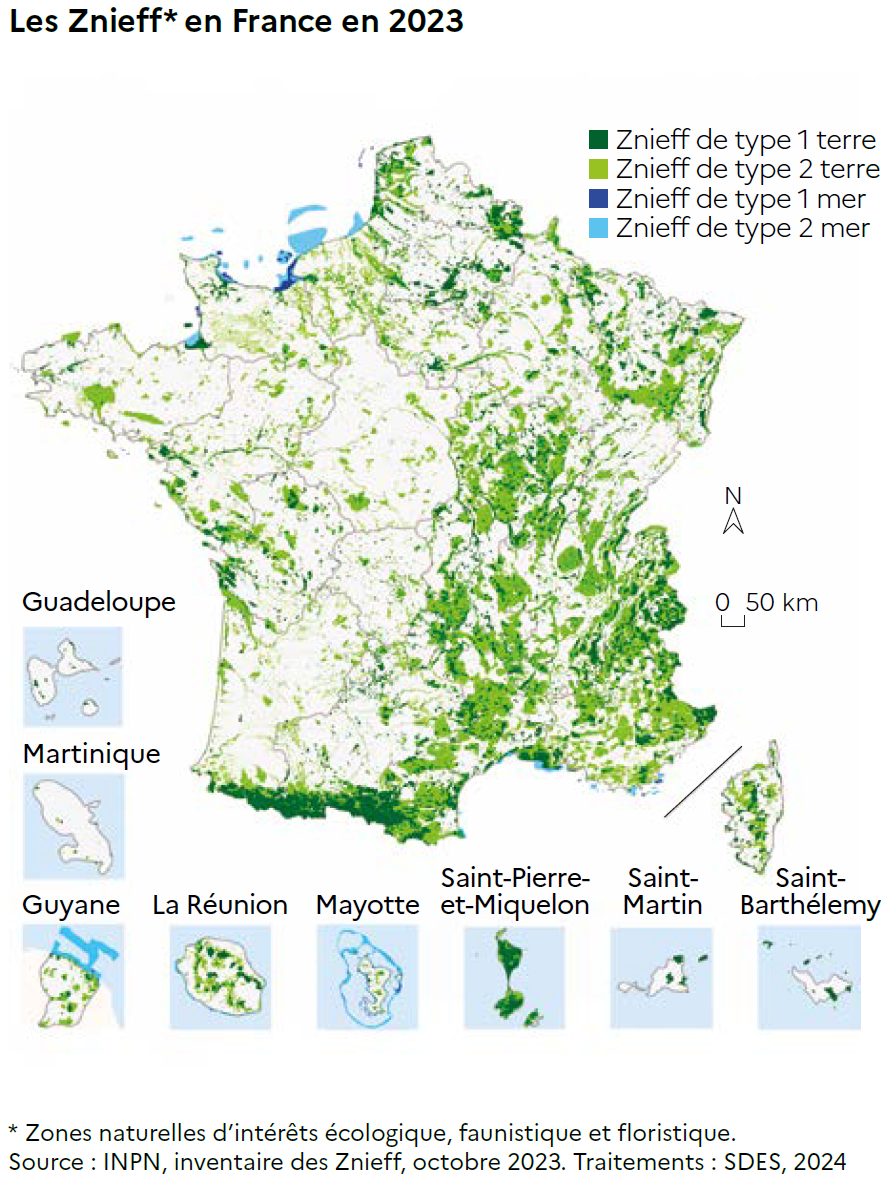
- Remarkable natural areas in mountainsType 1 ZNIEFF• The inventory of natural areas of ecological, fauna, and flora interest (ZNIEFF) records small-sized spaces harboring at least one rare or threatened species and/or habitat, of interest at local, regional, national, or community level. In 2017, Type 1 ZNIEFF cover nearly 20% of the surface of metropolitan mountain ranges. They are particularly present in the Pyrenees (50% of the area) and in the Alps (25%). • Type 1 ZNIEFF in the Alps in 2017 • Type 1 ZNIEFF in the Pyrenees in 2017 • Type 1 ZNIEFF in the Massif Central in 2017 • Type 1 ZNIEFF in the Jura in 2017 • Type 1 ZNIEFF (2nd generation) in the Vosges in 2017 • Type 1 ZNIEFF in Corsica in 2017 • > Definition • > Type 1 ZNIEFF: the inventory of natural areas of ecological, fauna, and flora interest (ZNIEFF) aims to identify, on the national territory, remarkable natural or semi-natural environments with strong biological capacity and good conservation status. This knowledge tool, which does not constitute protection per se for these spaces, indicates significant biodiversity for the territory concerned. Type 1 ZNIEFF are sectors of high biological or ecological interest defined by the presence of rare, remarkable, or characteristic species and habitats of national or regional natural heritage.
Further reading
- Comité français de l’UICN : Groupe Montagnenotre-environnement.gouv.fr
Le Groupe Montagne du Comité français de l’UICN s’attache à développer la préservation de la biodiversité des écosystèmes montagnards ainsi qu’à promouvoir la gestion durable de leurs ressources.
- Espaces protégésnotre-environnement.gouv.fr
Selon l'Union Internationale pour la Conservation de la Nature (UICN), un espace protégé est « un espace géographique clairement défini, reconnu, consacré et géré, par tout moyen efficace, juridique ou autre, afin d'assurer à long terme la conservation de la nature ainsi que les services écosystémiques et les valeurs culturelles qui lui sont associés ».
- Le réseau Natura 2000notre-environnement.gouv.fr
Le réseau Natura 2000 s’inscrit au coeur de la politique de conservation de la nature de l’Union européenne et est un élément clé de l’objectif visant à enrayer l’érosion de la biodiversité.
- L’inventaire ZNIEFFnotre-environnement.gouv.fr
Lancé en 1982, l’inventaire des Zones Naturelles d’Intérêt Écologique Faunistique et Floristique (ZNIEFF) a pour objectif d’identifier et de décrire des secteurs présentant de fortes capacités biologiques et un bon état de conservation.