Les ongulés sauvages de métropole
Les ongulés sauvages regroupent les ongulés de plaine (cerf élaphe, cerf sika, chevreuil, sanglier) et ceux de montagne (chamois, isard, mouflon, bouquetin). Depuis le début des années 2000, l’augmentation de leurs effectifs et de leurs des aires de répartition en constante progression affecte les écosystèmes ainsi que certaines activités humaines. À l’exception de quelques zones de montagne où les grands carnivores sont à nouveau présents, les cervidés n’ont plus de prédateurs. Quand les populations deviennent localement trop importantes, elles peuvent entraîner des dégâts importants sur les surfaces agricoles et forestières ainsi que dans les milieux naturels. La chasse est un moyen de régulation des populations.
Wild ungulates include lowland ungulates (red deer, sika deer, roe deer, wild boar) and mountain ungulates (chamois, Pyrenean chamois, mouflon, ibex). Since the early 2000s, their expanding populations and ranges increasingly affect ecosystems and human activities. Except in a few mountain zones with returning large carnivores, cervids lack natural predators. When populations become locally excessive, they cause major damage to agricultural and forest areas and natural habitats. Hunting is a population regulation tool.
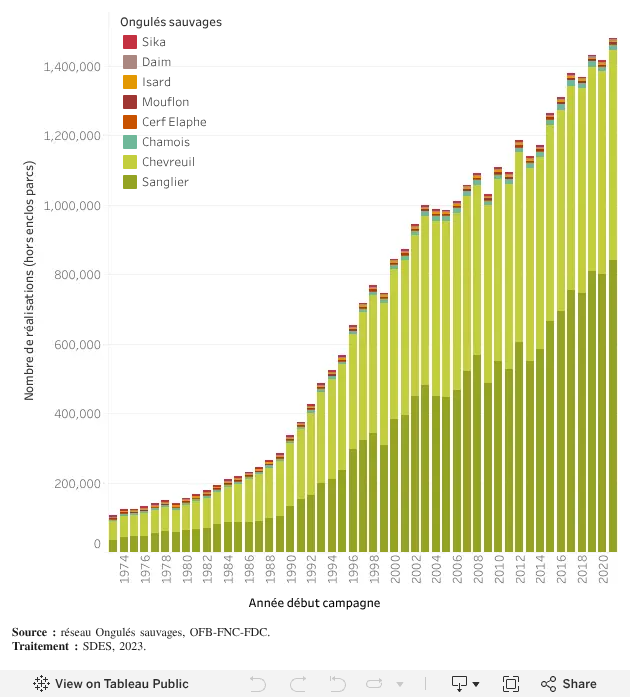
- Rising populationsHunting status and harvest trends• At the national level, red deer, roe deer, wild boar, Alpine chamois, Pyrenean chamois, mouflon (Corsican and Mediterranean), fallow deer, and sika deer have the status of game species whose hunting is permitted. Hunting harvests allow for assessing the population dynamics of wild ungulates on the territory. Thus, over the 1973–2021 period, the number of wild boars killed annually increased 23-fold, and roe deer 12-fold. However, harvests remain globally lower than the natural population growth. Certain marginal species such as fallow deer and sika deer are not indigenous to France. Their presence, mainly due to accidental escapes from enclosures, is currently receiving special attention.Population trends by species• Over the 2002–2021 period, sika deer—an invasive species (+ 342% in realized harvests), fallow deer (+ 180%), and red deer (+ 105%)—are the species whose populations increased most. Conversely, Pyrenean chamois (+ 10%) and mouflon (+ 3%) showed less pronounced growth, and chamois even declined (- 12%). Although roe deer (+ 31%) and wild boar (+ 88%) continue to expand over this same period, their growth has slowed compared to 1982–2002 (respectively + 48% and + 120%).Quotas and regulationHunting quotas, assigned annually (called "allocations"), form the hunting plan of the federations. Each licensed hunter receives a quota notified by individual decree. The number of hunted individuals (called "realized harvest" or "take") may be limited to preserve the species and prevent extermination (as with sika deer and Pyrenean chamois).
- Red deerSurvey of red deer regionsSince 1985, a survey of red deer regions has been conducted by the Wild Ungulates Network OFB-FNC-FDC. Renewed in 1988, 1991, 1995, 2000, 2005, and 2010, it characterizes the evolution of red deer populations and the geographic sectors where they live. The survey reveals that red deer (like roe deer) has increased sharply in France since 1985, both in population size and forested area colonized.Population growth and range expansion• In 2010, red deer occupied 16 million hectares spread across 83 departments, including 7.4 million hectares of forests (49% of national forested territory). Between 1985 and 2010, the area it occupied doubled and its population quadrupled, rising from approximately 37,500 in 1985 to about 160,000 in 2010. This growth, however, showed a slowdown between 1991 and 2010. • While red deer were sparse in southern France in the mid-1980s, the trend is now toward population equalization between north and south. This translates to uneven changes by geographic zone: • first, very strong population growth in mountainous departments: on average, populations increased 11-fold since the early 1990s in Alpine departments and 9-fold in Pyrenean departments; • second, growth below the national average for departments already exceeding 1,000 individuals in 1985 (except Loir-et-Cher). • The highest population concentrations are found in lowland and low-altitude forest massifs. Between 2005 and 2010, red deer expansion occurred mainly in areas where it was already present. Over 1980–2022, populations advanced significantly through population reinforcement policies and colonization of mountainous areas (Alps and Pyrenees) and southern France. • In 2021, red deer occupies 51% of national forest area (absent in departments 32, 62, 69, 75, 92, 93, and 94).AllocationsRealized harvestsDepartmental harvests
- Roe deerPopulation and distributionWith a population between 1.5 and 2 million individuals, roe deer is the most abundant species in metropolitan France. Its numbers have increased more than 3-fold over 2001–2021, with the majority concentrated in the northeast (Bas-Rhin, Moselle, Meuse, Haute-Marne, Vosges) and southwest (Landes, Gironde, Dordogne).Hunting tablesThe evolution of hunting tables realized since 1973 reflects recent growth in red deer and roe deer. Over 2002–2021, animals killed increased 105% for red deer and 31% for roe deer. In 2021, the realization rate (ratio of harvested to harvestable animals) reached 69% for red deer and 80% for roe deer. In the 2021–2022 season, approximately 75,000 red deer and 600,000 roe deer were harvested.AllocationsRealized harvestsDepartmental harvests
- Sika deer and fallow deerInvasive species and ecological impactsAlthough still scarce in France, invasive ungulate species (sika deer and fallow deer) have seen significant population increases in recent years, with consequences for local ecosystems: hybridization risk between sika and red deer, fallow deer impact on forest stands or agricultural land, etc. Since the early 2000s, the geographic distribution (outside enclosures) of fallow and sika populations has expanded significantly.Fallow deer distributionFallow deer are now found in more than half the departments, though geographic expansion is slowing. They concentrate in Haut-Rhin (461 individuals) and Seine-et-Marne (160 individuals). New arrivals were recorded in 7 departments including Aube and Aude, while populations disappeared from 8 departments such as Calvados and Eure-et-Loir where hunting pressure is high.Sika deer distributionSika deer appeared in 4 new departments including Seine-et-Marne and Isère and have not yet disappeared from any department. Loiret (66 individuals) and Haut-Rhin (60 individuals) hold the largest concentrations.Fallow and sika distribution in 2019Realization rateWith populations tripling in 20 years, fallow deer are harvested in 48 departments in 2021. The realization rate for this species reaches 41%. Sika populations follow similar dynamics, quadrupling over the same period. The species is harvested in 9 departments. In 2020, the realization rate was 33% (allocation data unavailable for 2021).Sika allocationsSika realized harvestsSika departmental harvestsFallow allocationsFallow realized harvestsFallow departmental harvests
- Wild boarHarvests and national dynamicsWith more than 842,000 individuals killed in 2021, wild boar is the most harvested animal in France (approximately 9,000 average annual harvests per department). For this species, harvests nearly doubled over 2002–2021. Similar dynamics are observed across Europe. Due to its lifestyle (feeding, reproduction, etc.), the species is heavily present throughout forest areas (national harvest of 4.73 boars per 100 hectares of woodland). In the 2021–2022 season, eight departments had harvests exceeding 20,000 boars annually (Loir-et-Cher (31,638), Gard (25,314), Moselle (24,263), Haute-Corse (23,955), Bas-Rhin (21,917), Cher (21,874), Hérault (21,799), and Var (20,594)). Haute-Loire (+ 52%) and Manche (+ 48%) showed the strongest harvest increases, while Vaucluse (- 19%), Gard, Hautes-Pyrénées, and Sarthe (- 16%) experienced significant declines.Realized harvestsDepartmental harvests
- Mountain ungulatesInventory of French populationsThe inventory of French mountain ungulate populations conducted between April 2016 and April 2017 across 45 departments clarified trends from previous surveys (1975, 1989, 1995, 2005, 2010). It had three objectives: update species distribution maps, analyze spatial distribution changes, and gather information on release operations, health status, monitoring methods, and hunting tables. While earlier surveys suggested population increases, the 2010 survey nuanced the picture for some species.Estimated populations of chamois, mouflon, Pyrenean chamois, and ibex
- ChamoisPopulation trends and harvestsWith a minimum estimated population of 103,345 individuals in 2010, chamois (Rupicapra rupicapra rupicapra) numbers tripled since 1988, despite an 8-fold increase in hunting quota allocations (1,677 animals in 1988, 14,029 in 2010). Between 1988 and 2005, quota increases were dramatic. Since then, chamois continue growing but more slowly. In the 2021–2022 hunting season, 12,206 individuals were harvested.Geographic distribution and population originChamois naturally inhabit the Alps (Hautes-Alpes, Savoie, Isère, and Alpes-Maritimes) and the Jura. They are also present in the Vosges and Massif Central (Cantal) where they were introduced in 1956 and 1978 respectively. In 2010, inventory across 263 presence zones showed 83% of individuals came from natural stock, 12% from reinforcement releases, and 5% from new introductions. More recently, in 2016, 25 individuals were released in the Gorges du Tarn and joined 5 surviving from 2015.Range and protection measuresMost of the species' range is concentrated in the Alps (84%). It favors forested areas, shrubby vegetation, and agroforestry zones. Its current range covers more than 24,000 km² (4.4% of metropolitan territory), a 11.4% increase from 2010. While present in 21 departments in 2011 (2010 census), it now occurs in 23 departments, representing 2,100 km² of new colonization. This range expansion results from conservation measures (creation of a 2,250 km² reserve network, harvest limitations, hunting plans, population introductions and reinforcements). Since the early 2010s, populations continue expanding especially at low and mid-altitudes, largely due to absence of predators and growing natural mountain habitats from agricultural land abandonment.AllocationsRealized harvestsDepartmental harvests
- Mediterranean mouflonPopulation trends and harvestsIn 2010, Mediterranean mouflon (Ovis gmelini musimon x Ovis sp.) population was estimated at 19,510 individuals, 3 times higher than 1988. Hunting quota allocations increased 5-fold during 1988–2010, reaching 3,604 individuals in 2021. In the 2021–2022 hunting season, 2,512 individuals were harvested.Introduction and distributionMediterranean mouflon were introduced to France in the Mercantour in 1950. Their range is now broader, concentrated mainly in southern French mountain departments (Provence, Languedoc, Eastern Pyrenees) and the dry Alps where populations have progressed significantly. Populations derive from direct introductions mainly for hunting; only a few formed by dispersal from introduced colonies. Currently, its range extends across 5,100 km² (0.9% of metropolitan territory). Most individuals (56%) live below 1,500 m elevation. With nearly 60% of total range, the Alps hold the main population, followed by the Massif Central and Upper Languedoc. The species favors forests over shrubby or sparsely vegetated areas. Strong territorial disparities exist; favorable conditions predominate in the most Mediterranean regions.Corsican mouflonUnlike Mediterranean mouflon, Corsican mouflon (Ovis gmelini musimon var. corsicana) range, where released in Eastern Pyrenees and Upper Provence Alps, has been stable since 2005. This reflects several factors: low reproduction, habitat pressure (forest fires, habitat closure, disturbance), poaching, etc.AllocationsRealized harvestsDepartmental harvests
- Pyrenean chamoisPopulation trends and harvestsBetween 1988 and 2010, Pyrenean chamois (Rupicapra pyrenaïca pyrenaïca) populations doubled to 31,160 individuals. After rising 1990–1996, hunting quotas fluctuated around 3,500 with 3,668 in 2021. Although hunting tables suggest relative stability 2002–2022, significant regional disparities exist. Disease presence in some populations (pestivirosis outbreaks, infectious keratoconjunctivitis) may explain slower growth, while other departments show increasing tables. In the 2021–2022 hunting season, 2,695 individuals were harvested.Geographic distribution and protectionPyrenean chamois occur only in Pyrenees departments, mainly Hautes-Pyrénées, Eastern Pyrenees, and Ariège. They favor low and mid-altitude areas (70% below 2,000 m). Since 1989, their French Pyrenees range continues expanding. In 1994 it covered 500 km², growing to over 6,000 km² in 2016 (1.1% of metropolitan territory). This species has never been introduced outside its historical range, unlike Alpine chamois. From 51 inventory zones in 2010, 78% had natural origins. Like chamois, similar conservation measures accelerated development (1,385 km² reserve network, harvest limits, hunting quotas, population introductions and reinforcements).AllocationsRealized harvestsDepartmental harvests
- IbexReintroduction campaignsTo protect wild ungulate species, reintroduction waves or protected perimeters were established. In the late 1980s, reintroduction campaigns for mountain ungulates—chamois, Pyrenean chamois, mouflon, and ibex—occurred to boost previously low populations.Alpine ibexNearly extinct at the late 19th century, Alpine ibex are now protected through conservation measures improving species status. In the 1960s, strong protection territories were created, followed by reintroduction operations. For example, Vanoise National Park, France's first, was created in 1963 for this species. From dozens in Vanoise in 1960, reintroductions grew the population to 1,650 by 1986, 4,300 by 1995, over 9,000 by 2010, and 10,500 today (2015 estimate). This rapid growth expanded species range. Genetic diversity loss from population extinction has consequences—species must adapt to environmental changes: climate, food resources, emerging diseases. Addressing this, May 2021 saw a Mercantour reinforcement operation: 19 ibex from Vanoise were released in Mercantour National Park. Since 2017, a cross-border France-Italy program (Alcotra Ibex) ensures better species conservation across the Alpine arc.Iberian ibexIberian ibex also undergo reintroduction programs. From 2014 to 2021, approximately 150 were released in Aspe Valley. Over 330 now occupy Pyrenees National Park territory, potentially doubling by 2027.
- Impacts of wild ungulate population growthHabitat pressure and wildlife impacts• With growing numbers, wild ungulates pressure natural habitats and human activities (weakened forest cover, population hybridization, collisions, crop damage). • In France, especially in forested mountain areas, increasingly strong cohabitation of lowland and mountain ungulate species occurs. Currently, 52% of French forest area and 34% of national territory host three to five coexisting ungulate species, creating significant habitat and species pressure. • Multiple ungulate species on shared territory can significantly impact wildlife. For example, sika deer genetically pollute red deer stocks. Ungulate diseases (bovine brucellosis, foot-and-mouth disease, bovine tuberculosis, etc.) can affect cohabiting populations. • Wild ungulates also modify vegetation community composition and diversity through activities (browsing, bark stripping, soil disturbance, etc.). For example, red deer and roe deer cause fir regeneration failures through seedling browsing (30–40% consumed first year). Fallow deer cause major forest damage through bark stripping, plus gregarious and sedentary behavior exceeds red deer. Sika also cause significant damage, preferring dense forests.Collisions and non-hunting mortalityAs ungulate populations grow, road collisions increase. Annually, approximately 40,000 collisions occur across all species—about 110 per day (25% wild boar, 20% roe deer). To facilitate biodiversity corridor exchange across fragmented road networks, wildlife passages are designed. France now has over 4,000 "ecoponts" (vegetation-covered bridges with amphibian ponds) or "ecoducts" (adapted tunnels). By 2027, approximately 250 new facilities are planned.Crop damageWild ungulates damage certain crops (corn, wheat, rapeseed, pasture, grapes). Farmer compensation for 2021 ungulate damage totaled €77.3 million nationally. 85% came from wild boar, 13% from red deer, 2% from roe deer. Wild boar alone destroys corn (6,000–8,000 ha yearly), pastures (24% of damage), and vineyards. In 2019–2020, over 52,500 compensation claims opened across 80 departments (+ 40% in five years). Population growth in agricultural areas drives this trend.
Further reading
- Les ongulés sauvages en France métropolitaine : fonctions écologiques, services écosystémiques et contraintes pour la sociétéecologie.gouv.fr
Théma - Commissariat général au développement durable - Mars 2023
- Les ongulés sauvages de France métropolitaine - Fonctions écologiques, services écosystémiques et contraintesecologie.gouv.fr
Rapport - Commissariat général au développement durable - Décembre 2022
- Réseau ongulés sauvages ONCFS-FNC-FDCprofessionnels.ofb.fr
Créé en 1985 et appelé initialement réseau « cervidés-sangliers » le réseau, issu d’une collaboration entre l’OFB (Office français de la biodiversité), la FNC (Fédération Nationale des Chasseurs) et les FDC (Fédérations Départementales des Chasseurs) change de dénomination en 2005 afin d’intégrer les ongulés de montagne et devient le réseau « Ongulés sauvages ».
- Fiches techniques sur la chasse et les espaces protégésprofessionnels.ofb.fr
Portail technique de l'Office français de la biodiversité (OFB).
- Tableaux de chasse et bilan des prélèvementsofb.gouv.fr
Tableaux de chasse publiés par l’Office français de la biodiversité.