Recenser les espaces naturels remarquables pour protéger la biodiversité de nos régions
La connaissance des milieux naturels et semi-naturels est aujourd’hui une nécessité pour les gérer et les protéger. Cette connaissance s’est construite progressivement à partir des années 1980. L’inventaire des ZNIEFF (zones naturelles d’intérêt écologique, faunistique et floristique) a été – et reste – l’un des programmes majeurs ayant apporté une large contribution à la préservation de la biodiversité.
Knowledge of natural and semi-natural environments is now essential for managing and protecting them. This knowledge developed gradually from the 1980s onward. The ZNIEFF inventory (Zones of Natural, Ecological, Faunistic and Floristic Interest) has been—and remains—one of the major programs that made a significant contribution to biodiversity conservation.
3 chapters
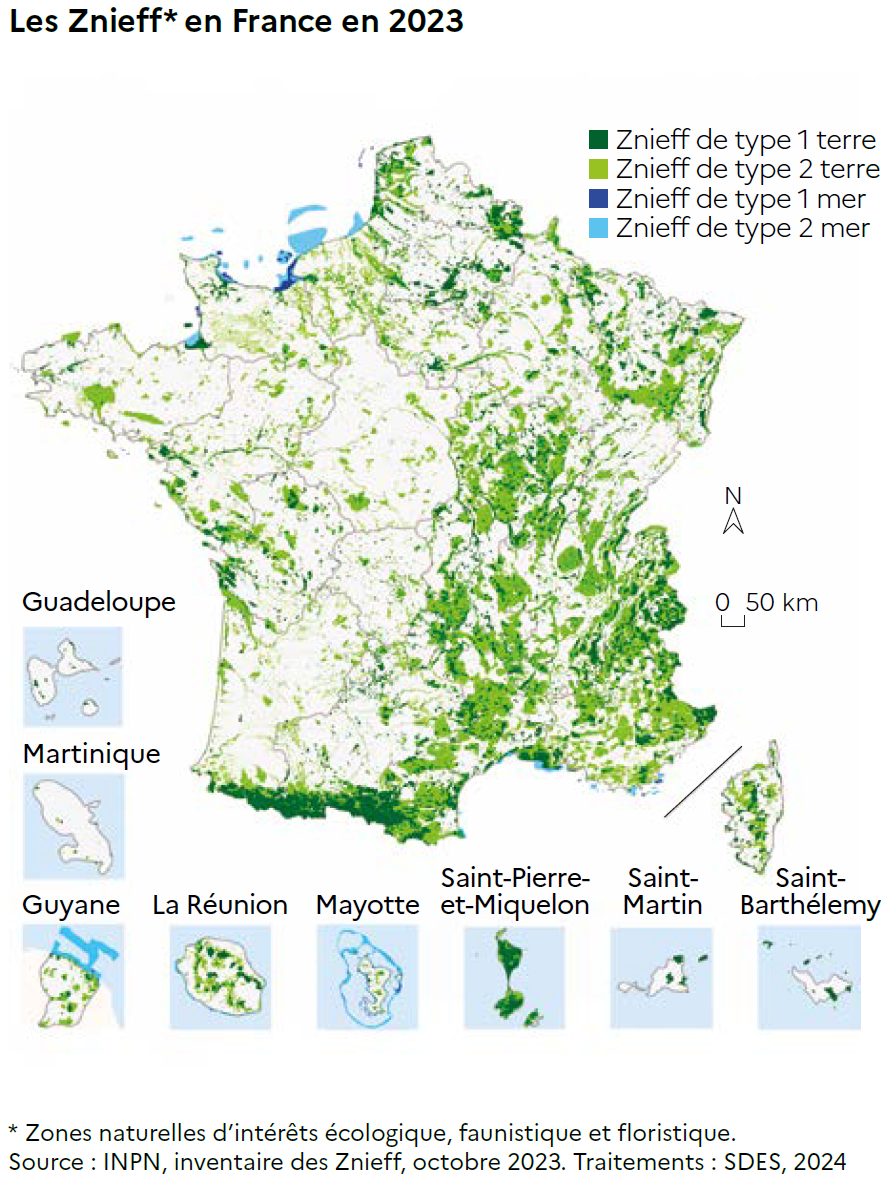
- What is a ZNIEFF (Zone of Natural, Ecological, Faunistic and Floristic Interest)?Program origins and scopeThis is a program launched in 1982 by the Ministry responsible for the environment and overseen by the National Museum of Natural History. It corresponds to an inventory of remarkable terrestrial natural spaces in mainland regions and the 5 overseas departments, as well as Saint Martin, Saint Barthélemy, and Saint Pierre and Miquelon. Two categories are distinguished:Two ZNIEFF types• Type I ZNIEFFs are small in area and are ecologically homogeneous spaces that contain at least one rare or threatened species or habitat of local, regional, national, or European significance. • Type II ZNIEFFs are large natural areas that are rich or little modified, offering significant biological potential; they may include Type I zones and have important ecological and landscape coherence.
- How does it work?Inventory validationThe ZNIEFF inventory is conducted regionally by specialists whose work is validated by the regional scientific council for natural heritage appointed by the regional prefect. At the national level, the National Museum of Natural History validates the work.Legal scope• This inventory is not a protected status. However, these natural zones are an expert resource for evaluating the impact of development on natural environments. Even though a ZNIEFF has no legal value, it must inform public authority decisions. • The courts have progressively given ZNIEFFs significant weight. Thus, failure to consider or respect a ZNIEFF frequently constitutes a manifest error of judgment. If an administration fails to respect a natural zone, it would be considered at fault.
- Status in 20232023 key figuresIn 2023, France had 19,847 terrestrial natural zones of interest, representing 30.2% of French terrestrial area, and 308 marine zones, representing 0.3% of French maritime space. Nearly 70% of French municipalities today host at least one of these zones.Overseas presenceThey are also present overseas, such as in Saint Pierre and Miquelon where the entire territory is covered by a zone of natural interest.Link with Natura 2000Historically, the ZNIEFF inventory helped establish the Natura 2000 network, which identifies protected areas within the European Union. It continues to play a crucial role in selecting habitats to preserve.
Further reading
- L’inventaire ZNIEFFnotre-environnement.gouv.fr
Lancé en 1982, l’inventaire des Zones Naturelles d’Intérêt Écologique Faunistique et Floristique (ZNIEFF) a pour objectif d’identifier et de décrire des secteurs présentant de fortes capacités biologiques et un bon état de conservation.