Les grands prédateurs
Cinq grands prédateurs sont présents en France : trois en métropole (le loup gris - canis lupus, le lynx boréal - lynx lynx, l’ours brun - ursus arctos) et deux en Guyane (le jaguar - panthera onca, le puma - puma concolor). Alors que les deux espèces ultramarines ne sont à ce jour pas menacées, les trois grands prédateurs rencontrés en métropole font l’objet de mesures de protection, suite à leur inscription sur la Liste rouge nationale des espèces menacées. L’aire de distribution occidentale des trois espèces métropolitaines, autrefois largement présentes en Europe, s’est réduite du fait de la chasse, de la destruction de leurs habitats et de la raréfaction de leurs ressources alimentaires.
Five large predators are present in France: three in mainland France (the grey wolf—canis lupus, the boreal lynx—lynx lynx, the brown bear—ursus arctos) and two in French Guiana (the jaguar—panthera onca, the puma—puma concolor). While the two overseas species are not currently threatened, the three large predators found in mainland France are subject to protection measures following their listing on the National Red List of endangered species. The western distribution range of the three mainland species, once widely present in Europe, has shrunk due to hunting, habitat destruction, and the rarefaction of their food resources.
- The return of large predators to mainland FranceRecolonization in mainland France• After completely disappearing from mainland France, the grey wolf and boreal lynx are gradually recolonizing certain mountain ranges in the east and south of mainland France. The brown bear remains vulnerable with a population of 70 individuals in the Pyrenean massif. Faced with the return of large predators, the challenge is to reconcile their preservation with the interests of the population, particularly those of the agropastoral sector.Golden jackalOften confused with the red fox and grey wolf, the golden jackal (canis aureus), another large predator naturally coming from Asia, arrived in France for the first time in Haute-Savoie in 2017.Felines of French GuianaHome to six species of felines, French Guiana is the only overseas territory hosting two other large predators: the puma (puma concolor) and the jaguar (panthera onca). Given the immensity of this territory and the presence of a difficult-to-access and little-known zone (the Amazon), surveying these species remains challenging.
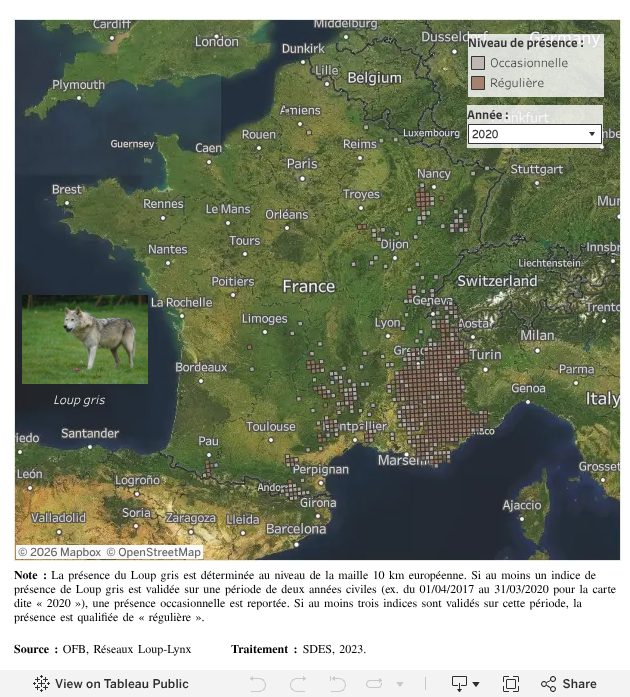
- The grey wolf: strong demographic and spatial expansionGlobal distributionThe grey wolf is the most widespread canid species in the world (across the entire Northern Hemisphere). Its distribution range covers a significant portion of Eurasia and North America.Recolonization history• Present on 90% of mainland French territory two centuries ago, the grey wolf disappeared from France at the end of the 1930s. At the end of the 1980s, the first evidence revealed the presence of grey wolves in the southern Alps. Its authenticated presence through natural recolonization was confirmed in the Mercantour National Park in 1992, originating from the Apennine chain in Italy. From there, it expanded throughout the Alps. Colonization continued in the Massif Central, the eastern Pyrenees, and the Vosges. Since 2011, its presence has been reported on the eastern periphery of the Paris Basin. It has also recently been spotted in Finistère. This recovery results from several factors: protection measures, the presence of numerous wild ungulates (roe deer, wild boar), agricultural abandonment (increasing forested areas and prey availability).Monitoring and population trends• Each year, the wolf-lynx network collects field evidence (fecal presence or prey carcasses, camera trap captures, howling recordings) to identify permanent presence zones (ZPP). In 2022, 157 ZPP were identified compared to 125 in 2021. Evidence collection has been strengthened since 2020 (2,600 indices in 2020, 3,700 in 2021, and 4,500 in 2022), allowing for more detailed monitoring. The number of grey wolves present in France during winter 2021-2022 is estimated between 826 and 1,016 individuals, compared to 783 the previous winter. This dynamic reflects the rapid expansion of the species and continues the overall trend observed since 1993. Over the entire period, the population has increased by an average of nearly 20% per year. This trend suggests that the species' survival rate is confirmed (viability threshold set at 500 individuals by the grey wolf national action plan). • With a satisfactory species survival rate and increased reproduction, the number of established wolf packs continues to grow. In 2021, 106 packs were identified at the end of winter compared to 20 in 2011.
- The boreal lynx: a fragile momentum underwayPopulation and range• Estimated at approximately 200 individuals in France and 9,500 in Europe, the boreal lynx population is developing again on French territory since the early 1970s. Monitoring its distribution range helps assess its population conservation status. Unlike irregular presence, regular presence identifies socially established specimens that can participate in breeding. In 2020, territories with documented regular boreal lynx presence cover 10,800 km² (+7% compared to 2019). The Jura core (8,600 km²) containing most of the population (between 74 and 108 individuals) is consolidating, with expansion of its range in the Alps (1,500 km² compared to 1,400 km² in 2019); its presence in the Vosges massif is weak, outside the Alsatian Jura (500 km²). The Alpine core is dispersed across the northern part of the massif and connects with the Jura core from which it originated. The species is now present across a large portion of France's eastern edge but remains partly dependent on Jura populations. Occasional detection of the species outside its regular range is being observed increasingly frequently (two visual observations in the Provence-Alpes-Côte d'Azur region in 2020). However, only recurrent detection of evidence can confirm the species' presence in these new territories.
- The brown bear: population is growing but species vulnerability persistsDemographic monitoring methodEach year, the brown bear population in the Pyrenees is determined from presence evidence collected by the brown bear network. Based on these demographic results, a Minimum Detected Number (EMD) is estimated annually across the Pyrenees, with the EMD from the previous year(s) also being re-evaluated in light of newly collected information to provide the Minimum Retained Number (EMR).Population structure and trends• In 2021, the EMD was 70 individuals. Excluding cubs of undetermined sex, the sex ratio is balanced with 34 females and 32 males. With 15 cubs born in 2021 and 19 subadults (below 3 years for females and 5 years for males), the population is predominantly young (80% under 10 years). Based on EMR changes (68 individuals in 2020), the average annual growth rate of the Pyrenean population can be estimated at 11.40% since 2006.Fragility of rangeIn 2021, the total range of brown bears in the Pyrenees covers approximately 6,500 km², a decrease of 1,700 km² compared to 2020. The western part of its range contains only one breeding female. Its future is thus not guaranteed despite a recent litter of three cubs. Although the number of individuals is growing, the brown bear population in the Pyrenees remains fragile.
- The golden jackal: a new large predator naturally arriving from AsiaArrival and expansion in France• Having arrived in Europe approximately 2,000 years ago, the golden jackal (canis aureus) was previously confined to southeastern Europe until 1960. Thanks to various protection measures favoring the expansion of large predators, this species then colonized northern and western Europe before arriving in France for the first time in Haute-Savoie in 2017. It was spotted in 2022 in Finistère as well as in several other locations (Deux-Sèvres, Bouches-du-Rhône, Essonne, and Alpes-Maritimes). In 2022, 19 presence records were reported.Protection status and coexistenceThrough natural expansion, this species is now part of Europe's natural heritage and is not considered an invasive exotic species. It benefits from certain protection measures ensuring it is neither hunted nor trapped (listed in Annex V of the Habitats Fauna-Flora Directive). However, its coexistence with other species such as the grey wolf or red fox needs monitoring, as the golden jackal could compete for food and habitat preferred by these two endemic species in our territories.
- The jaguar and puma: species present in French Guiana still poorly known2013 CNES study• In 2013, a study funded by the National Center for Space Studies (CNES) on jaguars using camera traps made it possible to estimate their abundance (3.22 individuals/100km²) and the species' home range (282 km² for males and 102 km² for females) over nearly half of the Guiana Space Centre (approximately 300 km²). Although this study focused on jaguar density, it also provided information on the abundance of other species such as the puma. At the four camera trap stations, 90 photographs of the species were taken (32 at Montagne Fer, 21 at Nouragues, 20 at Kaw, and 18 at Counami). This information makes it possible to estimate a puma home range of approximately 50 km². These estimates marked the beginning of the first large feline capture campaigns in French Guiana. Although attacks are more frequent in jaguars than pumas, they affect both livestock producers (farm animals) and individuals (domestic dogs) and generate conflicts between humans and these species.Attacks and coexistence management• Between 2010 and 2017, surveys conducted by the French Biodiversity Office (OFB) assessed jaguar attacks. Over this period, more than 120 attacks were documented, fatally affecting at least 300 animals. 47% of victims were goats/sheep, 37% domestic dogs, 13% cattle, 2% pigs, and 1% horses. The proximity of the forest promoting the presence of large predators near settlements means most attacks occur in developed areas (46%). Faced with this situation, in 2017, the OFB published a Human-Jaguar Coexistence Guide to inform local populations and established essential aspects of the biology, conservation, and knowledge of Guiana's large felines and their coexistence with humans and domestic animals. One year later, the multi-stakeholder project COFEEL (Feline-Livestock Coexistence), led by the Directorate General for Territories and the Sea (DGTM), developed actions to ensure sustainable coexistence at ecological, economic, social, and psychological levels between human activities and the preservation of large felines in French Guiana long-term.
- Measures necessary to protect large predators and agropastoral activitiesProtection of large predators• Listed on the Red List, mainland France's large predators are now threatened. In response, national action plans (NAP) have been implemented for the brown bear (NAP 2018-2028 for restoration and conservation of the brown bear in the French Pyrenees), the grey wolf (NAP 2018-2023 on wolves and livestock activities), and more recently the boreal lynx (NAP 2022-2026 for the boreal lynx). • The brown bear NAP aims to maintain the brown bear population by reconnecting two population cores; it also sets the objective of a minimum of 50 individuals by the end of the plan, support measures for herders facing predation, and promoting genetic diversity across the massif. • The grey wolf NAP aims to develop a new species management method based on better understanding of the species and its behavior to better protect it and enable protection of flocks and herders. • The boreal lynx NAP aims to establish a knowledge assessment and propose actions enabling the existence and sustainable cohabitation of this feline on the territory. • In parallel, the boreal lynx and brown bear are subjects of reintroduction programs. Within the Life Lynx framework, the German forest of the Palatinate, adjacent to the Vosges, received European Commission financial support for reintroducing 20 lynxes between 2016 and 2020. The first three animals, originating from Slovakia and Switzerland, were reintroduced in July 2016. An awareness and consultation campaign is underway with all stakeholders (hunters' federation, breeders' federation, North Vosges Regional Natural Park union) to improve feline acceptance in the territory. On 4 and 5 October 2018, two female bears were reintroduced in Béarn to supplement the current small population (2 males), marking a first since 12 years. • Other measures protect these species, such as creating protected areas (biological and natural reserves, Natura 2000 zones), limiting habitat fragmentation (installing wildlife crossing bridges over roads), or restoring connectivity between forest massifs.Impacts on agropastoral activities• With the increasing grey wolf population in France, stronger predation is being exerted on livestock in agropastoral areas. In 2022, 10,214 indemnifiable cattle (provisional data) were recorded. The Provence-Alpes-Côte d'Azur and Auvergne-Rhône-Alpes regions concentrate the majority of cattle victims of grey wolves eligible for or undergoing indemnification (respectively 45% and 36%). • A map of attack findings processed by competent administrative authorities and resulting in indemnification is available on Geopredateur. • Sheep (mainly domestic sheep) are the species group most hunted by grey wolves (92% of victims), far ahead of goats (5% of victims). Environmental factors (food availability, topography, proximity to forest cover, proportion of open space, distance to human infrastructure), pastoral factors (herd size, flock protection measures, domestic stock type), population factors (local bear density, number of nursing females, sex and age structure), or intra and inter-individual variability in predatory behavior can explain the pressure exerted by large predators on sheep flocks (see Gastineau thesis 2019, see § 5.2 ROB 2019 report). • As an exception to species protection provisions and to protect flocks that have suffered attacks, removal shootings, framed by the prefect coordinating Auvergne Rhône-Alpes, may be authorized. • Thus, in 2020, an ordinance (ministerial ordinance of 23 October 2020) sets the maximum number of grey wolf specimens whose destruction may be authorized annually. This allows destruction, under all prefectural derogations, of 19% of the estimated grey wolf population. The number of grey wolves killed under prefectural ordinance, stable until 2013, subsequently increased significantly as the number of documented grey wolf victims grew. In 2023, shooting authorizations could reach 174 individuals. Concurrently, this species has been subject to illegal killings in recent years (6 individuals in 2021, 8 in 2020). • The brown bear and boreal lynx can also pressure livestock. In 2021, on the French side of the Pyrenees, 331 attacks resulted in 570 animals killed or injured attributed to the brown bear (and 2 attacks on 6 destroyed beehives). In 2021, the number of flock attacks decreased compared to the previous two years (10% decrease compared to 2020). • In 2020, 102 boreal lynx attacks on flocks were recorded, mainly in the Jura massif. Associated mortality varies year to year, with no clear long-term trend emerging.Support for agropastoral activities• An indemnification system has been implemented to compensate for economic losses suffered by herders due to predation by the three large predators. In addition to this indemnification, funding for protection measures is offered to herders. • In 2020, total indemnification costs for damages (direct and indirect losses) reached €4.54 million (compared to €5.04 million in 2019), of which €3.96 million was allocated to grey wolves. • Over 10 years, indemnification amounts related to grey wolf predation have nearly quadrupled, and the number of indemnified findings increased from 984 in 2010 to 3,730 in 2020. • A similar trend is observed for indemnifications for damage caused by the brown bear. In 2020, the amount reached €583,537 compared to €89,086 in 2015, five times more, with the number of indemnified cases increasing from 93 in 2015 to 403 in 2020. • Boreal lynx attacks are less deadly. Between 2010 and 2020, between 40 and 102 attacks are recorded each year with the number of indemnified cattle ranging from 59 to 176 animals per year. • Since 2019, the ordinance on the environmental protection operation in rural spaces concerning flock protection against predation sets the list of possible aid to the agropastoral sector. In 2020, total spending on predation protection from grey wolves and brown bears stood at €29.71 million (€15.60 million financed by the European FEADER fund). In this same year, 2,790 cases were processed by state services to indemnify the agropastoral sector for livestock losses from large predator attacks. According to initial estimates, in 2023, this spending should exceed €35 million. These aids enable funding for flock herding and monitoring by an employee, service provider, or shepherd, deployment of protection dogs, or acquisition of equipment (electric fencing, etc.).
- Networks of correspondents to monitor and study populationsWolf–Lynx NetworkCreated in 1988, the boreal lynx network merged in 2001 with the grey wolf network to become the Wolf-Lynx Network, now coordinated by the French Biodiversity Office. This network of 4,500 correspondents, more than half (55%) of whom are state agents and regional natural park staff, with the remainder being individuals and volunteers, is deployed across nearly 40 departments in 2020 where one of the species is present (Vosges, Jura, Alps, Massif Central, and eastern Pyrenees). It monitors the demographic and range evolution of both species across the territory.Brown Bear NetworkFollowing the disappearance of the last brown bear in the central core in 1980, the state established in 1983 a large-scale scientific monitoring tool for the Pyrenean brown bear population: the Brown Bear Network. Currently coordinated by the French Biodiversity Office, the Brown Bear Network comprises a multi-partner correspondent group of over 450 professional members (state agents, naturalists and association members, hunters, mountain guides, shepherds/herders, individuals, and volunteers) who monitor and study the French brown bear population across 6 departments in the French Pyrenees. This network collects presence evidence across the species' entire range spanning several thousand square kilometers. Demographic and spatial analyses rely on combining opportunistic data and systematic monitoring. Individual identification uses genetic techniques and analysis of photographs from camera traps. Cross-border monitoring is coordinated within the Cross-border Brown Bear Monitoring Group in the Pyrenees (GSTOP).Necessary international cooperationEvolving across territories extending beyond borders, mainland France's large predators require monitoring that necessitates international cooperation. To enable a robust assessment of population status, sharing knowledge and practices allows pursuing a standardized and comparable approach between countries. The Large Carnivore Initiative for Europe brings together, for example, a college of experts whose mission is to exchange field experiences on ecological, sociological, or management aspects of these species. Other more operational groups such as the Status and Conservation of Alpine Lynx Population provide expertise to refine protocol operability (development of monitoring standards, preparation of expert assessments, etc.). More recently, in 2018, a network of scientists called Eurolynx was established to strengthen collaborative science on the Eurasian lynx.
Further reading
- Plan national d’actions en faveur du Lynx boréalplan-actions-lynx.fr
Ce site présente l’espèce, le plan national d’actions en faveur du Lynx boréal, les résultats de suivi, la gouvernance du plan et met à disposition les publications faites sur l’espèce ces dernières années. Plan national d’actions issu du site internet dédié.
- Loup et activités d’élevageauvergne-rhone-alpes.developpement-durable.gouv.fr
Page de la DREAL Auvergne-Rhône-Alpes dédiée au Loup gris et aux activités d’élevage
- Indicateur de présence des grands prédateurs en métropole – NatureFrancenaturefrance.fr
Indicateur de l’Observatoire national de la biodiversité présentant la part du territoire métropolitain avec présence régulière d’au moins un grand prédateur terrestre (Loup gris, Lynx boréal, Ours brun)
- Plan national d’actions 2018-2023 sur le Loup et les activités d’élevagebiodiversite.gouv.fr
Quatrième plan national d’actions dédié au Loup gris qui a pour objectif d’élaborer une nouvelle méthode de gestion de l’espèce, fondée sur une meilleure connaissance de l’espèce et de ses modes de vies, pour mieux la protéger et permettre également la protection des troupeaux et des éleveurs.
- Plan national d’actions 2018-2028 sur l’ours brunnotre-environnement.gouv.fr
Avec un effectif estimé de 150 ours au début du XX° siècle, la population a été en baisse constante jusqu’à ne plus représenter qu’un noyau résiduel de 5 individus, localisé en Béarn, en 1995.
- Présence des grands prédateurs en métropolenaturefrance.fr
8,2 % du territoire français abrite régulièrement au moins un grand prédateur terrestre (loup, lynx, ours). Indicateur publié sur le site Nature France.
- Données sur les dommages causés par le loupauvergne-rhone-alpes.developpement-durable.gouv.fr
Il s’agit des données relatives aux dommages causés par le loup. Données publiées par la DREAL Auvergne-Rhône-Alpes
- Rapport d’information de l’Assemblée nationale relatif aux conséquences financières et budgétaires de la présence des grands prédateurs sur le territoire nationalassemblee-nationale.fr
Rapport d’information publié par l’Assemblée nationale. La rapporteure formule 26 recommandations pour réformer la politique de protection du pastoralisme et pour réévaluer à une échelle pertinente la protection des grands prédateurs.
- Les grands félins en Guyane, entre gestion des conflits et amélioration des connaissancesnotre-environnement.gouv.fr
Article publié par Faune Sauvage, 2ème trimestre 2018.
- ONCFS : Réseau Loup - Lynxoncfs.gouv.fr
Le Réseau loup/lynx a été créé comme un outil de suivi patrimonial pour rendre compte des tendances d’évolution des aires de répartitions et de la démographie dans un objectif de mesurer l’état de conservation de ces deux espèces protégées.
- ONCFS : Réseau Ours brunsoncfs.gouv.fr
Le Réseau Ours Brun constitue un réseau d’observateurs multipartenaires susceptibles de recueillir des indices de présence de l’espèce sur l’ensemble de l’aire de répartition qui couvre plusieurs milliers de kilomètres carrés. Cette méthode assure un suivi extensif sur un large territoire tout en valorisant la compétence des personnes lors d’opérations de suivi systématique (itinéraires prédéfinis, stations de suivi …). Ces données recueillies sont ensuite analysées pour mieux comprendre le fonctionnement de la population d’ours bruns à travers des analyses comportementales, d’utilisation de l’espace ou d’interactions avec les activités humaines. Ainsi, une meilleure connaissance de la population établie sur les Pyrénées permet de répondre aux enjeux qui entourent cette espèce menacée en France.
- DREAL Rhône-Alples : Mission loupauvergne-rhone-alpes.developpement-durable.gouv.fr
Rubrique consacré au loup sur le site de la DREAL Rhône-Alples.