Les déchets ménagers en France : chiffres et enjeux pour l’environnement
En France, chaque habitant produit en moyenne environ 500 kg de déchets par an. Ces volumes importants ont des conséquences pour l’environnement, car il faut collecter, trier, stocker ou recycler ces déchets. Si la production de déchets a augmenté ces dernières années, des solutions existent pour inverser la tendance. Découvrez les chiffres-clés et les enjeux de la gestion des déchets ménagers en France.
In France, each inhabitant produces an average of approximately 500 kg of waste per year. These significant volumes have consequences for the environment, as this waste must be collected, sorted, stored or recycled. While waste production has increased in recent years, solutions exist to reverse the trend. Discover the key figures and challenges of household waste management in France.
- What are household and similar waste?Definition• Household and similar waste represents all waste produced by households and businesses collected by the public waste management service. It includes: • residual household waste (grey bin, green or black bin depending on the municipality) • separately collected waste (packaging, glass, paper) • occasional waste (bulky items, green waste, rubble and aggregate) • market waste, public green spaces and street waste when collected by the public serviceCollection figures• In 2021, the public service collected 615 kg of household and similar waste per capita per year, according to INSEE. • Excluding rubble and aggregate, this figure drops to 549 kg/inhabitant/year. • Considering only waste actually produced by households, excluding business waste collected at the same time, this volume is estimated at around 500 kg/inhabitant/year.
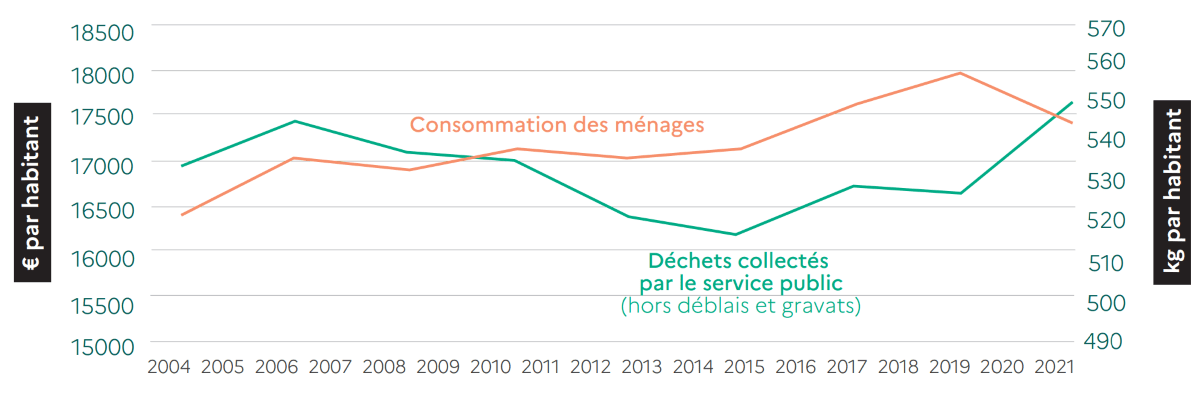
- Recent changes in household waste quantitiesTwo-phase trend• Since 2004, the quantity of household waste collected in France, excluding rubble and aggregate, has evolved. • Between 2007 and 2015, it decreased, falling from 544 kg/inhabitant to 514 kg/inhabitant. • Since 2015, it has risen again, reaching 549 kg/inhabitant in 2021.Link with consumptionThere is generally a link between consumption and waste production, except between 2019 and 2021, when waste increased despite a decline in consumption.AGEC law objectivesThis trend makes it harder to achieve the objectives of the anti-waste for circular economy law (AGEC), which aims for a 15% reduction in household waste between 2010 and 2030.Recovery and incineration (2011-2021)• Between 2011 and 2021, it is also noted that: • Half of all waste collected was recovered as material or organic input, a 11% increase over 10 years, but just below the national target of 55% set for 2020; • Two-thirds of residual household waste, after sorting, was incinerated to produce energy (Source: INSEE).
- Waste quantities vary widely by departmentDifferences between departmentsThe quantity of household and similar waste collected (excluding rubble and aggregate) varies significantly from one department to another in 2021 (Source: INSEE), ranging from 390 kg/inhabitant/year (Val-de-Marne) to 890 kg/inhabitant/year (Landes).Coastal tourist zonesThe highest volumes are concentrated in coastal tourist areas such as Landes, South Corsica (770 kg/inhabitant/year), Côtes-d'Armor (760 kg/inhabitant/year), Var (740 kg/inhabitant/year), Finistère (710 kg/inhabitant/year) and Alpes-Maritimes (690 kg/inhabitant/year). These differences can be explained by the presence of a tourist population, different consumption patterns and the diversity of collection systems.Urbanised areasConversely, urbanised departments in Île-de-France such as Paris (430 kg/inhabitant/year) or Rhône (410 kg/inhabitant/year) show significantly lower average quantities.
- Waste composition: untapped recovery potentialCollection breakdown• In 2021, household and similar waste collected by the public service consisted of (source: Ademe): • 40% thrown together in the 'grey bin' (246 kg per inhabitant) • 20% separately collected for recycling (122 kg per inhabitant) • 40% brought to waste disposal sites (242 kg per inhabitant)Grey bin contents• The contents of our grey bin show that much of it could actually be disposed of elsewhere. Nearly 80% of waste could be recovered differently: • 38% is biodegradable waste, such as food scraps or peelings, which could be composted instead of being incinerated or buried, • 40% is waste that could be recycled, such as packaging or everyday products, but ends up wrongly in the grey bin.
- Where does our waste go after collection?Residual household waste• All waste we throw out does not follow the same path; it depends on the type of collection. • For residual household waste (grey bin): • 67% is burnt to produce energy (heating or electricity), • 24% is buried in landfills without specific treatment, • 8% undergoes mechanical-biological treatment: it is partially sorted then sent to composting or anaerobic digestion.Separately collected waste• For separately collected waste (sorted): • 84% is sent to recycling, • 16% of biodegradable waste (peelings, food scraps, etc.) collected is composted or anaerobically digested to produce compost or biogas.Waste disposal site waste• For waste brought to disposal sites: • 43% is sent to recycling, • 25% is converted into organic material (such as compost), • 25% is stored without recovery, • 6% is used to produce energy.Overall balanceOverall, in 2021, 49% of household and similar waste collected by the public service was directed to recycling (33%) or composting and anaerobic digestion (16%).
- Four solutions to reduce our wasteSource sorting of biodegradable waste• Since 1 January 2024, source sorting of biodegradable waste has been made easier for everyone. This waste still represents a third of the weight of our household waste bins, or nearly 6 million tonnes per year. • By early 2024, 22.9 million inhabitants, more than one in three French people, were served by a source-sorted biodegradable waste solution.Incentive-based pricing• Incentive-based pricing consists of charging users based on the amount of waste they produce. When well-designed and supported, it can reduce residual household waste collection by an average of 10 to 20%. • In 2022, 220 municipalities applied incentive-based pricing rules affecting 7.2 million inhabitants, more than one in ten French people.Fighting food wasteIn France, 63 kg of edible food is wasted from production to consumption each year per person. The objective for food waste reduction is 50% by 2025 for food distribution and collective catering compared to 2015, and by 2030 for other sectors.Reducing single-use plastic packaging• France has set several objectives: • reduce single-use plastic packaging quantities by 20% by 2025 compared to 2018 levels, • achieve 100% recyclable plastic packaging by 2025, • achieve 10% reusable packaging, meaning it can be reused at least a second time, by 2027, • end single-use plastic packaging by 2040.
- Benefits of recycling for the environmentReducing environmental impacts• Recycling means avoiding certain production stages that are very energy-intensive with major environmental consequences. • In 2021, recycling of major materials such as metals, glass, papers, cardboard, plastics, helped prevent: • the emission of approximately 17 million tonnes of CO2 equivalent greenhouse gas, or about 5% of France's emissions on its territory • the consumption of approximately 34 TWh of fossil energy, which also represents about 10% of all nuclear-origin electricity production in France in 2024 (Source RTE).Raw materials for industry• Recycling also provides essential raw materials for French industry: • 71% of the paper industry, • 63% of the glass industry, • 43% of the steel industry.
Further reading
- Déchets chiffres-clés : L’essentiel - édition 2024librairie.ademe.fr
Ce document rassemble les données essentielles sur la production, la collecte, le traitement et la valorisation des déchets en France, avec un focus sur les déchets ménagers et assimilés. ADEME, août 2024
- Les déchets ménagers et assimilés : plus de 600 kg collectés par habitant en 2021, le tri en hausse de plus de 20 % en 10 aninsee.fr
INSEE Première, juin 2025
- Longue vie aux objets de l’ADEMElonguevieauxobjets.ademe.fr
Ce site, édité par l’ADEME, accompagne les citoyens dans le tri et la consommation responsable en leur proposant des conseils pratiques et des adresses locales pour réparer, partager, donner ou vendre leurs objets.