Les Demoiselles d’Avignon – Picasso «invente» le cubisme
5 chapitres
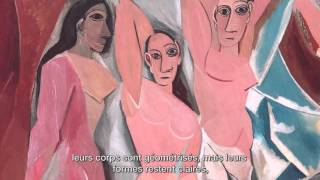
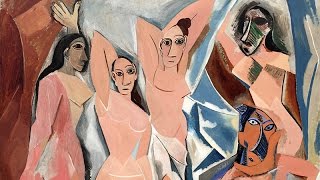
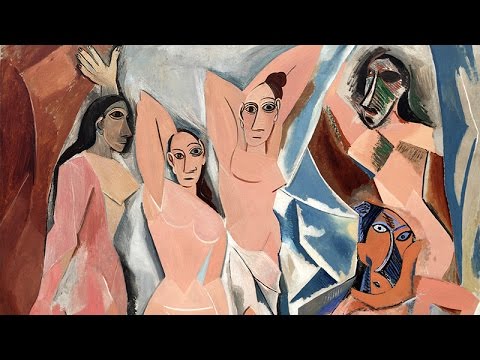
- The emergence of Cubism and its originsHistorical definitionCubism is considered the first true aesthetic break with the representation of reality. Dealer Daniel-Henry Kahnweiler locates its origins in 1907 with the famous canvas Les Demoiselles d'Avignon.Picasso's originsAfter visiting an exhibition of African tribal objects at the Trocadéro museum, Picasso completely reworked the right portion of the painting.Birth of the termThe term 'Cubist' comes from a reflection by Matisse before a painting by Braque entitled Houses at L'Estaque, dating from the same year 1907.Braque-Picasso collaboration• The collaboration between Braque and Picasso lasted a few years in a very close manner. • They did not sign certain paintings so that the work could not be attributed to one or the other. • Picasso, reluctant to engage in public relations, unscrupulously claims paternity of Cubism.
- Cézanne's legacy and Picasso's impostureThe true sourceThe true origin of Cubism goes back to Cézanne, not Picasso. A letter from Cézanne to Émile Bernard in 1904 provides its conceptual key.Cézanne's principlesCézanne recommends treating nature through the cylinder, sphere, and cone, putting everything in perspective so that each side of an object or plane is directed toward a central point.New visionCézanne relentlessly pursues a fusion of space and object, creating a pictorial field that is no longer a simple imitation of reality.Mutual recognition• Braque recognizes well before Picasso what he owes to the master of Aix-en-Provence. • Les Demoiselles d'Avignon seem to have overwhelmed Braque with their audacity and proximity to his own research.
- The spatial revolution of Les Demoiselles d'AvignonAcademic ruptureBy making two abstract spaces coexist in Les Demoiselles, Picasso deals a fatal blow to the principle of unity of academic space.Destruction of perspectiveBraque and Picasso together destroy space in perspective and limit the point of view to find a space revealing the truth of the object.New visionThis common search imposes a new conceptualized vision, later named Analytic Cubism, which transforms the logic of painting.Immediate consequencesThe abolition of classical space plunges Cubism toward abstraction, which dissatisfies Braque and Picasso.
- From Analytic Cubism to Synthetic CubismMaterial innovation• Artists incorporate letters, often stenciled. • They integrate foreign elements such as collages. • Use of materials like a piece of oilcloth in the famous Still Life with Caned Chair.New autonomySpace and color become autonomous. The object is no longer presented in order, but must be mentally recomposed by the viewer.Synthetic CubismThis phase authorizes a figurative freedom never achieved before, marking the beginning of Synthetic Cubism.Scientific contextCubism illustrates Einstein's theory of relativity, which questioned the uniqueness of Euclidean space and gave painting a transformed function.
- The impact and legacy of Cubism in modern artMovement's limitsCubism did not completely break with reality and did not produce a total rupture with figuration.Paths opened• Cubism paved the way for abstraction. • It prepared the ground for conceptual art. • It freed vision from pure observation.Conceptual evolutionIf the reality of vision was the obsession of realism in the nineteenth century, Cubism of the early twentieth century focuses on the mental experience of the artist facing the world.Historical importanceBy inheriting Cézanne's research, Cubism opened the way to all modern painting and can be considered the most decisive movement in contemporary art.