La pollution de l’eau par les nitrates
Les nitrates sont utilisés en agriculture pour permettre la croissance des végétaux. Ils sont apportés sous forme d’engrais à des sols appauvris pour améliorer le rendement des cultures. Très solubles dans l’eau, ils se diffusent et se retrouvent dans les eaux de surface (rivières, lacs, etc.) ou souterraines (nappes phréatiques). Quand ils sont en excès, ils ont un effet toxique sur l’environnement et notre santé.
Nitrates are used in agriculture to allow plant growth. They are added in the form of fertilizer to depleted soils to improve crop yields. Highly soluble in water, they spread and are found in surface waters (rivers, lakes, etc.) or groundwater (aquifers). When in excess, they have a toxic effect on the environment and our health.
2 chapters
- Nitrates: What Are They?Nitrogen in Soil• Nitrates are a form of nitrogen. Nitrogen is an important nutrient for plant growth. It occurs naturally in soil: • in organic form (plant remains, animals, microorganisms…) • in mineral form (nitrates, ammonium, ammonia...) • Plants absorb nitrogen mainly in the form of nitrates.Nitrogen FertilizersWhen plants are harvested, nitrogen leaves the soil. To compensate for this loss and maintain fertile soils, nitrogen fertilizers are used. These fertilizers can be produced directly on the farm (organic fertilizers) or purchased (organic fertilizers or chemical fertilizers). 90% of the nitrogen found in the environment comes from agriculture (the rest comes from households or certain factories).Leakage into WaterWhen there is too much nitrogen fertilizer, nitrates, which dissolve easily in water, can infiltrate groundwater aquifers or flow into surface waters.Effects on Health and Environment• These nitrate leaks have effects on our health and environment • captured water must be treated and monitored to remain drinkable • in excessive quantities in rivers and coastal areas, nitrates increase the amount of green algae which, as it decomposes, releases hydrogen sulfide, a gas toxic to humans and animals
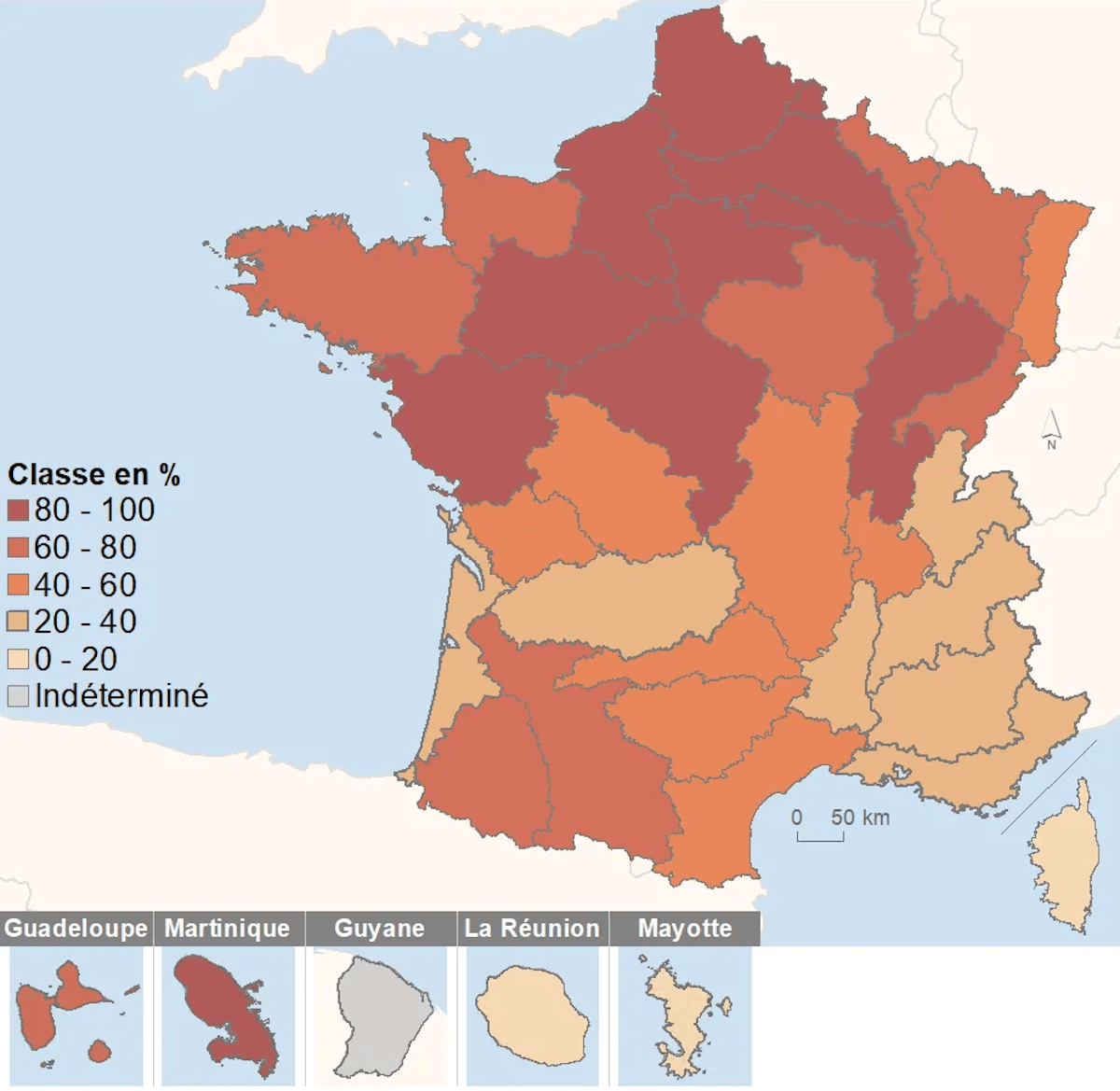
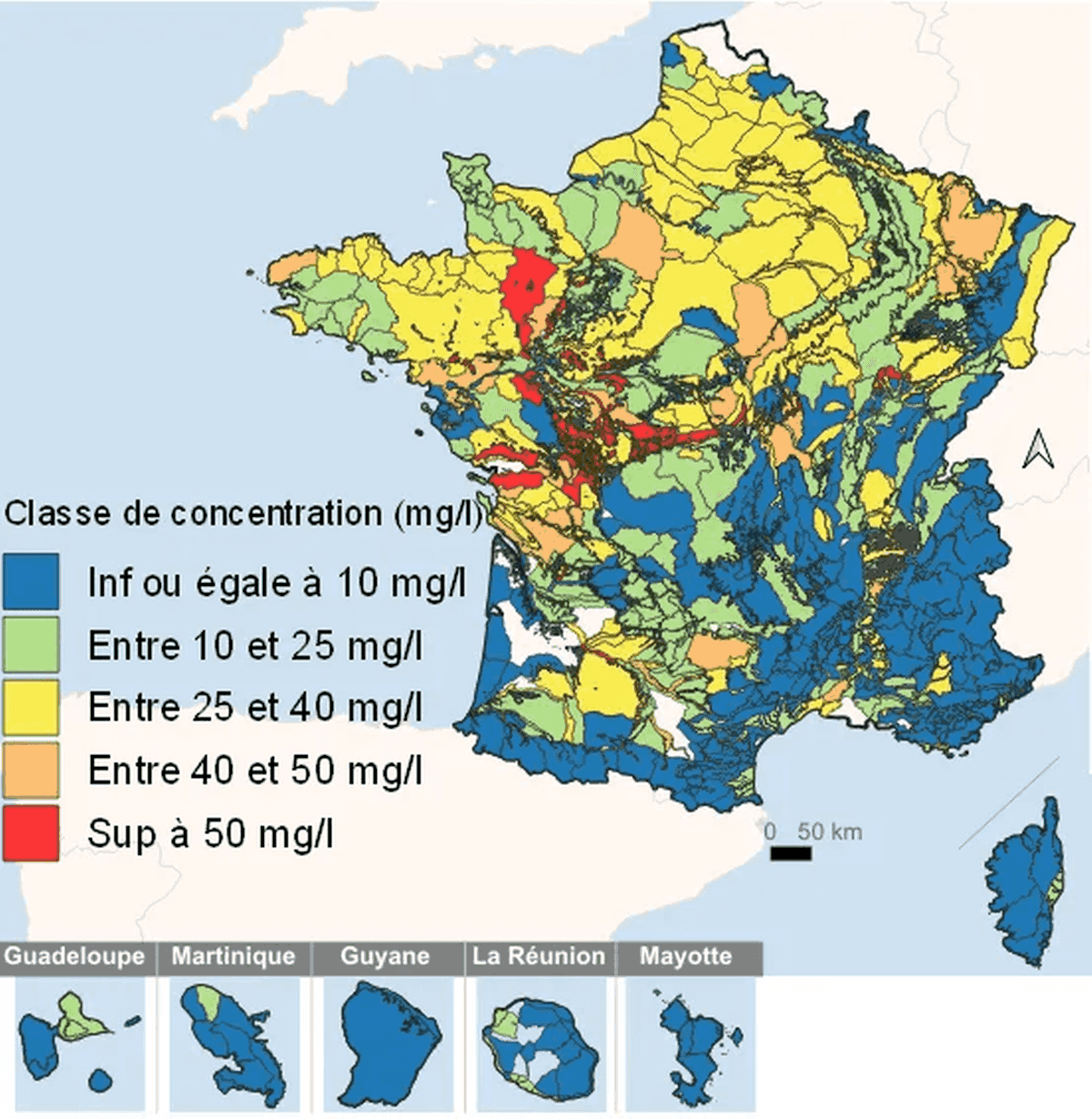
- Nitrates: How Are They Changing?Sales Declining• The total amount of nitrogen sold, relative to the area of land that can be fertilized: • was 57 kg per hectare in 1972-1973 • increased significantly between the 1970s and 1990s • remained around 85 kg per hectare from the early 1990s to the end of the 2010s • Since 2018-2019, this quantity has been decreasing: it has fallen below 70 kg per hectare. This decline is explained by aid to farmers, actions taken in sensitive areas, and measures to better use animal manure as fertilizer. This helps limit water pollution from nitrates.Nitrates in Groundwater• Nitrates, along with pesticides, are the pollutants most commonly found in groundwater in France. Between 2000 and 2022, the amount of nitrates in aquifers remained globally stable at the national level. • Year-to-year variations are often due to weather: there are fewer nitrates during dry years and more during very rainy years (because rain carries nitrates present in soil toward aquifers). • Southern France is less affected than northern France. In the Loire-Brittany, Rhine-Meuse, Artois-Picardy, and Seine-Normandy regions, 24% of shallow aquifers exceed 40 mg of nitrates per liter of water (mg/liter), compared to only 8% in the south. • In overseas departments and regions, no aquifer exceeds 40 mg/liter: concentrations range from 10 to 25 mg/liter. • Nitrate concentration in groundwater for the period 2019-2022Nitrates in Surface Water• In rivers, the amount of nitrates remained stable between 2000 and 2023, as it has over the past ten years, with an average of approximately 15 milligrams per liter. The highest concentrations are found in northern France, especially in Brittany and Normandy. • Nitrate concentration in surface water for the period 2019-2022
Further reading
- La pollution des eaux superficielles et souterraines en France - Extrait du Bilan environnemental 2024statistiques.developpement-durable.gouv.fr
La pollution des eaux superficielles et souterraines constitue une problématique environnementale majeure, affectant la qualité de l’eau potable, des écosystèmes aquatiques et des activités humaines. Analyse des principaux polluants de l’eau et de leur évolution par le Service des données et études statistiques.