La pollution de l’eau par les pesticides
Les pesticides sont souvent utilisés en agriculture pour augmenter la production des cultures. Mais ces produits ne restent pas là où on les utilise : ils peuvent se répandre dans la nature, en s’évaporant ou en étant emportés par la pluie. C’est pourquoi on les retrouve dans les eaux de surface (les rivières, les lacs, etc.) ou dans les eaux souterraines (les nappes phréatiques).
Pesticides are often used in agriculture to increase crop production. But these products do not stay where they are applied: they can spread into nature by evaporating or being carried away by rain. This is why they are found in surface water (rivers, lakes, etc.) or in groundwater (aquifers).
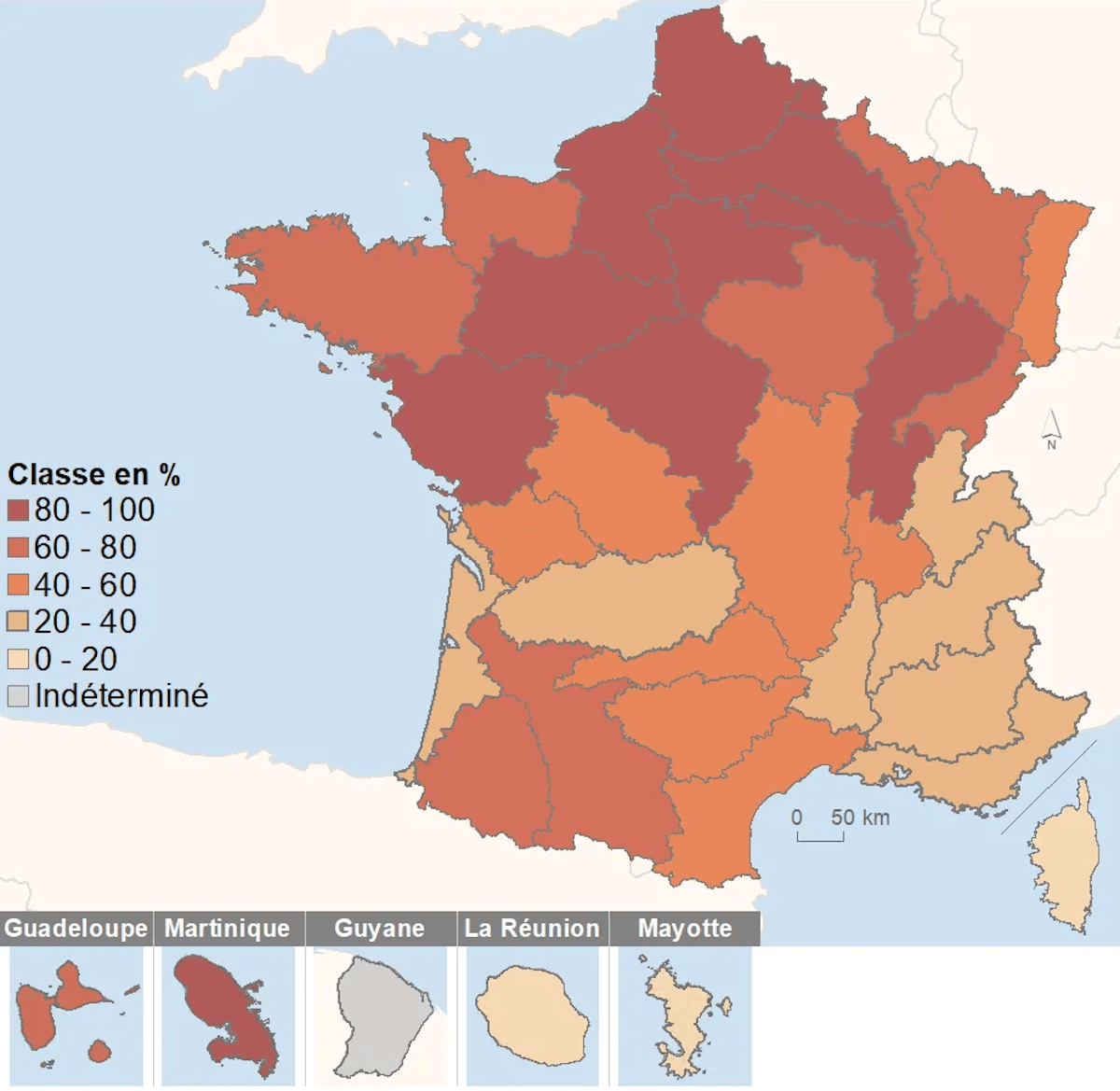
- Pesticides and water pollutionIntroduction• Pesticides degrade slowly. The active substances they contain, or the products resulting from their degradation (called "metabolites"), remain present in the environment. They then pollute the air, soil, water, food chain, and therefore our food. • Since these pesticides can move through different environments, they pose varying degrees of risk to humans and ecosystems, whether in the short or long term. • Quality controls of rivers and groundwater show that pesticides are present in most aquatic environments. • The highest concentrations are observed in heavily cultivated regions, areas with extensive fruit trees, or wine-growing areas. Only mountainous zones or regions with little agricultural land, such as permanent grassland, are less affected.Pesticides in surface water• Pesticides are present in nearly all monitored locations (in waterways or bodies of water): • in mainland France, mainly herbicides (pesticides that kill weeds) and their metabolites are found; • in overseas France, mainly insecticides (pesticides that kill insects) and their metabolites are found. • Pesticide pollution is considered severe when the Cumulative Pesticide Toxic Pressure Index (IPTC) exceeds 1. Since 2008, this index has exceeded 1 on all sizes of waterways and at approximately 1 out of every 2 monitored sites. • Share of monitored rivers where the IPTC-pesticides index exceeds 1 for the 2020-2022 period – In % • The regions most affected by river pesticide pollution are located in northern France and Martinique: • in mainland France, this pollution is mainly caused by 5 herbicides used in agriculture, • in overseas territories, it comes from 3 herbicides and 1 insecticide. Some of these products have been banned since before 2018.Pesticides in groundwater• Groundwater (aquifers) is also affected by pesticides, both in mainland France and in overseas departments and regions (DROM): • in mainland France, mainly herbicides and their metabolites are found; • in overseas departments and regions, both insecticides and herbicides are present. • Between 2019 and 2022, of the 782 pesticides monitored in mainland France, 588 were detected at least once in aquifers. Over the same period, of the 689 pesticides monitored in DROM, 160 were detected at least once. • Among the most frequently detected pesticides are substances (and their degradation products) that have been banned for several years. This is the case, for example, with atrazine, banned since 2003, but which was used extensively for 40 years. • Top 15 pesticides and their metabolites most frequently detected in mainland France groundwater for the 2019-2022 period – In % • Top 15 pesticides and their metabolites most frequently detected in DROM groundwater for the 2019-2022 period – In %Mixed pesticides in rivers• When multiple types of pesticides are found in the same river, this is called "mixed pesticides." In this case, it is very likely that the IPTC will exceed 1, which can have significant consequences for the environment. • The risk often increases in summer. This increase is likely linked to seasonal variations in water levels and the periods of use of plant protection products (pesticides used only on plants) in mainland France. Indeed, unlike winter, the period from April to September corresponds to low water levels in rivers and high agricultural activity. • In mainland France, between 2015 and 2017, 29 of the 55 watersheds (area where rainwater flows) had more than 80% of measurement points with risk levels considered unacceptable. Among these 29 watersheds, 28 were located in the northern half of the country.
- How to find out about tap water quality in your region?Tap water monitoringIn France, the tap water we drink and use daily is one of the most closely monitored products. It is continuously controlled to ensure it is safe for your health. Direct access to test results conducted by Regional Health Agencies (ARS) allows you to learn more about the water you consume.
Further reading
- Pesticides : quels usages, quelles conséquences ?notre-environnement.gouv.fr
Utilisés en agriculture, les pesticides peuvent nuire à la santé et à l’environnement. Usages, risques, exposition : où en est-on en France ?
- Retrouvez toutes les informations sur la qualité de l’eau potable de votre régionsante.gouv.fr
- La pollution des eaux superficielles et souterraines en France - Extrait du Bilan environnemental 2024statistiques.developpement-durable.gouv.fr
La pollution des eaux superficielles et souterraines constitue une problématique environnementale majeure, affectant la qualité de l’eau potable, des écosystèmes aquatiques et des activités humaines. Analyse des principaux polluants de l’eau et de leur évolution par le Service des données et études statistiques.
- Détecter et surveiller les pesticides dans l’eau du robinetanses.fr
Afin de garantir la santé du consommateur, l’Anses (Agence nationale de sécurité sanitaire de l’alimentation, de l’environnement et du travail) fournit à la Direction générale de la santé les repères scientifiques utiles à la surveillance de la qualité de l’eau du robinet.