Un "Plan Eau" pour aider l’outre-mer à traiter les eaux usées
En France métropolitaine, le traitement des eaux usées est globalement satisfaisant grâce aux collectivités locales chargées du financement, de l’assainissement et de la maintenance des équipements. La situation est moins favorable dans les cinq départements et régions d’outre-mer (DROM), ce qui a des conséquences sur l’environnement et la santé. Coordonner les acteurs locaux autour de projets concrets fait partie de la solution.
In mainland France, wastewater treatment is generally satisfactory thanks to local authorities responsible for financing, sanitation and equipment maintenance. The situation is less favorable in the five overseas departments and regions (DROM), which has consequences for the environment and health. Coordinating local stakeholders around concrete projects is part of the solution.
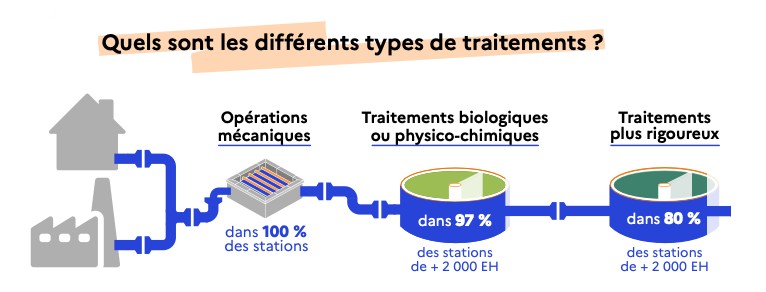
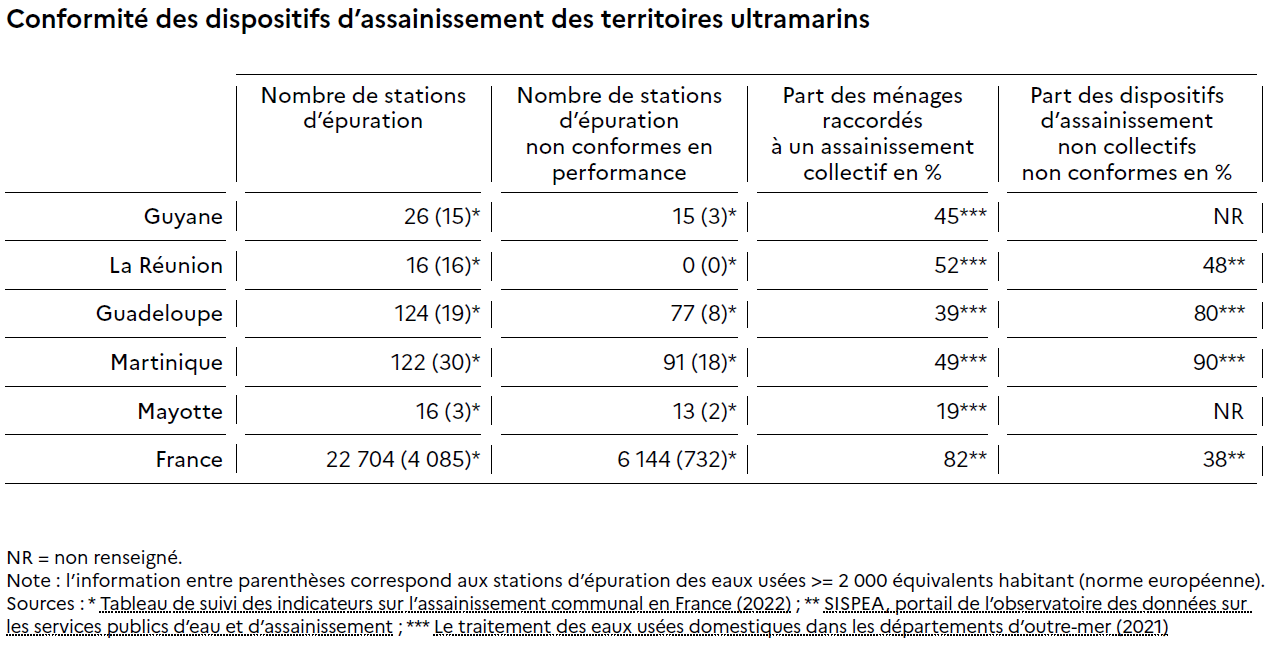
- Wastewater Treatment: Current StatusSanitation Management• In the DROM, domestic wastewater sanitation is managed by: • local authorities such as municipalities or groups of municipalities (wastewater collection networks, treatment facilities); • private individuals or groups of individuals. • Once treated, water flows into rivers, lakes, seas and oceans, soil and groundwater. Ecosystem health is therefore linked to: • the efficiency of wastewater treatment systems; • compliance with regulations (equipment conformity, treatment capacity based on water volume, etc.).Insufficient Connection• In the DROM, the proportion of the population not connected to a treatment plant often exceeds 50%. Living standards prevent residents from investing in an effective sanitation system or its maintenance. Almost all existing individual systems do not function properly. • With the exception of Réunion, half of collective installations do not comply with regulations due to problems in managing public sanitation services (difficulty collecting bills, adaptation to growing populations, etc.). • The DROM are often islands with salt-rich atmospheres or emissions from decomposing algae such as sargassum. This further promotes corrosion of sanitation equipment.Observed ConsequencesBeyond ecosystem degradation, there are other consequences: odor and visual nuisances, difficulty producing drinking water at reasonable cost, negative impact on tourism, etc.
- The Water PlanWhat Is Its Purpose?• For all these reasons, the "Water Plan DROM" was established in 2016. • The Water Plan aims to: • strengthen the governance of local authorities; • develop their technical and financial capacity; • improve maintenance and upkeep services; • integrate water policies into territorial planning. • It commits public authorities by supporting local authorities through financial resources, engineering, training, studies and expertise. • It is addressed to: elected officials, administrations, public institutions, consultation assemblies, public financial institutions, etc. • Within the Water Plan framework, overseas local authorities have the option to sign a "progress contract." This is a five-year agreement signed between the State, local authorities and partners to improve water quality and sanitation. Each contract serves to: • plan investments; • pool financing; • organize dialogue among different stakeholders; • fund studies to properly prepare and carry out the project.A Concrete Example• Mayotte offers a striking example. • In 2021, only 19% of Mahorais households were connected to collective sanitation (81% in mainland France). • In 2022, 67% of treatment plants handling wastewater from over 2,000 residents did not comply with legal requirements. • Thanks to the progress contract: • construction of a new treatment plant, which will handle wastewater from 60,000 residents, began in Koungou in August 2023; • the first stone of a future treatment plant was laid in Mamoudzou Sud in May 2025.
Further reading
- Plan Eau : Pour une gestion durable de l’eau potable et de l’assainissement dans les Outre-merecologie.gouv.fr
Dans les territoires d’outre-mer, les services publics d’eau potable et d’assainissement sont confrontés à des difficultés spécifiques qui constituent des freins au développement social, économique et sanitaire et à la préservation de la biodiversité. Le Plan Eau s’adresse aux collectivités gestionnaires de services d’eau potable ou d’assainissement de six territoires d’outre-mer pour offrir aux usagers une meilleure qualité de service en matière de distribution d’eau potable et d’assainissement.