Le traitement des eaux usées : comment protège-t-il l’eau et l’environnement ?
Chaque jour, les eaux usées doivent être traitées avant d’être rejetées dans l’environnement. En France, environ 22 800 stations d’épuration collectent ces eaux usées. Sans traitement, ces eaux dégraderaient la qualité des cours d’eau et pourraient perturber les milieux aquatiques. Le traitement des eaux usées joue donc un rôle essentiel dans la protection de l’environnement et de la santé.
Every day, wastewater must be treated before being released into the environment. In France, approximately 22,800 treatment plants collect this wastewater. Without treatment, these waters would degrade the quality of waterways and could disturb aquatic ecosystems. Wastewater treatment therefore plays an essential role in protecting the environment and public health.
6 chapters
- What happens to wastewater after it leaves homes?Collective sanitation networkIn France, 82% of the population is connected to collective sanitation, also known as the "sewer system". Wastewater is discharged through approximately 400,000 km of underground pipes (equivalent to the distance from Earth to the Moon) to a wastewater treatment plant (WWTP), commonly called a treatment station. There it is treated to remove a large portion of pollutants before being released into the environment, most often into a waterway or sea (source for all data on this page: SDES, 2023 figures).Source of collected water• Treatment plants do not only process household wastewater: they also receive wastewater from businesses and many public buildings, such as schools or hospitals. This includes water used in toilets, sinks, or for cleaning facilities. • Industrial activities can produce wastewater containing pollutants in large quantities. Depending on the pollutants, the water may require special treatment before joining the collective network. Some industrial sites have their own treatment facility.Key figures 2023In 2023, 22,827 treatment plants were operating in France. They treat 7 billion cubic meters of wastewater annually. Together, they have a treatment capacity corresponding to approximately 106 million population equivalents (PE). This unit of measurement corresponds to the amount of organic pollution produced in one day, from both residents and economic activities.Collective vs. individual sanitation• When homes are connected to a public network, their wastewater is collected and sent to a treatment plant. Collection and treatment are managed as a public service run mainly by local authorities: this is collective sanitation. • In areas where homes are more spread out, they may not be connected to this network. Wastewater is then treated on-site using an individual installation. This might include a tank that collects wastewater and a system that treats it. This is called individual sanitation. • This article addresses collective sanitation only.
- Where does the water treated in treatment plants come from?Household drinking waterMuch of the water arriving at treatment plants is drinking water used in daily activities: toilet water, showers, sinks, washing machines, etc.Business withdrawalsOther wastewater can enter the network. Some businesses or facilities, for example, use water they draw directly from a river or groundwater. When connected to collective sanitation, this water is then sent to a treatment plant.RainwaterRainwater can also reach treatment plants. This occurs in areas with a "combined" network system, where wastewater and rainwater are collected in the same pipes. As rainwater flows over roofs and streets, it can pick up various pollutants before entering the network.
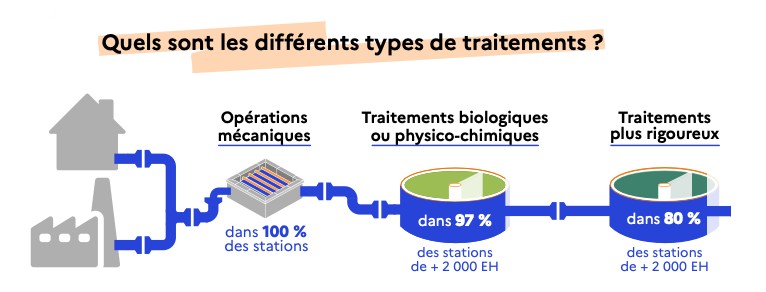
- How does a treatment plant work?Treatment stages• In a treatment plant, wastewater passes through several stages. Each one removes some of the waste or pollutants it contains: • pretreatment first removes the easiest elements to separate: large waste is retained by screens (screening), sand settles (desanding), and oils and grease are recovered from the surface (degreasing); • primary treatment continues this mechanical separation: remaining matter in the water settles to the bottom of a basin through sedimentation; • secondary treatment, most often biological, addresses organic matter. Microorganisms, mainly bacteria, consume and break it down. This treatment is mandatory for wastewater from sanitation systems of 2,000 population equivalents or more; • tertiary treatment (also called "advanced" treatment) can supplement these stages. It can particularly reduce nitrogen and phosphorus levels. Not all plants use this final treatment level. Requirements depend on the pollution load to be treated and where the water is discharged. In 2023, 887 of 963 relevant plants had mandatory tertiary treatment, roughly 9 out of 10.Towards greater wastewater reuseToday, nearly all treated wastewater is discharged into the natural environment. But with more frequent droughts, France is seeking to reuse part of it for agricultural irrigation, green space watering, or urban cleaning. Some experiments even aim to transform wastewater into drinking water. This practice is not yet authorized on a large scale in France.
- What happens to treatment sludge?Sludge composition and treatment• By cleaning wastewater, the plant removes some of the matter and pollutants it contains. Much of this ends up in treatment sludge. This is a residue composed mainly of water, organic matter, and mineral salts. • When sludge leaves treatment, it still contains a lot of water. It can be dewatered and undergo other treatments to reduce its volume, odors, and potential risks. • In 2023, French treatment plants produced approximately 1.1 million tonnes of sludge in dry matter. This unit allows measuring only the quantity of matter in the sludge, without accounting for the water it contains.Recovery methods• Sludge can be used or treated in several ways: • 50% is transformed into compost, which can then be used to enrich soil; • 35% is used directly in agricultural spreading: it is distributed on cultivated land to provide organic matter and fertilizing elements; • 12% is incinerated, sometimes with heat recovery; • 1.2% is anaerobically digested to produce biogas; • 1.8% undergoes other treatments, including landfill disposal.Agricultural spreading regulationsThe use of sludge on agricultural land is regulated. Before spreading, its content of certain pollutants must meet limit values. The quantities used and the parcels where sludge is spread must also be monitored.
- Is water released into nature safe?Risk situations• Before being released, water must be treated sufficiently to meet required standards. • Two situations warrant particular attention: • during heavy rainfall, large amounts of water can reach networks at once that collect both wastewater and rainwater. To prevent overflow, part of this water may be released without undergoing all treatment stages; • some pollutants remain difficult to eliminate completely with current treatments. This is particularly true for certain micropollutants, present in very small quantities.Ecological water statusWastewater treatment reduces pollution discharges into waterways, lakes, and seas. But alone, it is not enough to guarantee good water quality. In 2022, 44% of surface water bodies were in good ecological condition, compared to 41% in 2010. Waterways are indeed subject to other pollution sources, particularly pesticides used in agriculture (source: France's Environmental Report 2025).Why do wastewater treatment rules evolve?• Since 1991, a European directive has set the main rules for wastewater collection and treatment: the Urban Wastewater Treatment Directive, or UWTD. • This directive was revised in 2024 to progressively strengthen wastewater treatment. It notably provides for better treatment of certain micropollutants, reducing untreated wastewater discharges during heavy rainfall, and extending obligations to more sanitation systems. • These new rules must be integrated into French law by July 31, 2027.
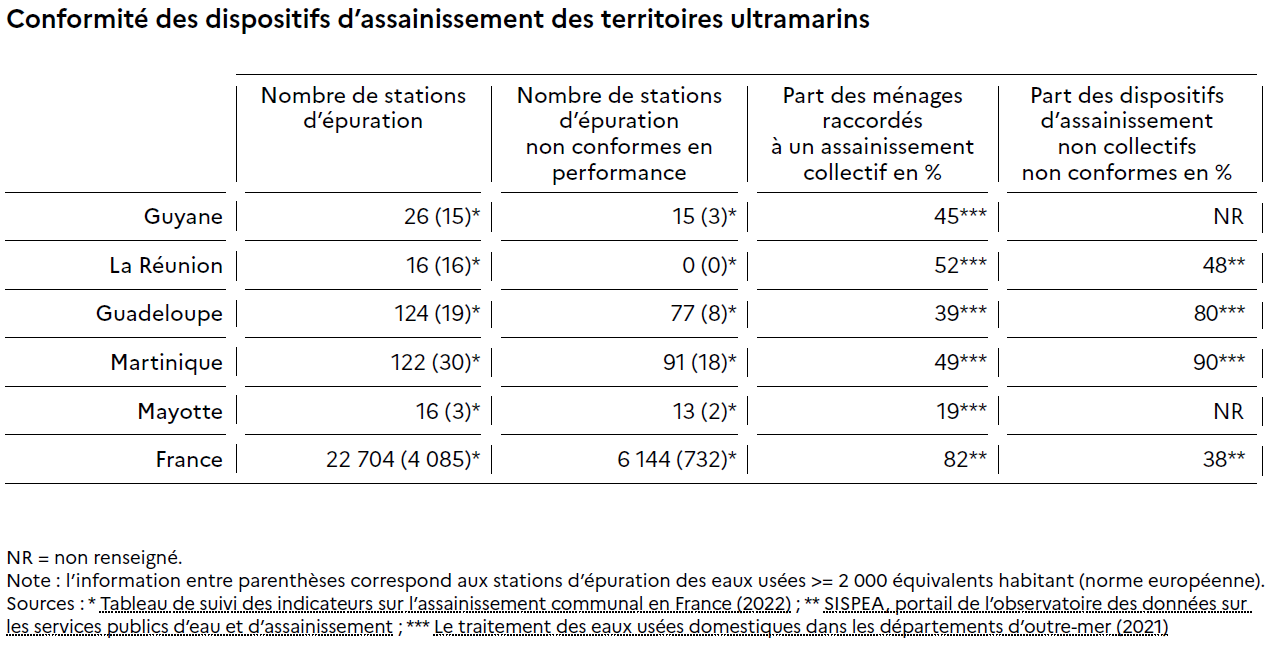
- Is wastewater treatment effective in France?Annual inspectionsThe operation of sanitation systems is inspected annually.2023 compliance• In 2023, among plants serving agglomerations of 2,000 population equivalents or more: • 90% were compliant in terms of equipment, meaning they had the facilities required by regulation; • 68% were compliant in terms of performance, meaning they met required treatment levels.SummaryThus, treatment plant equipment is largely compliant, but performance falls below standards in nearly one-third of cases.
Further reading
- La pollution de l’eau par les pesticidesnotre-environnement.gouv.fr
Les pesticides utilisés par l’agriculture sont une source de pollution des eaux de surface et des nappes d’eau souterraines.
- Connaître l’état de fonctionnement de la station de traitement des eaux usées de sa communeassainissement.developpement-durable.gouv.fr
Le ministère de la Transition écologique met à disposition les dernières données collectées dans le cadre du suivi de la conformité des stations d’épuration.