La contamination des sols par les métaux
Cadmium, mercure, plomb, cuivre, nickel… les métaux sont naturellement présents dans les sols avec le volcanisme et l’érosion des roches. Mais les activités humaines (agriculture, industries, extraction minière, transports…) génèrent aussi des pollutions qui les disséminent partout. Toxiques pour l’environnement et pour les humains, parfois même à faible dose, ces métaux font l’objet d’un suivi environnemental et sanitaire.
Cadmium, mercury, lead, copper, nickel… metals naturally occur in soils through volcanism and rock erosion. But human activities (agriculture, industries, mining, transportation…) also generate pollution that disperses them everywhere. Toxic to the environment and to humans, sometimes even at low doses, these metals are subject to environmental and health monitoring.
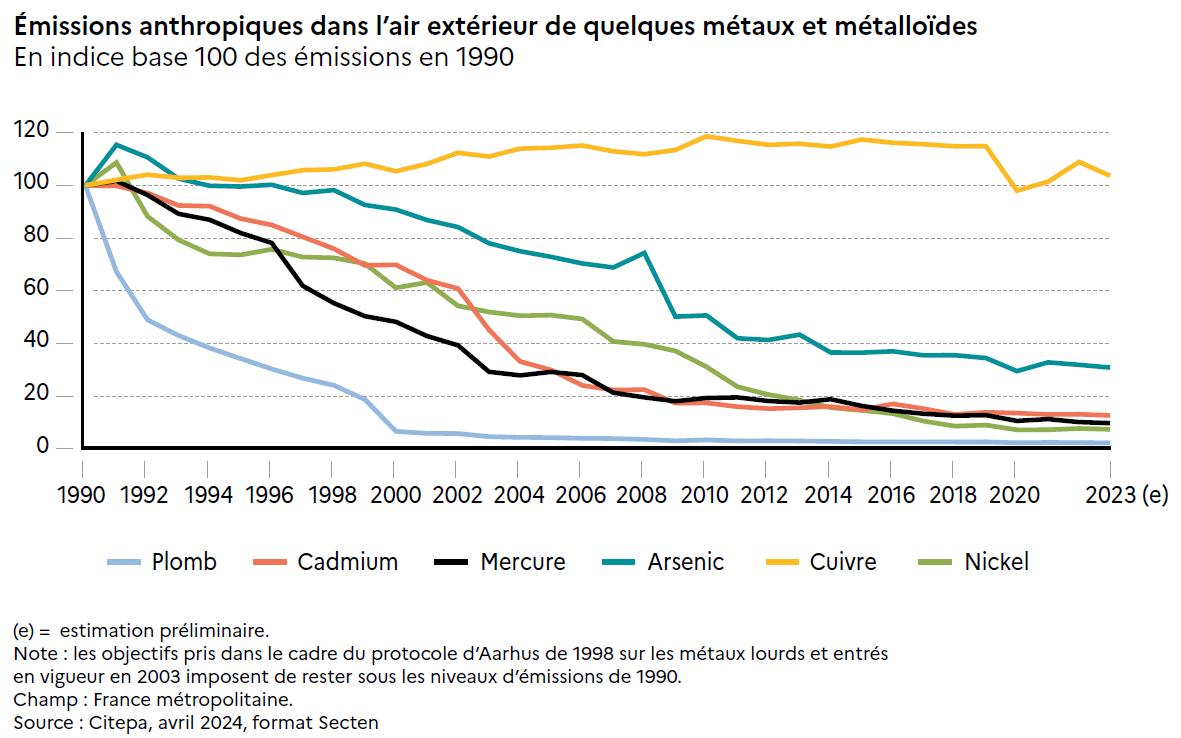
- Why are there metals in soils?Natural soil presence• Metals (copper, lead, nickel, etc.) and metalloids (boron, arsenic, etc.) naturally occur in soils. They are part of what is called the "natural geochemical background." • High concentrations of chromium, nickel and zinc appear for example in soils developed in Jurassic rocks, while lead levels are linked to crystalline rocks. Volcanic rocks, in turn, give rise to high concentrations of chromium, copper, nickel and zinc.Human activity pollution• Current or past human activities can, however, increase metal concentration levels in soils relative to this natural geochemical background. Some of these pollutions have diffuse origins, notably linked to emissions into outdoor air. • From 1990 to 2023, emissions into outdoor air from human activities have generally decreased in France, except for copper. These improvements follow action plans implemented and regulatory changes. In 2023, France met its international commitments for cadmium, mercury and lead releases into outdoor air. The origins of metals and metalloids are variable, but the largest contributions come mainly from industry and transport. • In addition to this diffuse pollution, localized pollution can occur, observed near contaminated sites from human activity. This is notably the case for pollution identified in the large Aquitaine and Paris basins where the geochemical background shows very low values, with no risk to human health. In 2023, more than half of the 3,316 identified contaminated sites and soils are polluted by heavy metals (1,748 sites), 23% by arsenic (768 sites) and 13% by mercury (445 sites).Environmental and health effects• Toxic sometimes even at very low doses to humans, fauna and flora, metals can pollute ecosystems through food chains and water. • In humans, metals accumulate in the body. Over a shorter or longer term, and for chronic exposures, heavy metals produce respiratory disorders (arsenic, cadmium, nickel), cardiovascular (arsenic), neurological (lead, arsenic) and kidney disease (cadmium). Some are classified as carcinogenic to humans (arsenic, cadmium, nickel). Mercury can deposit in water or soil, form new toxic elements and pollute living things through accumulation in the body, mainly via the food chain, particularly with fish (source). • At the environmental level, metallic particles create deposits that pollute soils, water and the food chain. They also accumulate in living organisms, affecting the health of fauna and flora.
- Different metals polluting soilsArsenic• A metalloid toxic to humans and the environment, arsenic can pollute groundwater due to its mobility in the environment. Geology explains the main variations of arsenic in mainland France and, to a lesser extent, human activities: past use of lead arsenate as a pesticide in vineyards, residual presence in certain mineral fertilizers, or releases from industrial or mining activities. • In France, 16% of monitoring points in the soil quality measurement network (RMQS) show a content above 25 milligrams per kg (mg/kg) of fine soil, a precaution threshold proposed by the High Council of Public Health in August 2022. However, recent research projects suggest that when considering arsenic bioavailability, this threshold of 25 mg/kg would be exceeded at only one of the 2,200 RMQS sites. • Eight anomalies of geological origin or from mineralization processes are recorded in the Massif Central. However, mining activities and pesticide use in the southwest of this region may also be sources. Acidic sandy soils (Landes, Sologne, northern Vosges) show the lowest concentrations as do soils formed in Quaternary eolian deposits (Paris Basin, Northwest) and shallow chalk soils (Charentes, Champagne).Mercury• In 2007, according to Ademe, the spreading of animal waste (50%), sludge and compost (17%) and atmospheric fallout (21%) represent nearly all mercury inputs to soils. Used in industry to produce chlorine and caustic soda (chlor-alkali), in metallurgy or paper pulp processing, this metal is also found in certain industrial effluents. Particularly volatile, mercury emitted during combustion (contaminated waste, fossil fuels) can pollute soils and the environment through atmospheric fallout. • The surface layer of soils in the Paris region and northern France shows mercury levels higher than values commonly observed in ordinary cultivated or forest soils in rural areas due to past industrial activities and previous sludge spreading from the largest wastewater treatment plant northwest of Paris. The same applies to certain parts of the Massif Central naturally rich in mercury but whose levels have increased due to past gold extraction activities. • In 2023, more than half of the 3,316 identified contaminated sites and soils are polluted by heavy metals (1,748 sites), 23% by arsenic (768 sites) and 13% by mercury (445 sites).Cadmium• Cadmium is an element very widespread in the environment in its natural state, but also due to human activities, mainly agricultural and industrial. Present in phosphate fertilizers used in conventional agriculture, it accumulates in soils, easily enters plants through their roots, and thus enters the food chain, the main source of human exposure to this heavy metal. • Recognized as carcinogenic, mutagenic and toxic for reproduction, cadmium causes kidney damage in humans and bone fragility during prolonged exposure, particularly through oral ingestion via food and drinking water. • In terms of distribution in soils across the territory, cadmium from chalk and Jurassic limestone is found in Champagne, Charente, the Causses or the Jura, resulting from rock alteration and soil development. • Diffuse pollution from agricultural sources is concentrated in the cereal-growing regions of northern and southwestern France and in Alsace, while pollution from industrial activities is more significant in the north.Chromium• While rocks and soils naturally contain little chromium, high levels can result from human inputs (urban sewage sludge, livestock effluent, mineral fertilizers containing impurities, industry). In stable form, chromium can bind to soil elements (iron oxides, clay, organic matter). • The median value in French soils reaches 49 mg/kg and 95% of values are below 104 mg/kg. The highest levels are observed in the Massif Central, the Alps, or eastern Paris Basin. • Under certain conditions, particularly pH, chromium can become more mobile and migrate to water, more available to plants and more toxic. This is notably the case in the Vosges or northeastern Corsica.Copper• Copper can naturally occur in soils, notably from the degradation of magmatic rocks. But its presence is also the product of agricultural activities, particularly recurring fungicide treatments based on copper sulfates (Bordeaux mixture). • Total copper levels measured in the surface layer of soils locally range from 1 to 508 mg/kg in mainland France and 27 to 156 mg/kg in the Caribbean, where its presence is mostly natural. • In mainland France, soils from sandy formations (Gascony Landes, Sologne) or sandy rocks (Vosges) contain particularly little copper. 53% of high levels (over 100 mg/kg) are found in areas occupied by more than 20% by vineyards and orchards. Gironde and Languedoc-Roussillon account for 62% of copper levels exceeding 100 mg/kg. This effect is less visible in other wine-growing regions.Nickel• Nickel naturally occurs in rocks and soils in relatively low amounts, but its concentration can also come from human activities such as spreading wastewater treatment sludge. • The median value measured in French soils reaches approximately 20 mg/kg and 95% of values are below 57 mg/kg. The highest values result from high natural levels in soils developed in magmatic rocks of the Massif Central, or in those from Jurassic rocks (Charente, Jura). • For the former, high nickel levels are explained by its ability to partially substitute for iron or magnesium present in these rocks. Conversely, some higher levels in the north, around Paris or in Lower Normandy appear more related to pollution from human sources, probably resulting from spreading sludge from the largest urban wastewater treatment plant.Lead• Lead is a metal naturally present in the Earth's crust and soil. Used in many fields, particularly until the 1990s in automotive fuels whose emissions generated diffuse pollution, its use is now highly regulated due to its toxicity (lead poisoning). • Total lead levels measured in the top 30 centimeters of mainland soils range locally between 3 and 624 mg/kg. One third of the highest concentrations (exceeding 100 mg/kg) were measured within 30 km of a major metropolitan area (Grenoble, Lille, Lyon, Montpellier, Nantes, Paris, Strasbourg…) and another third within the same radius of smaller cities (Alès, Arras, Belfort, Lens, Tarbes…). • At depth, the highest levels appear in contact zones between sedimentary basins and crystalline massifs (Cévennes, Massif Central, Morvan). In Poitou, high levels in ferrallitic soils ("red earth") correspond to natural anomalies. Caribbean soils developed in basalt are naturally low in lead. Levels range between 7 and 51 mg/kg in the top 30 centimeters of soil and between 6 and 16 mg/kg at depth. The very low lead levels in Caribbean soils result from their formation in basaltic rocks.Zinc• While zinc can naturally occur in certain soil types, high concentrations are essentially due to human activities (mines, industry, agricultural spreading, road traffic, roofing…). In 2007, according to Ademe, nearly 80% of zinc inputs to soils were attributed to animal waste, due to food supplements used in cattle, pig or poultry farming. • Total zinc levels in mainland soils range between 5 and 1,230 mg/kg at the surface. Natural zinc levels in soils are low, except in soils from crystalline rocks (Massif Central) or Jurassic rocks (Causses, Jura, etc.). High levels in Brittany, central Grand Est and northern Hauts-de-France result from human activities.
Further reading
- Cadmium, mercure, plomb... : quels impacts des métaux lourds sur la santé et l’environnement ?notre-environnement.gouv.fr
Mercure, plomb, cuivre, cadmium, arsenic, nickel : certains métaux présents dans notre environnement peuvent être dangereux pour la santé et les écosystèmes.
- Seuils de détection d’anomalies pour différents éléments traces métalliquesentrepot.recherche.data.gouv.fr
Ce jeu de données rassemble les seuils de détection d’anomalies en éléments traces métalliques (arsenic, cadmium, cobalt, chrome, cuivre, mercure, nickel, plomb, thallium, zinc) dans les sols de surface.
- Réseau de mesure de la qualité des sols (RMQS)gissol.fr
Toutes les données, cartes et publications du RMQS disponibles sur le site du Groupement d’intérêt scientifique sur les sols (GIS Sol).
- Groupement d’intérêt scientifique sur les sols (GIS Sol)gissol.fr
Structure ayant pour mission de constituer et gérer un système d’information sur les sols de France et répondre aux demandes des pouvoirs publics et de la société au niveau local et national.
- Portail des substances chimiques (INERIS)substances.ineris.fr
À travers ce portail, l’Institut national de l’environnement industriel et des risques (INERIS) transmet son expertise sur les substances chimiques, issue de ses travaux d’étude et de recherche.
- Association française pour l’étude des sols (AFES)afes.fr
L’AFES est une société savante consacrée au sol. Elle est la branche française de l’Union internationale de la sciences du Sol (UISS).