La pollution des sols par les hydrocarbures aromatiques polycycliques (HAP)
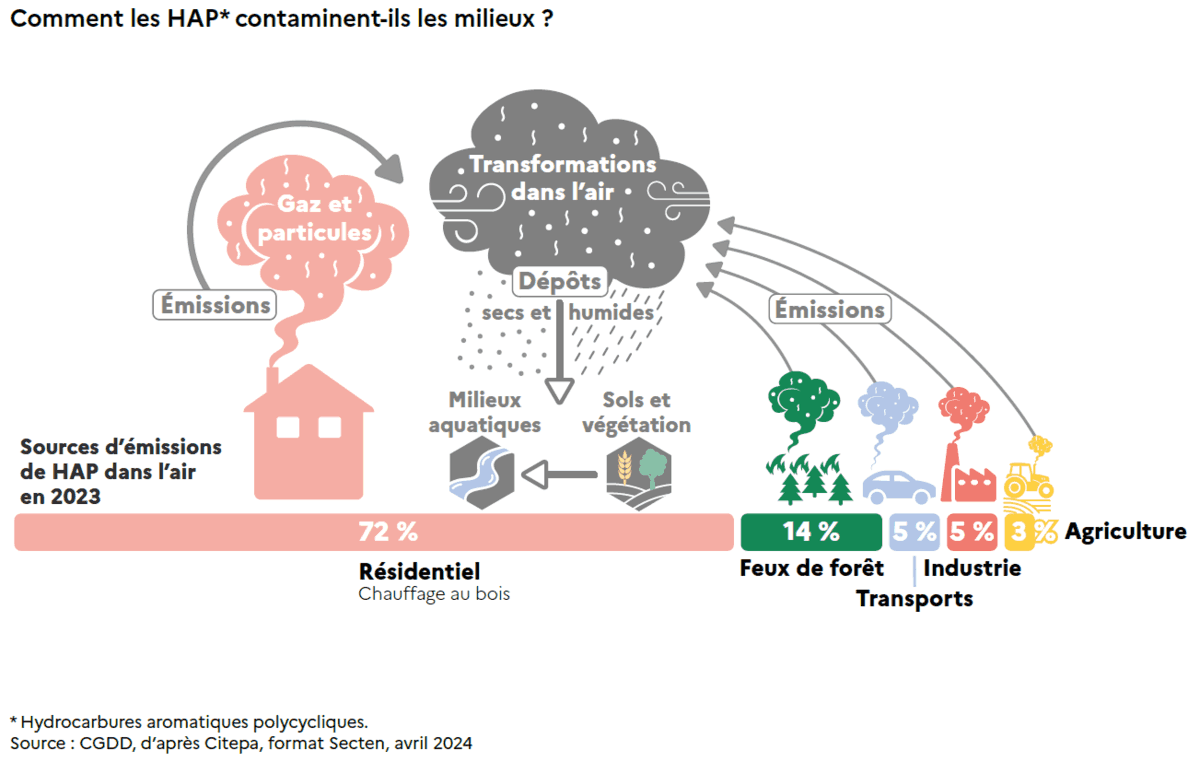
Les hydrocarbures aromatiques polycycliques (HAP) font partie des polluants organiques persistants. Ils proviennent principalement de la combustion des matières organiques (combustion d’énergies fossiles, feux de forêt). Toxiques pour la santé humaine et l’environnement, ces polluants sont généralement peu biodégradables. En plus de leur capacité à voyager sur de longues distances, ils s’accumulent dans les tissus vivants, se fixent sur les matières organiques, les matières en suspension ou les sédiments des cours d’eau. Les HAP sont un indicateur clé du degré de pollution des sols.
Polycyclic aromatic hydrocarbons (PAHs) are among persistent organic pollutants. They stem mainly from combustion of organic matter (fossil fuel combustion, forest fires). Toxic to human health and the environment, these pollutants are generally poorly biodegradable. Beyond their ability to travel long distances, they accumulate in living tissues, bind to organic matter, suspended matter, or river sediments. PAHs are a key indicator of soil pollution levels.
- What are polycyclic aromatic hydrocarbons (PAHs)?PAHs, persistent organic pollutants• Persistent organic pollutants (POPs) refer to organic compounds such as PCBs, dioxins and furans, polycyclic aromatic hydrocarbons (PAHs) and derivatives. They are simultaneously persistent, accumulate within living organisms, are toxic, and can travel long distances. • Identified for several decades as requiring monitoring and priority action, European regulations prohibit (with limited exceptions) the manufacture, marketing, and use of these substances in any form. It also aims to minimize emissions of these substances into the environment. Due to their long persistence in environments and their ability to accumulate in living organisms, POPs are harmful and widely distributed in the environment.Origins of PAHs in soil• Arising mainly from combustion phenomena (biomass, fossil fuels, waste, forest fires), PAHs are primarily emitted into the air, from which they disperse throughout the environment and living things. Readily binding to suspended organic matter particles in air, soil, and water, they are easily transported far from their emission zones. Dissolved PAHs from the manufacture of petroleum-based materials (pigments, resins, etc.) can also be released into the environment residually or through accidental pollution.
- Where are they present in French soils?Regional pollution variations• France's soil quality monitoring network is Europe's first surveillance network that has enabled mapping of PAH soil pollution. • The highest concentrations are measured in northern and eastern France and result from past industrial activities. Along the Atlantic coast, lower PAH concentrations come from probable long-distance transport followed by rain deposition. Very low concentrations of certain PAHs in the Southwest (Landes) can be explained by leaching in sandy soils.Different PAHs detailed• Of the 16 PAHs analyzed at soil surface, only five are quantified in more than half of the monitoring network sites: benzo(b)fluoranthene, fluoranthene, pyrene, indeno(1,2,3-cd)pyrene, and phenanthrene. Point pollution accounts for approximately one-third of the 3,316 polluted sites and soils documented in 2023 whose pollutants are known to contain PAHs and their derivatives in soil and subsoil. • Regarding fluoranthene, concentrations locally range from 0 to 1.17 milligrams per kilogram of fine soil. Fluoranthene is heavily concentrated in the North and East, likely due to these regions' past activities (mining, industry). Pollution presumably of mining, petroleum, or industrial origin also appears in the Paris region, downstream from the Seine valley, on the Mediterranean coast, in the Rhône corridor, and in the Massif Central. More uncertain, pollution origins on the Atlantic facade could result from long-distance atmospheric deposition. • Sites identified in eastern Massif Central (anthracene, benzo(k)fluoranthene) correspond to historical pollution (coal mines, metallurgy).
Further reading
- Réseau de mesure de la qualité des sols (RMQS)gissol.fr
Toutes les données, cartes et publications du RMQS disponibles sur le site du Groupement d’intérêt scientifique sur les sols (GIS Sol).
- Portail des substances chimiques (INERIS)substances.ineris.fr
À travers ce portail, l’Institut national de l’environnement industriel et des risques (INERIS) transmet son expertise sur les substances chimiques, issue de ses travaux d’étude et de recherche.
- Groupement d’intérêt scientifique sur les sols (GIS Sol)gissol.fr
Structure ayant pour mission de constituer et gérer un système d’information sur les sols de France et répondre aux demandes des pouvoirs publics et de la société au niveau local et national.
- Association française pour l’étude des sols (AFES)afes.fr
L’AFES est une société savante consacrée au sol. Elle est la branche française de l’Union internationale de la sciences du Sol (UISS).