
La pollution des sols par les pesticides
Glyphosate, lindane, chlordécone, S-métolachlore… de nombreux pesticides sont employés en agriculture pour lutter contre les organismes considérés comme nuisibles (insectes, parasites, champignons, plantes concurrentes). Mais l’utilisation prolongée de ces produits, qui s’accumulent dans les sols et persistent parfois des dizaines d’années, est à l’origine de pollutions diffuses. Cette pollution touche une grande partie du pays, avec des conséquences sur la santé humaine et les écosystèmes.
Glyphosate, lindane, chlordecone, S-metolachlor… many pesticides are used in agriculture to combat organisms considered harmful (insects, parasites, fungi, competing plants). But prolonged use of these products, which accumulate in soils and sometimes persist for decades, causes diffuse pollution. This pollution affects much of the country, with consequences for human health and ecosystems.
- Pesticides remain widespread in soilsCurrent situation• Since 2008, three plans to reduce the use of crop treatment products have been implemented, all targeting a 50% reduction, first for 2018, then 2025, and finally 2030. Despite some progress, the problem persists in France. • Among 111 pesticides analyzed between 2019 and 2021, glyphosate (70%) was most frequently detected in French soils, an herbicide widely sold, followed by fluopyram (69%) and fluxapyroxad (68%) despite being far less used. The polluting nature of pesticides depends not only on their toxicity and persistence but also on soils' ability to retain or degrade them. • Analysis confirms that while cultivated land is most polluted, untreated forests and grasslands are also affected. Sometimes soils accumulate high pesticide concentrations with increased ecotoxic risks for their microfauna and flora. Since pesticides are biocides, they inevitably harm biodiversity and ecosystem health.Health impact• Humans can be exposed to pesticides in various ways, notably through residues in food (especially from "conventional" agriculture) and through drinking water contamination. • A major study conducted by the European Environment Agency between 2014 and 2021 across 5 countries found more than 46 pesticides or metabolites (substances from pesticide degradation) in samples from tested individuals, with at least 2 different pesticides in 84% of cases. • While precisely estimating pesticide health impacts is complicated, scientific research has established strong or suspected links between pesticide exposure and increased risk of certain chronic diseases: • many types of cancer • neurological diseases (Parkinson's, Alzheimer's…) • cardiovascular diseases • developmental delays in children • impaired reproductive capacity • cognitive deficiencies • declining respiratory health
- Focus on key soil pollutantsS-metolachlor pathway• In 2022, S-metolachlor was the 4th best-selling herbicide in France (6% of total). Used on corn, beets, sunflower, or sugarcane before weed emergence, its sales increased 23% in France between 2009-2011 and 2020-2022 (1,800 tonnes sold in 2022). • Three regions account for over 50% of total purchases: Nouvelle-Aquitaine (458 t), Occitanie (293 t), and Centre-Val de Loire (169 t). However, evolution between 2015-2017 and 2020-2022 is highly variable: purchases decreased in regions like Auvergne-Rhône-Alpes (−30%), Brittany (−26%), and Provence-Alpes-Côte d'Azur (−21%), while increasing elsewhere, such as Île-de-France (+53%), Hauts-de-France (+39%), and Centre-Val de Loire (+30%). • This herbicide, classified as "suspected carcinogen" by the European Chemicals Agency, is found in air (approximately 50% of French mainland analyses) and soils (17% of analyzed soils). Since 2018, its metabolite metolachlor-esa has most often degraded distributed water quality, far ahead of all other pesticides. It has caused drinking water non-conformities. In 2021, three metabolites frequently exceeded European quality standards in these waters. • To reduce these risks, the French food safety agency banned in 2023 the main uses of phytosanitary products based on S-metolachlor, with stock use permitted until 2024. At European level, the decision not to renew S-metolachlor approval was taken in December 2023.Lindane persistence• Considered toxic to humans and dangerous for the environment, lindane was used for over 50 years as an agricultural insecticide. Highly immobile in soils, this pesticide can evaporate and be transported in air. Soil type, climate, and lindane burial depth all affect degradation duration in soil, which can require over 40 years. • Although its ban for agricultural uses in France dates to 1998, residues persist in metropolitan soils. Values range between 0.16 and 5 micrograms per kilogram (µg/kg) of soil. Highest values (over 2 µg/kg of soil) result from widespread lindane use as insecticide in intensive farming zones (Beauce, northern Hauts-de-France), or as antiparasitic in intensive poultry and pork farming areas (Brittany). • Breton soils, rich in organic matter, strongly retained lindane spread via livestock effluent. Conversely, lowest values occur in more forested regions (Auvergne-Rhône-Alpes, Occitanie, Nouvelle-Aquitaine, Provence-Alpes-Côte d'Azur) and especially in the Landes de Gascogne where sandy, acidic, organically poor soils retain little lindane.Chlordecone crisis• In the Caribbean, chronic agricultural soil, water, and ecosystem pollution by chlordecone results from its use until 1993 to combat a crop pest, the banana weevil. Chlordecone is classified as a persistent organic pollutant and recognized as an endocrine disruptor and potential carcinogen. Caribbean populations can be exposed through contaminated water or food ingestion. • On average, 30 g of chlordecone per banana plant were applied annually between 1971 and 1993. Slightly mobile, poorly soluble, barely volatile, chlordecone permanently binds to soil organic matter and degrades extremely slowly in aerated soils. Crop contamination mainly affects roots and tubers and to a lesser extent cucurbits, lettuce, and alliums. • Chlordecone pollution risk affects over one quarter of agricultural land in Guadeloupe (14,200 hectares) and two fifths in Martinique (10,000 hectares). According to chlordecone concentration evolution simulations, coastal clay soils should contain none within two centuries, while high-altitude volcanic soils will remain heavily polluted. • Various measures aim to reduce population exposure: treated and distributed water through active carbon filtration (1999), root crop cultivation oversight (2002), river fishing ban (2003-2004), coastal fishing delimitation (2008), 20 µg/kg fresh weight maximum residue limit in food (2007), triennial national chlordecone action plans (since 2008). • Chlordecone Plan III (2014-2020) continues actions initiated since 2008 along four axes: develop sustainable development strategy, prevent health risk and protect populations by reducing exposure, develop research (human and animal health; environment; human, economic, and social sciences), support fishing and agricultural professionals whose activity is heavily impacted by this pollution. • Diagnostics of exposed families and potentially polluted soils (Family Gardens program) aim to limit exposure of populations regularly consuming root vegetables from their gardens according to soil chlordecone content: under 0.1 mg chlordecone/kg dry soil (no restriction), over 0.1 mg/kg dry soil (not recommended: roots, tubers), over 1 mg/kg dry soil (strongly discouraged except hydroponic: root vegetables, cucurbits, lettuce, sugarcane).Copper accumulation• Sometimes negative effects of substances used against "pests" that accumulate in soil concentrate on microfauna and flora. This notably occurs with copper used as fungicide (Bordeaux mixture). Decades of use, combined with naturally present soil levels, foster negative biodiversity effects. • Yet its use is increasing (+35% between 2009-2011 and 2020-2022). In mainland France, over half of high copper concentrations are in zones occupied over 20% by vines and orchards cultivated in conventional or organic agriculture, notably in Gironde and Languedoc-Roussillon. To limit this cumulative effect, European regulation restricts total usable copper to 28 kg per hectare over 7 years (2019-2025).
Further reading
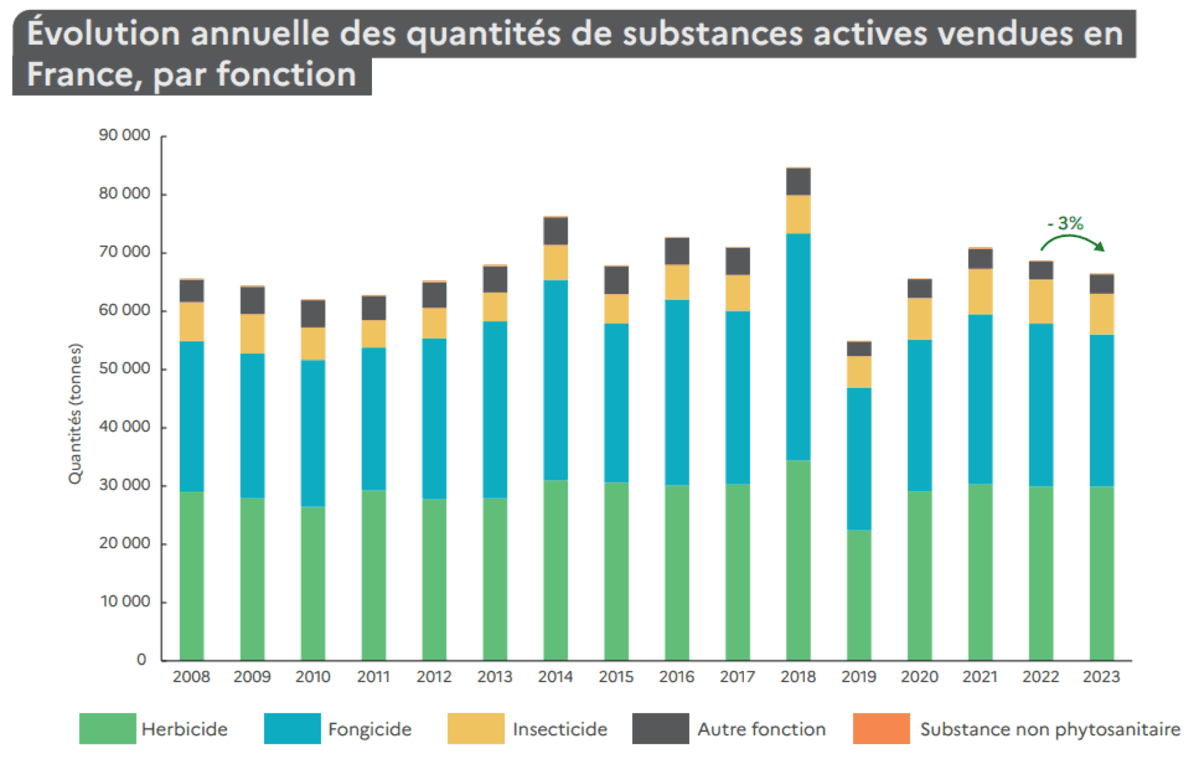
- Les quantités de produits phytopharmaceutiques vendues en Francenotre-environnement.gouv.fr
Herbicides, fongicides, insecticides… La France ne parvient pas à réduire fortement sa dépendance aux produits phytosanitaires et de vastes territoires sont pollués.
- Les quantités de glyphosate vendues en Francenotre-environnement.gouv.fr
Le glyphosate est l’herbicide le plus utilisé dans le monde avec plus de 800 000 tonnes vendues en 2014. La France en a utilisé 9 700 tonnes en 2018.
- Pesticides : quels usages, quelles conséquences ?notre-environnement.gouv.fr
Utilisés en agriculture, les pesticides peuvent nuire à la santé et à l’environnement. Usages, risques, exposition : où en est-on en France ?
- La pollution de l’eau par les pesticidesnotre-environnement.gouv.fr
Les pesticides utilisés par l’agriculture sont une source de pollution des eaux de surface et des nappes d’eau souterraines.
- Réseau de mesure de la qualité des sols (RMQS)gissol.fr
Toutes les données, cartes et publications du RMQS disponibles sur le site du Groupement d’intérêt scientifique sur les sols (GIS Sol).
- Portail des substances chimiques (INERIS)substances.ineris.fr
À travers ce portail, l’Institut national de l’environnement industriel et des risques (INERIS) transmet son expertise sur les substances chimiques, issue de ses travaux d’étude et de recherche.
- Groupement d’intérêt scientifique sur les sols (GIS Sol)gissol.fr
Structure ayant pour mission de constituer et gérer un système d’information sur les sols de France et répondre aux demandes des pouvoirs publics et de la société au niveau local et national.
- Association française pour l’étude des sols (AFES)afes.fr
L’AFES est une société savante consacrée au sol. Elle est la branche française de l’Union internationale de la sciences du Sol (UISS).