
Les quantités de glyphosate vendues en France
La France s’est engagée dans le processus de sortie du glyphosate, avec un objectif d’ici 2022 : diminuer de 50 % l’utilisation du glyphosate en France, sans laisser aucun agriculteur sans solution. Un état des lieux des ventes et des achats de glyphosate en France est établi d’après les données de la Banque nationale des ventes réalisées par les distributeurs des produits phytopharmaceutiques (BNV-D).
France has committed to a glyphosate phase-out process, with an objective by 2022: reduce glyphosate use in France by 50%, without leaving any farmer without solutions. An assessment of glyphosate sales and purchases in France is established based on data from the National Database of Sales Made by Phytopharmaceutical Product Distributors (BNV-D).
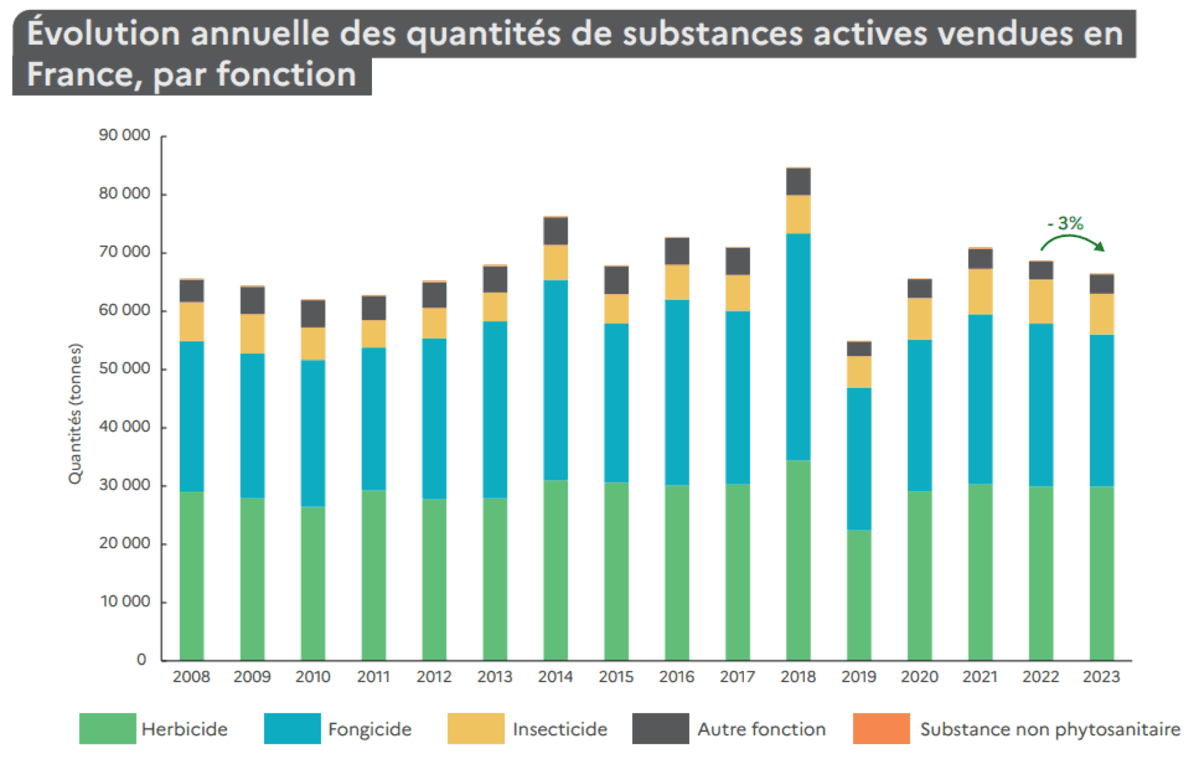
- Glyphosate, the most widely used herbicide in France and worldwideGlyphosate worldwide and in France• Glyphosate is the most widely used herbicide in the world, with more than 800,000 tonnes sold in 2014. France uses 1% of it (9,700 tonnes in 2018 compared to 8,800 tonnes in 2017). After sulfur—used in conventional and organic farming (14,150 tonnes)—it is the second most widely used active substance in France, accounting for 12% of total sales over 2016-2018. Between 2009-2018, it is also the best-selling herbicide nationally among 122 active substances for herbicide use.Sales evolution 2009–2018• Over 2009-2018, following a sales peak in 2014 likely due to anticipatory purchases linked to the modification of the diffuse pollution fee in early 2015, herbicide sales fell 2% between 2014 and 2017. Sales rebounded in 2018, with a 15% increase between 2017 and 2018, probably for the same reasons as in 2014. While herbicide sales averaged increase 14% between 2009-2011 and 2016-2018 (the longest available period), glyphosate sales rose 25%. The share of glyphosate sales in total herbicide sales increased between 2009 (23%) and 2012 (34%), then stabilized at 29% from 2015 onwards. The proportionally increased use of glyphosate can be explained by the generalization of cover crops in intercropping periods (to limit water pollution by nitrates) that must be eliminated before sowing main crops, or by the rise of conservation farming (to preserve soil quality).
- Declining glyphosate sales for non-agricultural usesLabbé Law• The Labbé Law of February 6, 2014 regulates the use of phytopharmaceutical products across the entire national territory. Since January 1, 2017, it prohibits many uses of phytopharmaceutical products for all public entities (the State, territorial authorities and their groupings, public institutions). This prohibition concerns the maintenance of green spaces, roads, promenades, and forests open to or accessible to the public. Certain spaces are not covered by this law, notably most cemeteries and mineralized sports fields. For private individuals, this prohibition has been in effect since January 1, 2019. All phytopharmaceutical products are affected, except biocontrol products, organic farming products, and products classified as "low-risk," labeled EAJ.EAJ sales evolution• In 2018, 223 product references (compared to 245 in 2017) contained glyphosate. Of these, 98 bore the EAJ designation (compared to 106 in 2017) and represented 936 tonnes (compared to 1,200 t in 2017) and accounted for 10% of total glyphosate sales (compared to 14% in 2017). Over 2009-2018, after a peak in 2013, sales declined by more than half (−54%) between 2013 and 2018, reaching below 1,000 t.
- Herbicide sales and purchases at the infra-national levelRegional sales disparities• Analysis of the total quantity of herbicides sold in 2018, excluding EAJ designation, shows that the (former) regions of Champagne-Ardenne, Picardie, Centre, Poitou-Charentes, and Midi-Pyrénées were, as in 2017, those with the highest herbicide sales. • This data must be compared with agricultural land. The highest herbicide sales were in Champagne-Ardenne (3,800 t) for 1.5 million ha of agricultural land, or 2.52 kg/ha (compared to 2.09 kg/ha in 2017). In Midi-Pyrénées, with approximately 2.3 million ha of agricultural land, 2,000 t of herbicides were sold, or 0.89 kg/ha (compared to 0.83 kg/ha in 2017). • The share of glyphosate among herbicides varies from region to region. It is 14% (compared to 18% in 2017) in Picardie, while it exceeds 65% in Languedoc-Roussillon, Provence-Alpes-Côte d'Azur, and Corsica, as in 2017.Departmental purchase disparities• One quarter of departments recorded, on average, more than half of glyphosate purchases from 2016 to 2018. Without actual usage data that would be interesting to study, we can only speak of potential pressure indicators. Indeed, over the same period, the national average of purchases relative to agricultural land is 0.32 kg of glyphosate purchased per ha compared to 0.30 kg per ha over 2015-2017. The department with the highest quantity of purchased glyphosate is Charente-Maritime, with 292 t, or 0.68 kg per ha (compared to 0.64 kg per ha with 276 tonnes over 2015-2017). Per hectare, glyphosate is purchased most in Gironde (256 t, or 1.06 kg per ha). Followed, with more than 0.80 kg per ha, by Hérault (181 t), Vaucluse (107 t), Gard (154 t), and Var (57 t). The lowest average purchases are in departments composed of agricultural land less treated, such as permanent grasslands.Purchases by buyer postal code• The BNV-D allows comprehensive and detailed knowledge of glyphosate purchases "at the buyer's postal code." For agricultural uses, the buyer is required to declare the postal code of their farm headquarters (billing address). This information does not, however, allow precise knowledge of where or when the purchased products are applied. Exploited parcels may be located in municipalities with different postal codes, and products may be stored. • The data below present the average annual purchases from 2016 to 2018 of non-EAJ glyphosate at the buyer's postal code, relative to the agricultural land of farms headquartered in the postal code zone, minus agricultural land under organic farming (in conversion and certified).Methodology• The BNV-D allows comprehensive and detailed knowledge of glyphosate purchases "at the buyer's postal code." For agricultural uses, the buyer is required to declare the postal code of their farm headquarters (billing address). This information does not, however, allow precise knowledge of where or when the purchased products are applied. Exploited parcels may be located in municipalities with different postal codes, and products may be stored. • Phytopharmaceutical products can be sold under two main employment categories depending on whether they benefit from the "authorized for use in gardens" (EAJ) designation or not. Only persons demonstrating professional user status and holding a competency certificate (Certiphyto) may purchase non-EAJ products. In the BNV-D, sales data by INSEE municipality code from distributors have existed since 2009, and those by buyer postal code have been available and reliable since 2015. Under the Water Law of December 30, 2006, sales statements contain information on phytopharmaceutical product sales by market authorization (AMM) for each distributor establishment. Sales registers were introduced by Decree 2014-1135 of October 6, 2014 and additionally contain the buyer's postal code. Buyer postal code declarations are mandatory only when distributors sell to professional users (see the "methodology" tab in the data file linked to this publication). • Description of the national database of sales made by phytopharmaceutical product distributors (BNV-D). The BNV-D is the database compiling all phytopharmaceutical product sales by distributors. It was created by Law No. 2006-1772 of December 30, 2006 on water and aquatic environments (LEMA). This law established the diffuse pollution fee starting January 1, 2008 and enables traceability of sales by approved distributors. Under the Water Law of December 30, 2006, sales statements contain information on phytopharmaceutical product sales by market authorization (AMM) for each establishment of a distributor. Sales registers were introduced by Decree 2014-1135 of October 6, 2014 and additionally contain the buyer's postal code. Buyer postal code declarations are mandatory only if distributors sell to professional users. • Sales and purchases of phytopharmaceutical products. In the BNV-D, sales data by "INSEE municipality code of distributors" have existed since 2009; those by "buyer postal codes" have been available and reliable since 2015. • Exploitation of this database allows calculation of indicators for monitoring sales and purchases of phytopharmaceutical products. It provides no direct information on the location and period of use of the products it records. • Active substances. Data in this article concern quantities of active substances, obtained after cross-referencing the BNV-D with the E-Phy database which inventories all phytopharmaceutical products (product names, composition, concentrations, etc.). The list of active substances in phytopharmaceutical products subject to fees is established annually in a ministerial decree that classifies them into three categories based on their danger to human health and the environment: • substances dangerous to human health classified Toxic (T), Very Toxic (T+) and/or Carcinogenic, Mutagenic and Reprotoxic (CMR); • organic substances dangerous to the environment classified "N orga"; • mineral substances dangerous to the environment classified "N miné". • This classification allows calculation of the diffuse pollution fee that distributors must pay. The price per kg increases with how dangerous the substance is considered. Beyond classification changes, fee increases often trigger anticipatory purchases that can explain year-on-year variations in addition to weather conditions. • A fourth category not subject to pollution fees comprises other products. • Usage categories. Phytosanitary products can be sold in two forms: • approved for authorized use in gardens (EAJ); The "LABBÉ" Law of February 6, 2014 regulates the use of phytopharmaceutical products across the entire national territory. Since January 1, 2017, it prohibits many uses of phytopharmaceutical products for all public entities (the State, territorial authorities and their groupings, public institutions). This prohibition concerns the maintenance of green spaces, roads, promenades, and forests open to or accessible to the public. Certain spaces are not covered by this law, notably most cemeteries and mineralized sports fields. For private individuals, this prohibition has been in effect since January 1, 2019. All phytopharmaceutical products are affected, except biocontrol products, organic farming products, and products classified as "low-risk," labeled EAJ; • approved for non-authorized use in gardens (non-EAJ). Only persons demonstrating professional user status may purchase non-EAJ products. • Seed treatments were only integrated into the BNV-D from 2012 onwards; they represent less than 1% of active substances sold in 2018. Foreign purchases were also integrated into the database in 2012. • BNV-D data allow comprehensive (national and regional sales levels via statements since 2009) and detailed visualization (purchases by buyer postal code via registers from 2015 onwards). For example, in the case of agricultural uses (non-authorized use in gardens), they indicate the postal code (billing address) of all agricultural farms but indicate neither the location nor the application period (possibility of stock buildup or product repurchases). • Confidentiality limits. If fewer than five farms operate within a postal code, the data are not disclosed ("Data under confidentiality"). • BNV-D exploitation. To exploit phytopharmaceutical product data at national or regional level, register and statement data were mobilized. • To exploit phytopharmaceutical product data at departmental level, only register data were mobilized. • Glyphosate purchase data are consolidated to reallocate quantities of glyphosate whose postal codes are not valid (data entry errors, etc.). Quantities of glyphosate assigned to postal code "00000" are distributed across all metropolitan postal code zones, proportionally to glyphosate quantities purchased by postal code. • Calculation of the indicator "quantity of non-EAJ glyphosate purchases distributed to agricultural land". Non-EAJ glyphosate purchase data at buyer postal code (from registers) were used. Glyphosate purchase data are consolidated to reallocate quantities of glyphosate assigned to a postal code that does not exist (data entry errors, etc.). First, quantities of glyphosate assigned to postal code "00000" are distributed across all metropolitan postal code zones, proportionally to glyphosate quantities purchased by postal code. Then, for each department, quantities of glyphosate assigned to postal codes that do not exist in the postal code database used are reallocated across all valid postal code zones in the department, proportionally to glyphosate quantities purchased by valid postal code. • Agricultural land used (SAU) corresponds to the SAU of farms headquartered in the postal code zone. Where SAU is zero, the ratio is not calculated ("Zero SAU"). This is notably the case for more urban postal codes (Paris and inner suburbs, for example) that have purchasing entities but no agricultural land. SAU minus land under organic farming is calculated from municipal data from the 2010 Agricultural Census and from the Organic Farming Agency over 2015-2018. For a given municipality, these areas are reallocated to each postal code covering it, proportionally to the area of the municipality covered by the postal code in question. Areas reallocated to postal codes are then summed, as a postal code can serve multiple municipalities. • Calculations cover only metropolitan France due to lack of simple access to overseas department postal code boundaries.
Further reading
- Produits phytopharmaceutiques, biocides et fertilisantsnotre-environnement.gouv.fr
Les produits phytopharmaceutiques et les biocides sont utilisés par les professionnels et les particuliers pour détruire, repousser ou rendre inoffensifs les organismes nuisibles. Avant leur mise sur le marché, l’ANSES est chargée d’évaluer l’efficacité de ces produits et les risques liés à leur utilisation. Elle évalue également les fertilisants et supports de culture.
- Enquête sur les pratiques culturalesnotre-environnement.gouv.fr
Principaux chiffres sur les pratiques culturales en arboriculture, grandes cultures, viticulture et légumes.
- Ventes totales de pesticides en Europeec.europa.eu
Données Eurostat sur l’ensemble des pays de l’Union européenne depuis 2012.
- Alim’Agri : Écophytonotre-environnement.gouv.fr
Rubrique consacrée à "l'écophyto" sur le site du ministère de l'agriculture et de l'alimentation.
- Alim’Agri : Glyphosatenotre-environnement.gouv.fr
Rubrique consacrée au "glyphosate" sur le site du ministère de l’agriculture et de l’alimentation.
- Plan de sortie du glyphosate : le centre de ressources mis en ligne ce jour apporte des solutions concrètes aux agriculteursnotre-environnement.gouv.fr
Le Gouvernement a engagé en juin dernier un plan d’action pour mettre fin aux principaux usages du glyphosate d’ici 2020 et d’ici 2022 pour l’ensemble des usages. Afin d’accompagner les agriculteurs, un centre de ressources est désormais opérationnel.