Les ventes de produits phytosanitaires en France
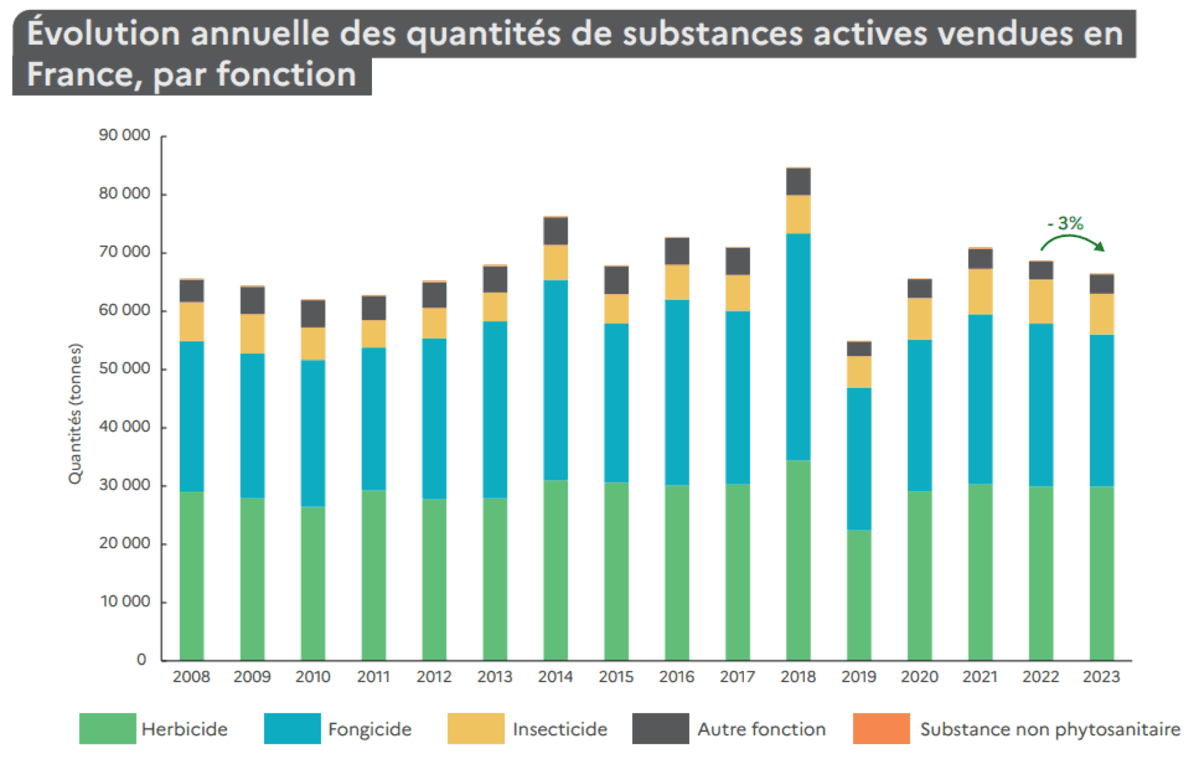
Depuis 2008, trois plans de réduction de l’usage des produits de traitement des cultures se sont succédé, tous visant une baisse de 50 %, d’abord pour 2018, puis pour 2025 et enfin pour 2030. Malgré quelques avancées, la France ne parvient pas à réduire fortement sa dépendance aux produits phytosanitaires (herbicides, fongicides, insecticides…) et de vastes territoires sont pollués. Si les produits les plus toxiques sont en recul, les autres eux sont en progression.
Since 2008, three plans to reduce the use of crop treatment products have succeeded one another, all aiming for a 50% reduction, first by 2018, then by 2025 and finally by 2030. Despite some progress, France is failing to significantly reduce its dependence on plant protection products (herbicides, fungicides, insecticides, etc.) and vast territories are polluted. While the most toxic products are declining, others are increasing.
- Plant protection products: a mixed outcome in light of the challengesStable sales volume since 2008• In 2023, 66,508 tonnes of active substances were sold to protect crops from insects, diseases and weeds (source). This volume is relatively identical to the average sales reported since 2008, when the first Ecophyto plan was defined. Yet this plan set an objective of a 50% reduction in 10 years in the use of plant protection products. • > Ecophyto 2030, France's strategy to reduce pesticide use > The Ecophyto 2030 strategy, launched on 6 May 2024, aims to continue reducing the use of plant protection products in France. Set at a 50% reduction target by 2030 compared to the 2011-2013 average, this objective is also part of a broader perspective of European alignment at environmental and health levels.Most toxic substances declining, others rising• This overall stability is accompanied, however, by a decline in the most toxic substances for human health that are progressively being banned (carcinogenic, mutagenic and reprotoxic or CMR) and an increase in those that can be used in biocontrol and/or organic farming. • Sales of CMR substances fell by 35% in volume between 2015-2017 and 2020-2022, and their share of total sales fell by 18 percentage points since 2009 (15% in 2022). Geographically, more than half of purchases in 2020-2022 came from 18 departments, led by Eure-et-Loir, Somme, Marne, Charente-Maritime and Eure. • Another indicator, the agricultural NODU (number of unit doses), measures the intensity of pesticide use. The higher the NODU, the more treatments agricultural land has received. Although the 2020-2022 assessment shows a decrease of 11.5% compared to the 2015-2017 average, the NODU did not decline over this period. • As part of the new Ecophyto 2030 strategy and to monitor its results, the Harmonised Risk Indicator 1 (HRI1), established by European Directive 2009/128, replaces the NODU as the main indicator. It allows tracking changes in active substance use by weighting them with a risk quantification coefficient.
- Distribution of sales in FranceMost toxic substance purchases by departmentNational plant protection product sales database (BNV-D)• > National plant protection product sales database (BNV-D) > The BNV-D is the database compiling all sales of plant protection products made by distributors. It was created by law no. 2006-1772 of 30 December 2006 on water and aquatic environments (LEMA). This law established the fee for diffuse pollution from 1 January 2008 and enables traceability of sales by approved distributors. • > BNV-D data provide both a global view (sales at national and regional scale thanks to reports since 2009) and a more detailed view of purchases according to the postcode of the buyer (thanks to registers, from 2015 onwards).
Further reading
- Pesticides : quels usages, quelles conséquences ?notre-environnement.gouv.fr
Utilisés en agriculture, les pesticides peuvent nuire à la santé et à l’environnement. Usages, risques, exposition : où en est-on en France ?
- Les quantités de glyphosate vendues en Francenotre-environnement.gouv.fr
Le glyphosate est l’herbicide le plus utilisé dans le monde avec plus de 800 000 tonnes vendues en 2014. La France en a utilisé 9 700 tonnes en 2018.
- La pollution des sols par les pesticidesnotre-environnement.gouv.fr
Les pesticides employés en agriculture s’accumulent dans les sols et polluent l’ensemble des milieux, avec des conséquences sur la biodiversité et la santé humaine.
- La pollution de l’eau par les pesticidesnotre-environnement.gouv.fr
Les pesticides utilisés par l’agriculture sont une source de pollution des eaux de surface et des nappes d’eau souterraines.
- Quantités de substances actives phytopharmaceutiques vendues en France en 2023ventes-produits-phytopharmaceutiques.eaufrance.fr
Présentation en infographies des données 2023 issues de la BNV-D (publication 2025).
- Ventes totales de pesticides en Europeec.europa.eu
Données Eurostat sur l’ensemble des pays de l’Union européenne depuis 2012.
- Banque nationale des ventes de produits phytopharmaceutiques (BNV-D)ventes-produits-phytopharmaceutiques.eaufrance.fr
Banque de données compilant l’ensemble des ventes de produits phytopharmaceutiques des distributeurs.
- Produits phytopharmaceutiques, biocides, fertilisants et macro-organismes (Anses)anses.fr
Page thématique de l’agence nationale de sécurité sanitaire (Anses) au sujet des produits phytopharmaceutiques (autorisations, vigilance sur leur impact, évaluation…).
- Stratégie Écophyto 2030agriculture.gouv.fr
Présentation de la stratégie Écophyto 2030 de réduction des risques et des usages des produits phytopharmaceutiques en France.
- L’agence Bioagencebio.org
Agence française pour le développement et la promotion de l'agriculture biologique.
- Enquête sur les pratiques culturales en grandes cultures en 2025 (CNIS)cnis.fr
Cette enquête permet de décrire et de caractériser les pratiques de conduite des cultures des agriculteurs et les itinéraires techniques choisis.
- Recensement agricole 2020agriculture.gouv.fr
Opération décennale européenne et obligatoire, le recensement agricole a pour objectif d'actualiser les données sur l'agriculture française.