
Engineering with Origami
Engineers are turning to origami for inspiration for all types of applications from medical devices to space applications and even stopping bullets
7 chapitres
- Introduction to Origami in EngineeringHistorical BackgroundOrigami dates back at least 400 years in Japan with only 100-200 patterns. The 20th century saw a renaissance, with Akira Yoshizawa creating thousands of designs and inspiring worldwide creativity.Modern Applications• Medical devices and surgical robots • Space applications and deployable structures • Bulletproof protective barriersCore ValueOrigami transforms a flat sheet into other shapes with relatively little processing, making it useful for structural and mechanical engineering.DemonstrationA cactus with pot folded from a single one-meter square sheet of paper took seven years to design, showing the scale and complexity possible through origami techniques.
- Bi-stable Mechanisms and Medical ApplicationsMechanism DesignA triangulated cylinder is a folded pattern that is bi-stable, existing stably in two different positions. Combining multiple mechanisms creates dynamic color-changing effects.Surgical InnovationOrigami bellows developed for the da Vinci surgical robot maintain consistent internal hole size regardless of movement, allowing flexible catheters to be inserted safely without buckling.Protective BarriersA foldable bulletproof wall based on the Yoshimura crease pattern uses 12 layers of Kevlar to stop handgun bullets. New designs with interchangeable panels can stop rifle rounds.Structural BenefitsFolding materials makes them more rigid without requiring thicker or heavier material, providing a practical advantage for engineering applications.
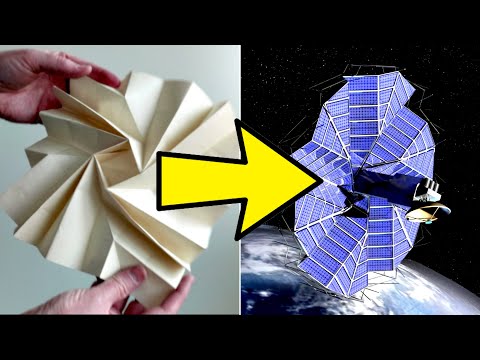
- Thick Materials and Rigid FoldingEngineering ChallengeThick, rigid materials like polypropylene cannot be folded like paper. Engineering requires using surrogate folds and hinges to accommodate material thickness.Solution Techniques• Cutting or scoring materials • Adding hinges as necessary • Using surrogate folds to replace standard creasesSpace DeploymentThe Miura Ori pattern is a foundational design for deployable structures. It was used on the 1995 Space Flyer mission for solar arrays, opening and closing in a single motion.Practical ImpactOrigami flasher patterns have been proposed for satellite solar arrays to increase compactness for launch and improve reliability in deployment.
- Aerodynamics and Functional OrigamiFreight InnovationFreight locomotives have poor aerodynamics because they function as modular units that connect anywhere. A deployable origami nose cone folds flat for compatibility but unfolds to improve aerodynamics.Economic BenefitComputer models and wind tunnel testing show the origami nose cone design saves one company millions of dollars annually in diesel fuel consumption.Compliant MechanismsOrigami-inspired compliant mechanisms can complete full 360-degree rotations continuously, unlike traditional mechanisms with bearings or hinges. These mechanisms have no rigid joints.Medical Grippers• Origami-based forceps can morph from small size for minimal incisions to larger gripper configuration • Mini gripper variant reduces medical instrument parts by 75 percent • Provides wider range of motion than previous mechanisms
- Microscopic Origami and Advanced ApplicationsMiniaturization AchievementThe world's smallest origami flapping bird is smaller than a grain of salt, folded from less than one millimeter square to microscopic dimensions using self-folding techniques.Medical Devices• Nano injector for gene therapy delivers DNA to cells • Only four micrometers thick • 400 devices fit on a one-centimeter wide computer chipArtistic ApplicationAn elliptic infinity lamp transforms from flat to three-dimensional shape using a single sheet of material. It comes in an envelope and folds together with a cable and clip.Design FoundationMathematical methods are essential for designing complex folded structures where curvature of lines affects bending and shapes at multiple points must work together.
- Mathematical Methods and Design AlgorithmsMathematical ApproachOrigami design can be described using mathematical language, allowing mathematicians and physicists to apply problem-solving tools to create complex folding patterns.Circle Packing Method• Represents origami features (claws, legs, tail) as circular regions • Packs circles into a square like balls into a box • Uses geometric rules to construct crease patterns from circle arrangementsDesign ProcessBy following systematic geometric rules, the crease pattern reveals exact shapes to fold. Add lines between circle centers, insert fold lines where any two lines meet in a V shape, and repeat until complete.Advanced AlgorithmsJapanese mathematician Tomohiro Tachi developed Origamizer, an algorithm that takes any triangulated surface and generates the folding pattern needed to create it from a flat sheet.
- Why Origami Matters for EngineeringCore Benefits• Transforms flat sheets into virtually any three-dimensional shape through folding • Reduces dimensions of products while enabling easy deployment • Increases material rigidity without additional weight • Creates specific functional motionsScalabilityOrigami principles work across all scales, from macroscopic architectural structures to microscopic medical devices, enabling miniaturization of complex mechanisms.Historical InnovationEngineers can adopt centuries of bright ideas developed through paper folding experimentation and translate them into practical engineering solutions.Implementation RequirementsTranslating origami ideas into practical solutions requires extensive math modeling and experimentation to ensure designs function as intended in real-world applications.