

What Happens If You Keep Slowing Down?
From a century old technique that still beats modern slow-mo cameras, as all the way to a massive quadrillion frames per second camera that captures electrons whizzing around molecules.
13 chapitres
- Introduction to Slowing TimeOpening ConceptA camera moving faster than light in a video of light traveling through a bottle, captured at 250 billion frames per second, demonstrating the possibility of unusual ways to stop time.Video Promise• Three unusual ways of stopping time will be explored • Century-old strobe technique still outperforms modern slow-mo cameras • Quadrillion frames per second camera capturing electrons in moleculesCentral QuestionWhat can we see when we keep slowing down and exploring faster timescales?Journey AheadThe video will progress from classic strobe photography through modern high-speed cameras to attosecond imaging of atomic behavior.
- Harold Edgerton and the Strobe RevolutionThe Problem• Electric motors were sensitive to electrical grid fluctuations and power surges • Machines spun too fast for human eyes to see what went wrong • Camera exposure times were too slow, resulting in blurry photographsThe InnovationMIT engineer Harold Edgerton noticed that power surge equipment produced bright flashes that froze motor movements in time, inspiring the strobe flash concept.Technical Design• High voltage power charges a capacitor with electrons • A trigger pulse ionizes argon or xenon gas in a tube • Capacitor discharge heats gas to 10,000 Kelvin, producing 10-microsecond bright flash • Electrons recombine with gas atoms, stopping current and darkening the circuitImpactBy the early 1930s, Edgerton traveled to factories demonstrating how strobes froze machinery in motion, allowing sharp photographs of gears and mechanical movements.
- Edgerton's Artistic Vision and ApplicationsUnique Perspective• Edgerton brought a photographer's eye to electrical engineering • While many engineers could create strobes, his artistic composition stood out • He captured subjects like tennis balls, pancakes, and hummingbirds frozen in timeMedia InfluenceStrobe photographs were published in Life Magazine and National Geographic during the 1930s-1940s, magazines that served as the social media influencers of that era.Technical ChallengeTiming the strobe to fire at exactly the right half-millionth of a second was solved using sound: a microphone detected the sound of a balloon pop or other event and triggered the flash.Military ApplicationIn 1939, the U.S. Army used Edgerton's powerful strobes for night reconnaissance photography, including reconnaissance of Normandy the night before D-Day in World War II.
- Strobe Photography vs Modern Slow-MotionComparison SetupA bullet piercing a playing card was photographed both with a modern 2020 research-grade camera shooting 20,000 FPS and Edgerton's strobe technique from the 1930s.Image Quality• Edgerton's strobe produces sharper focus and cleaner edges • Modern high-speed video captures motion progression but with lower spatial resolution • Single-frame strobe achieves pixel density that modern cameras cannot match at high frame ratesTechnical TradeoffSpatial resolution (pixel count) and temporal resolution (frame rate) are constrained by sensor read speed; you must choose between high pixel count or high frame rate.Timing MechanismEven with supersonic bullets, a microphone can detect the sonic boom created by the supersonic object and trigger the strobe at the right moment.
- Single-Pixel Cameras and Light Speed ImagingTechnology PrincipleSingle-pixel cameras count individual photons hitting a sensor a trillion times per second, with each frame lasting about one picosecond, during which light travels only 0.3 millimeters.Familiar TechnologyLIDAR systems in phones use the same principle: shoot a light pulse, measure how long it bounces back, and calculate distance from light travel time.Imaging Method• Laser pulse hits one point in a scene • Photons scatter and bounce into the camera at a trillion FPS • Camera position is moved slightly and experiment repeats • Scanning hundreds of times creates a grid of measurements • Multiple scans compiled together form complete videosKey RequirementThe scene must play out identically every time the camera moves, otherwise each pixel records a different event and creates a garbled result.
- Filming Light Propagation in Real TimeSetup ExampleA scaled-down room contains shapes like cones, spheres, mirrors, and logos; a short laser pulse illuminates the scene and the single-pixel camera records light scattering at different positions.Remarkable Results• Light propagating through a bottle with visible wavefronts and bouncing off the cap • Light reflecting off mirrors in a fish tank and hitting diffuse reflectors • Diffraction gratings separating light into different modes • Fly-through visualizations showing light propagation from any camera angleResolution AchievementBy scanning as many points as needed on a grid, resolution can reach 4K or higher; the more points scanned, the higher the final resolution, though it takes more time.Visual EffectsThe camera can move faster than light in the visualization because it's constructed from data showing when light arrives at different positions, not actual simultaneous events.
- From Light to Electrons: SLAC AcceleratorFacility OverviewSLAC National Laboratory houses a 3.2-kilometer-long perfectly straight electron accelerator, the world's straightest object until 2017, accelerating electrons to over 99.9999992% the speed of light.Operational Details• 120 hertz frequency generates electron pulses at 120 per second • Electrons are accelerated through the entire length of the facility • Equipment produces a characteristic 120 Hz sound matching the pulse frequencyScientific ImportanceElectrons create the electromagnetic fields governing all physical phenomena; studying electron motion provides the most fundamental way to understand materials and matter.Research PurposeObserving how electrons behave in molecules reveals how molecular bonds break and form, since electrons provide the push initiating these processes.
- Undulators and X-Ray GenerationDevice Design• Undulators consist of stacks of magnets spaced millimeters apart • Alternating north and south poles create opposing magnetic fields • Electrons experience Lorentz force perpendicular to velocity and field linesElectron BehaviorRelativistic electrons wiggle in alternating directions through successive magnet pairs, causing them to emit electromagnetic radiation with much shorter wavelengths than the magnet spacing.Relativistic CompressionAt near-light speeds, length scales contract; a macroscopic periodic magnet structure appears at much smaller scales to the electron, compressing oscillation periods and blue-shifting emitted light into the X-ray domain.X-Ray Properties• X-rays are produced with wavelengths as small as 50 picometers • Electric fields from initial X-rays cause electron bunching into microbunching • Bunched electrons emit light coherently as laser pulses • Resulting pulses last only a few femtoseconds to a couple hundred attoseconds
- Attosecond Scale and Electron ImagingTime Scale ReferenceAn attosecond is 10 to the power of negative 18 seconds; the attosecond is to the second what the second is to the age of the universe.Observable PhenomenaAt attosecond scales, electrons can be observed zipping around atoms and molecules, revealing electron cloud movements and interactions invisible at longer timescales.Experimental StationsX-ray pulses from undulators are sent to experimental stations where molecules are placed at interaction points to study how their electrons respond to radiation.Conceptual ChallengeEven at these extreme resolutions, what electrons truly 'are' remains debated: they don't act exactly like waves or particles, but mathematical expressions can predict their behavior.
- Molecular Ionization and Electron Density MeasurementIonization Process• X-ray pulses ionize molecules predominantly from inner core electron shells • Different elements require different ionization energies • Excess energy after ionization becomes kinetic energy of ejected electronsElement-Specific TuningX-ray energy can be tuned to match specific ionization energies; nitrogen requires ~400 eV, oxygen requires ~550 eV, allowing selective ionization of specific atoms within molecules.Electron Interactions• Electrons have negative charges and interact with each other • High electron density around an atom loosens core electron binding • Low electron density tightens binding and increases ionization energy • Kinetic energy measurements reveal electron density differences around atomsDensity MappingBy measuring ejected electron kinetic energies and comparing them to input X-ray energy, researchers can infer and map electron density distributions within molecules.
- Probing Molecular Dynamics with Laser SculptingLaser Preparation System• Infrared lasers are generated in a separate laser hall • Laser conditioning boxes modify color, polarization, and pulse duration • Sculpted pulses co-propagate with X-rays to the target moleculeTrigger and Probe MethodInfrared laser pulses create non-equilibrium states and drive molecular dynamics; attosecond X-ray pulses then probe the resulting changes at precise time intervals.Time-Delay Technique• First X-ray pulse ejects electrons after time delay t • Subsequent measurements increase probe delay to t plus delta t • Incremental delay increases create sequential snapshots • Sequence reveals how electron density evolves over timeRepeatability RequirementThe initiating laser must drive identical dynamics each time; if processes differ between trials, the technique fails because each pixel would record different events.
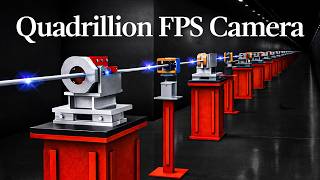
- Creating Molecular Movies at Quadrillion FPSMinimum Time ResolutionThe smallest time delay that can be tweaked between X-ray probes is around 300 attoseconds, enabling frames separated by only a few hundred attoseconds.Frame Rate AchievementBy stitching attosecond-separated snapshots together, scientists create videos running at technically over a quadrillion frames per second, visualizing electron dynamics in real time.Example SystemPara-aminophenol molecule was studied; simulations predicted electron density changes after X-ray ionization, with red representing density increases and blue representing density decreases.Charge Motion Imaging• Charge distribution initiates and moves across molecules after ionization • Experimental measurements validate simulated predictions at early timescales • Divergence between prediction and measurement at 5-10 femtoseconds reveals new physics • Unexpected results represent the most exciting moments in science discovery
- The Power of Visualizing Electron MotionAnimation SignificanceMost Veritasium videos feature animated electrons moving in some form, making actual observations of electron density motion particularly meaningful.Scientific AchievementSeeing electron densities physically move and change around atoms represents a spectacular capability, revealing fundamental processes previously only theorized.Research ImpactThe ability to image electron behavior provides direct evidence of molecular processes, transforming how scientists understand chemical reactions and material properties.Journey SummaryFrom century-old strobe photography freezing factory equipment to quadrillion FPS cameras revealing electron clouds around molecules, each method reveals phenomena hidden at conventional timescales.