How Hidden Technology Transformed Bowling
This is the biggest, most in-depth video about bowling ever.
12 chapitres
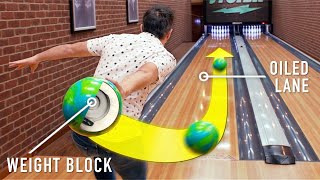
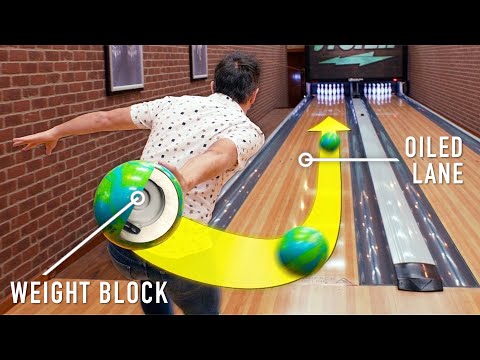
- The Anatomy of a Bowling BallInternal Structure• Bowling balls contain an asymmetrical weight block at the center • The weight block is embedded in a core of lightweight glass beads • Weight blocks are 2.5 to 3 times more dense than the core material • The weight block is not symmetric and not centered in the ballManufacturing Process• Weight blocks are created first, then embedded in core material • Urethane cover stock is poured around the core in heated tanks • Balls are spun at nearly 2000 RPM to achieve perfect roundness • A needle identifies and marks the center of gravity on the ball's surfaceSurface PreparationFresh bowling balls emerge extremely porous and dull with high friction, then are smoothed to a desired finish level.Production ScaleStorm Bowling, one of only 11 bowling ball manufacturers in the world, produces over 3000 balls per day.
- The History and Rules of BowlingAncient Origins• Wall drawings resembling bowling were found in ancient Egyptian tombs dating back 7000 years • In Germany, bowling was used as a religious ritual where pins represented sins • Martin Luther was a bowling fanatic and fixed the number of pins at nineModern Evolution• Nine-pin bowling was banned in America because it promoted gambling • Ten-pin bowling was created to circumvent the ban • Today, nine-pin bowling is only played in Texas, the one state that didn't ban itLane SpecificationsBowling lanes are 3.5 feet wide and 60 feet long to the headpin, made of 39 narrow boards traditionally constructed from maple and pinewood, now often synthetic with melamine resin coating.Scoring System• One game consists of 10 frames with two throws per frame • Maximum score without strikes is 190 • Strikes allow double counting of next two throws • A perfect game with all strikes scores 300
- Mastering the Perfect StrikeTarget Strategy• Hitting the headpin straight on results in splits or deflection • The optimal angle is 6 degrees off center at the headpin • Hitting pins 1, 3, 5, and 9 creates a chain reaction for a strike • This 6-degree angle provides over 90% chance of a strikeThe Hooking AdvantageDirect headpin hits only give a margin of error smaller than half a board, but a 6-degree angle approach provides a board and a half of room for error while maintaining over 90% strike probability.Technique RequirementsBowlers must curve the ball on the same lane by spinning it, which became a major part of bowling by accident when lane oiling was introduced to protect the wood.Professional ExamplesPro bowlers like Pete Weber and Chris Barnes demonstrate precise execution of identical shots that hit the target pins consistently and accurately.
- Lane Oil: The Game ChangerOriginal PurposeLane oil was originally applied as a lubricant to protect wooden lanes from damage caused by bowling balls, not for competitive advantage.Unintended Effect• Oil prevents the ball from gripping and rolling, allowing it to skid instead • Balls can rotate independently of their direction of travel • This discovery transformed bowling strategy and made the sport more enjoyableModern Application• Machines like $30,000 lane systems apply specific oil amounts to each board • Oil typically extends about 2/3 down the lane to 40-45 feet • A dry patch before the pins increases friction for rolling without slipping • Hundreds of different oil patterns are availableGame DynamicsWithout oil, bowling becomes impossible as the ball immediately hooks into the gutter, making the sport unplayable and unfun.
- The Three Phases of a Perfect ThrowSkid PhaseThe ball is released at 20 mph spinning at 500 RPM (nearly 10 revolutions per second), then slides down the lane spinning but not rolling during the skid phase.Hook PhaseAs the ball reaches the end of the oil, friction increases and the ball accelerates in the direction of its spin, hooking because the spin begins aligning with the direction of travel.Roll PhaseThe ball transitions into rolling without slipping and barrels into the pins at approximately a 6-degree angle for optimal strike probability.Practical ExecutionA perfect trajectory starts on the left side of the lane, goes straight across rightmost, then hooks at the last minute rolling directly into the pocket.
- Bowling Ball Evolution and TechnologyMaterial Progression• Hard rubber bowling balls were standard in the mid-1970s • Columbia Yellow Dot introduced plastic balls • Urethane bowling balls provided significant performance improvements • Reactive resin balls with porous surfaces offer superior grip in oilWeight Distribution• Perfect spheres gave way to asymmetrically weighted designs • Drilling holes removes weight, compensated by small pancake weights • Identical-looking balls with same weight can roll differently based on internal mass distributionMoment of InertiaMass concentrated near the rotation axis creates lower moment of inertia, allowing the ball to spin faster for the same energy input, referred to in bowling as radius of gyration or RG.Performance ImpactSmaller radius of gyration enables sharper hooks further down the lane, giving bowlers better chances of achieving the optimal 6-degree entry angle.
- Symmetric vs Asymmetric Ball CoresCore Design Types• Symmetric weight blocks maintain consistency when rotated about the central axis • Asymmetric cores have three different principal axes of rotation with varying moments of inertia • All cores are identified by a pin marking the minimum moment of inertia axisRotation BehaviorBalls spin most easily about their pin axis, with maximum moment of inertia at the equator for symmetric designs.Precession Effect• Asymmetric balls precess like gyroscopes as they travel down the lane • The axis of rotation rotates, changing contact points between ball and lane • This creates track flare, visible as spread-out oil lines on the ball surfaceStrategic AdvantageLarger RG differential in asymmetric cores causes dramatic precession and increased hook near the pins, while symmetric cores with minimal precession reduce traction and hooking.
- Center of Gravity and Ball MotionDiscovery MethodThe heavy side of a bowling ball can be identified by letting it spin freely on a cushion of air until it settles with the heavy side down.Left-Side PositioningWhen the center of mass is on the left side of the ball, it pulls in the same direction as the spin, helping the ball hook to the left toward the pins.Right-Side EffectA flipped ball with center of mass on the right will hook left initially but then pull sharply to the right at the end, creating an unusual trajectory.Impact SignificanceCenter of gravity effects are most noticeable when balls are thrown slowly and have less overall impact on ball motion compared to surface properties and RG differential.
- The USBC Ball Motion StudyResearch Method• The US Bowling Congress conducted a landmark study in 2008 • Harry, a robot bowler, threw thousands of identical shots • Harry was the most consistent bowler in the world at the timeKey Findings• Center of gravity affected ball motion minimally, similar to environmental factors like temperature and humidity • RG and RG differential significantly influenced ball motion • Ball surface properties had the greatest impact on ball motionTop Five Factors• Amplitude of surface roughness (microscopic spike height) • Coefficient of friction with oiled lane • Surface roughness spacing (distance between microscopic spikes) • Coefficient of friction with dry lane • How quickly the ball surface absorbs oilRobot PerformanceEarl, Harry's successor in 2011, lost to Chris Barnes in his debut because his perfectly consistent throws wore away oil in one lane section, causing excessive hooking.
- Ball Surface and Finish StrategyRough Surface Benefits• Rougher finishes give the ball more traction in oiled lanes • They help the ball start hooking earlier in the lane • Useful for long oil patterns and slower axis rotationRough Surface DrawbacksRough surfaces act like winter tires on clean roads, actually reducing friction on completely dry lanes because rougher exteriors mean less surface area touching the lane.Smooth Surface Advantages• Near mirror-shine finishes prevent excessive early hooking • Better for short oil patterns • Multiple smoothness levels are availableEquipment SelectionProfessional bowlers carry multiple balls to each competition and switch balls during games based on changing lane conditions, similar to how golfers select different clubs.
- The Impact of Technology on Bowling PerformanceScore ImprovementsOver the last 20 years, average bowling scores have increased by more than five points, demonstrating measurable improvement in player performance.Perfect Game Trends• The number of perfect 300 games bowled per year per thousand bowlers has increased dramatically since the 1980s • In 1976, soaker balls were banned, causing a dip in perfect games • The Brunswick LT-48 rubber ball introduced that same year led to more 300sEquipment Correlations• 1991 introduction of reactive resin balls created a significant jump in perfect games • New ball technology correlates with increased perfect game rates • Improvements extend beyond ball technology to overall equipment and natural variabilityMicro-FactorsEven ball color has a measurable impact—a 2016 USBC study found that different pigments absorb oil at different rates, affecting ball motion.
- Putting It All Together: The Complete GameStrategic Considerations• Consider the oil pattern on the lane • Account for how the pattern shifts as the game progresses • Select appropriate weight block type (symmetric or asymmetric) • Choose which axis to spin the ball aboutBall Properties• Determine center of mass placement for left or right pull • Select cover stock material and finish (rough or smooth) • Match ball characteristics to current lane conditionsExecution TargetExecute a shot that skids, hooks, and rolls to the pins between boards 17 and 18.5 at as close to a 6-degree angle as possible.Perfect Game ChallengeRepeat this complex decision-making and execution process 12 consecutive times flawlessly to achieve a perfect 300-point game.