How To Earthquake-Proof A House
6 chapitres
- The Kobe Earthquake and E-Defense CreationEvent OverviewOn January 17, 1995, a magnitude 6.9 earthquake struck Kobe, Japan, killing over 6,000 people and leaving 300,000 homeless. More than 80% of fatalities were caused by building collapse.Why Kobe Was Unprepared• Japan sits on the boundary of four tectonic plates where 90% of powerful earthquakes occur • The Kobe earthquake was caused by an interplate fault, a crack not at a plate boundary • This fault had not produced earthquakes for around 1,000 yearsEconomic ImpactThe earthquake caused an estimated 80 billion US dollars in damage and became the catalyst for building the world's largest earthquake simulator.Government ResponseThe Japanese government gathered scientists for a conference on earthquake disaster prevention and agreed to construct E-Defense, the world's largest earthquake simulator ever built.
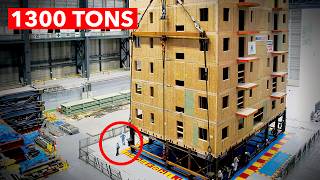
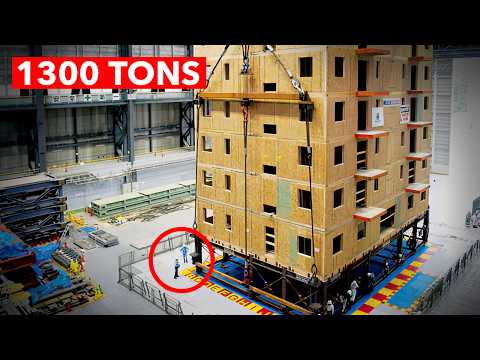
- E-Defense Facility and Shake Table TechnologyFacility Scale• E-Defense has conducted more than 100 tests on different building types • The shake table measures 20 meters by 15 meters and weighs 800 tons • Buildings are constructed in a separate warehouse and then transferred to the test facilityPower SystemThe facility uses 20 lead spherical shaped accumulators filled with nitrogen gas to store pressure. Liquid nitrogen expands 694 times its original volume when warmed, providing the sustained pressure needed for tests lasting minutes.Actuation Mechanism• Five hydraulic actuators on each side push the table horizontally with 30-ton pistons driven by high-pressure oil • 14 additional actuators at the bottom move the table vertically • Electronic servo valves control precise, timed forces to match real earthquakes • Seven-meter universal joints transfer force while allowing flexibilityTesting CapabilitiesThe shake table can support masses up to 1,200 tons and jolt them with accelerations up to 15 meters per second squared, or 1.5 gs, simulating the world's most destructive earthquakes.
- Seismic Data and Earthquake MeasurementRecording Methods• Early seismometers used a pen attached to springs drawing patterns on moving paper • Modern geophones use a coil of wire suspended around a magnet to generate current when ground shakes • Three geophones are needed to measure movement in all three dimensionsMagnitude ScaleThe magnitude scale is logarithmic, where an increase of one unit represents a tenfold increase in earthquake force. The smallest earthquakes humans can feel are about a billion times less powerful than the largest ever recorded.Earthquake Classification• Earthquakes under 2.5 magnitude are imperceptible to humans and occur millions of times yearly • Earthquakes above 6.0 magnitude can damage buildings but occur only a few hundred times yearly • The Great Chilean earthquake of 1960 measured 9.5, the most powerful ever recordedBeyond MagnitudeEarthquake destructiveness depends not only on magnitude but also on epicenter distance. The Great Hanshin earthquake's epicenter was 16 kilometers underground near the Akashi Kaikyo Bridge, which moved 80 centimeters despite being directly above it.
- Testing Traditional Houses and Building Code ImpactFirst Test ResultsE-Defense's early tests compared two traditional Japanese wooden houses shaken at Kobe earthquake magnitude. The retrofitted house with wooden braces, beams, and metal joints survived, while the unmodified house collapsed.Building Code Success• In 1981, Japan introduced new building codes requiring seismic dampening, isolation systems, and wooden beams • During the Kobe earthquake, only 0.3% of post-1981 buildings collapsed compared to 8.4% of older buildings • This represents a 30-time difference in safety between new and old structuresInterior Safety ConcernsHalf of the injuries sustained indoors during the Kobe earthquake were from furniture falling on people. E-Defense tests how to make building interiors safe by examining furniture placement and fall protection.Retrofit SolutionsSimple and inexpensive structural reinforcements like wooden braces, beams, and metal joints can significantly increase earthquake resistance in older buildings.
- Simulating the Kobe Earthquake and Future ThreatsKobe Test ParametersThe Great Hanshin (Kobe) earthquake lasted only 20 seconds with a 6.9 magnitude and maximum acceleration of 0.9 g, demonstrating how brief but powerful the seismic event was.Duration Variations• The Kobe earthquake recorded very large but brief motion lasting only seconds • The 2011 Japan earthquake produced very long duration motion lasting about five minutes • The expected future Tokai-Nankai earthquake is predicted to produce very long duration motionFuture Risk AssessmentSeismologists give a 70% chance that a magnitude 8 earthquake will occur near the Tokai region within 30 years, affecting more than 15 million people. The Nankai trough produces massive earthquakes every 100 years, but the Tokai region hasn't experienced one in over 160 years.Potential CasualtiesGovernment estimates predict over 320,000 deaths from a major Tokai-Nankai earthquake. While most will be from a 30-meter tsunami, around 82,000 could result from building collapse.
- From Safety to FunctionalityCurrent ProgressNewly built buildings in Japan are very safe with high seismic performance, and most can survive even very large earthquakes without collapse.New ChallengeWhile building collapse prevention is largely solved, the next goal is to keep buildings functional after earthquakes. Currently, water pipes burst and electricity is lost, forcing people to evacuate even when structures remain intact.Research DirectionE-Defense is now testing methods to prevent functional loss in buildings during major earthquakes, moving beyond just preventing collapse to ensuring habitability.Broader ImpactJapan invested billions in earthquake research and preparation rather than waiting for disasters. This approach demonstrates how proactive science and updated building codes can save hundreds of thousands of lives even when earthquakes cannot be predicted.