Why Airships Might Make A Comeback
14 chapitres
- The Problem With AirshipsHistorical ContextThe Hindenburg disaster killed many people and created a lasting negative perception of airships. The ship was filled with over 200 million liters of hydrogen and had an iron oxide and aluminum powder coating that created thermite, a highly flammable mixture.Core Limitations• Airships are inherently big and slow • They lack the speed advantages of planes • They lack the cost advantages of shipsCurrent StatusDespite these drawbacks, a handful of companies around the world are competing to build a new generation of airships.The QuestionWhy would anyone invest in airships when they have such fundamental disadvantages?
- The Transportation GapDomestic Transport• Air transport is fastest but extremely expensive • Ships are cheap but very slow • Rail is faster than ships and cheaper than planes • Trucks dominate because they balance speed and costThe Sweet SpotTrucks are not the fastest or cheapest option, but they occupy the 'Goldilocks zone' of cheap enough and fast enough, making them the primary transport method for goods in the U.S.International LimitationsInternationally, only two transport options exist: planes (expensive but fast) and ships (cheap but slow). There is no middle-ground option.The OpportunityIf a transport method existed that was faster than ships and cheaper than planes, it would likely capture most of the cargo market, similar to how trucks dominate domestic transport.
- Airships as the Sky's TrucksThe PropositionAirships could fill the gap between ships and planes by transporting cargo across oceans in around a week instead of a month, while costing several times less than planes.Environmental Advantage• Planes burn fuel to stay aloft because they rely on wing lift • Airships get lift for free from buoyancy of lighter-than-air gas • Modern airships could reduce carbon emissions by 90% or morePhysics AdvantageLift depends on volume (proportional to radius cubed) while drag depends on surface area (proportional to radius squared). Doubling an airship's size increases lift eightfold but only doubles drag, giving larger airships dramatic efficiency advantages.Scaling PotentialRigid airships can scale even better than the cube-squared advantage because the structural weight decreases as a fraction of total weight, making them ideal for large cargo operations.
- Types of AirshipsBlimpsBlimps are over-pressurized balloons with gondolas and motors. The skin is in constant tension, making them difficult to scale up because larger blimps become increasingly hard to maintain their shape.Semi-Rigid DesignSemi-rigid airships add some structural support to the hull while maintaining tension, offering a middle ground between blimps and rigid structures.Rigid Body Airships• Have internal structure to maintain shape • Contain gas cells filled with hydrogen or helium • Gas cells are not over-pressurized • No scaling limits like blimps haveBest Option for CargoRigid airships are best suited for the cargo market because they can scale to much larger sizes without the structural weight becoming prohibitive.
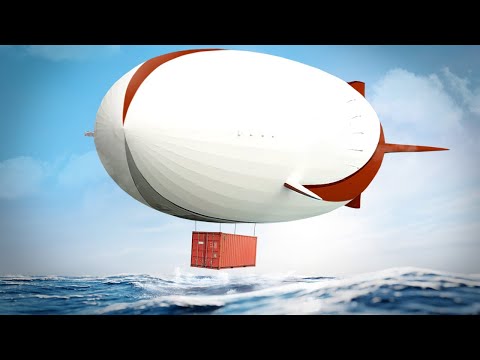
- The 500-Ton VisionThe Design ConceptA 388 meter long rigid airship capable of carrying 500 tons of goods at 90 kilometers per hour, equivalent to carrying two Statues of Liberty at highway speed.Record-Breaking ScaleThis airship would be the largest aircraft in the world by far, both in size and weight capacity.Market PotentialTo capture a significant piece of the cargo market would require a fleet of thousands constantly moving goods globally.Revenue ImplicationsIf airships took over half the ocean freight container market at 10 cents per ton kilometer, the revenue would be 650 billion dollars per year, making it bigger than Apple, Amazon, or Walmart.
- Luxury Travel MarketCurrent FocusRather than pursuing cargo, some companies are targeting luxury travel markets with fewer competitors and better profit margins.The Airlander 10Built by UK company Hybrid Air Vehicles, this airship is designed for extraordinary experiential holidays to remote locations like the North Pole, safaris, and the Amazon.Travel ExperiencePassengers travel in luxury while making almost no environmental impact and experiencing destinations inaccessible by other means.Cost and TimelineA cabin for two costs about 200,000 dollars. First trips are scheduled for no later than 2026.
- Infrastructure AdvantagesMinimal Requirements• Trucks need roads • Ships need water and ports • Trains need railways and stations • Planes need long runways and airports • Airships need only a reasonably flat surface like grass, sand, ice or waterRemote ConnectivityAirships can connect remote villages in Canada and Alaska that have been disconnected forever, with little to no infrastructure.Disaster ReliefWhen natural disasters destroy roads, rails and ports, airships can quickly deliver rescue workers, supplies, or cellular service from the sky.Specialized CargoLarge, fragile items like wind turbine blades can be transported without the careful choreography required for road transport, allowing for bigger turbines and faster delivery.
- LTA Research and Flying WhalesLTA ResearchBacked by Google co-founder Sergey Brin, LTA Research is developing airships for disaster relief missions. Their Pathfinder 1 prototype has completed multiple indoor flight tests and is scheduled to fly outside in the next few months.Forest ResourcesFrance has vast natural resources like wood in remote forests that cannot be reached by truck, preventing extraction of already-harvested logs.Flying Whales SolutionThe French company Flying Whales, backed by the French government, is developing a 200 meter long cargo airship capable of carrying a 60-ton payload to hover above forests and pick up logs.Timber TransportThis airship can carry harvested logs to timber processing facilities, solving the problem of accessing remote forest resources.
- The Load Exchange ProblemThe Core IssueWhen an airship releases a heavy load, it suddenly becomes much lighter and wants to shoot up into the sky. Without solving this, cargo airships cannot function effectively.Weather ChallengesLoading and unloading from the sky requires the airship to stay still, which is difficult in wind due to the sail effect. A large area multiplied by even light wind creates huge control problems, limiting operations to stable weather locations.Venting Gas Solution• Decrease lift by venting lifting gas • Problem: most modern airships use helium • Venting 54,000 cubic meters costs hundreds of thousands of dollars • Helium is scarce, making this impracticalAlternative Approaches• Using propellers to push the airship down negates efficiency advantages • Compressing and decompressing lifting gas requires compressors we haven't yet developed for this scale • Replacing weight by carrying ballast water is the short-term solution
- Hybrid Airship InnovationThe Hybrid ApproachThe Airlander 10 combines lift from helium and aerodynamic lift created by its hull shape.How It Works• Helium lifts the entire weight of the aircraft so it weighs nothing during flight • Aerodynamic lift from the hull lifts the payload • When landing, passengers disembark and aerodynamic lift is turned offKey AdvantageThe airship doesn't float away after passengers exit because aerodynamic lift can be turned on and off, unlike buoyancy which is always present.Payload LimitationsHybrid airships work well for relatively light payloads but are not ideal for heavy payloads over long distances because aerodynamic lift cannot replace the free lift advantage needed for large cargo.
- Manufacturing and ConstructionScale ProblemNo one has ever built a 388 meter long airship before. The largest airship hanger ever built was only 360 meters long, so a mega-airship wouldn't even fit.Production Challenge• Building thousands of airships would require either constructing fragile airships outside without hangers • Or building many of the world's largest hangersLifting Gas VolumeEach airship must be filled with over one million cubic meters of lifting gas, raising critical decisions about hydrogen versus helium.Building RequirementsAirships are normally built in humongous hangers to protect them from the elements, which creates a significant scaling problem for mega-airships.
- The Hydrogen QuestionThe Trade-off• Helium is really expensive and has lower lifting ability • Hydrogen is really cheap but highly flammableHistorical ContextAfter the Hindenburg burned in less than 40 seconds, helium seemed like the obvious choice. The FAA banned hydrogen as a lifting gas for many years.Safety Reality• Of 97 people on the Hindenburg, more than 60 miraculously survived • The USS Akron, filled with helium, crashed killing 73 of 76 people • The issue may not be that hydrogen airships were inherently unsafe, but that we didn't know how to build safe airshipsPractical ChoiceFor building thousands of large-scale airships, hydrogen is the only realistic option because helium is too scarce and expensive. Hydrogen is easy to produce, cheap, and provides about 8% more lift.
- Certification and ChallengesRegulatory HurdleCertificating any new aircraft is lengthy and expensive. For airships, it's even harder because you're certificating a brand new type of aircraft that no one has certificated at scale before.Regulatory Scope• Building the largest aircraft the world has ever seen • Filling it with tremendous amounts of highly flammable gas • Obtaining certification for an unprecedented designStructural LimitsAirship structures must be light, robust, strong, and have good integrity. At a certain size, the weight needed for structural integrity becomes too heavy to achieve lift, creating a fundamental size limitation.Unknown ThresholdNo one is certain exactly how large an airship can be before structural weight requirements make it impossible to achieve sufficient lift.
- Current Development and FuturePresent ApproachSeveral companies around the world are developing next-generation airships, but none are currently setting out to develop the massive 500-ton cargo airships.Market Strategy• Companies are focusing on areas where airships have distinct advantages • Targeting markets with less competition and decent profit margins • Building experience and technology for future expansionOptimistic VisionIndustry experts believe it may not be very long before airships become visible in the sky, bringing happiness and nostalgia for the great airships of the past.Path ForwardAs airships mature and become normalized, one company may eventually take the leap and develop the massive cargo airships. The reward for success could be enormous, but the challenges are significant.