
How To Measure The Tiniest Forces In The Universe
8 chapitres
- Introduction to Mass Measurement StandardsThe ChallengeMeasuring extremely small objects like a 10 microgram weight, which is barely visible to the naked eye and smaller than an eyelash.Historical Approach• Mass was measured by balancing objects against known standards • The kilogram was defined by a platinum-iridium cylinder stored in Paris • Replicas were distributed to countries worldwide as mass standardsPrecision ProblemThe uncertainty in a standard kilogram is about tens of micrograms or roughly 0.000001%, and uncertainty increases when weighing lighter objects.Key IssueReplica kilograms showed diverging weights by up to 75 micrograms when brought back to Paris for comparison, making a physical standard unreliable.
- Subdivision and Test WeightsSubdivision MethodBreaking down a kilogram into progressively smaller masses by comparing equal pairs on a balance, from 500 grams down to individual milligrams.Test Mass Examples• 50 gram test weight serves as a reference mass • 10 gram weight noticeably lighter than the 50 gram • 1 gram paperclip used as a practical reference pointPractical ApplicationLaboratories use test weights to calibrate scales and verify accuracy of measurements in research and industrial settings.The Range• Can subdivide a kilogram by a million times down to milligrams • Uncertainty at milligram level reaches about 0.01 percent or one part in 10,000 • Each subdivision step increases uncertainty slightly
- Redefining the Kilogram with Planck's ConstantThe ProblemPhysical mass standards became unreliable due to changing masses, making it unacceptable to base measurements on objects that drift over time.The Solution• Eliminated dependence on a physical kilogram cylinder • Defined kilogram based on Planck's constant, a fundamental constant of nature • In 2019, officially set Planck's constant value in Joule-secondsScientific ConnectionPlanck's constant relates photon frequency to energy through E=hf, and since energy and mass connect through E=mc², mass can be defined through Planck's constant.Practical AdvantageThis definition enables Kibble balances to measure mass by balancing weight with electromagnetic force, achieving direct traceability to the International System of units.
- The Kibble Balance and Electrostatic Force BalanceKibble BalanceA specialized scale that balances an object's weight with electromagnetic force, allowing very accurate measurements since electrical quantities can be read with high precision in units of Planck's constant.Electrostatic AlternativeThe Electrostatic Force Balance (EFB) uses a capacitor instead of an electromagnet, consisting of two concentric cylinders that create attractive force when voltage is applied.Extreme Conditions• Lab located deep underground to isolate from vibrations • Air temperature maintained at constant 20 degrees Celsius • All measurements performed in vacuum to eliminate air currents and buoyant forcesPrecision CalibrationScientists carefully measured local gravity acceleration in the lab at 9.801 meters per second squared, which is essential for accurate mass measurements.
- Measuring at the Microgram LevelCurrent LimitsThe EFB lab measures forces most accurately in the world at the milligram level, achieving precision of about 10 micro-newtons of force.Visualization ChallengeA 10 microgram test weight is nearly impossible to see without assistance, requiring arrows and special macro lenses to visualize, comparable to a hair thinner than an eyelash.Manufacturing DifficultyCreating a 10 microgram test weight requires great effort and meticulous calibration on a balance, pushing the limits of what can reasonably be made as a standard weight.Next StepTo measure even smaller forces below the microgram range requires different technology, such as atomic force microscope cantilevers.
- Atomic Force Microscope CantileversDesign• Tiny cantilever beams with sharp tips on the end • Function like small diving boards that bend under force • The degree of bending indicates the magnitude of force appliedForce RangeCapable of measuring nanonewton to piconewton forces, allowing application of extremely small controlled forces.VisualizationThe tips are so small they require a microscope to see, making direct observation impossible without magnification.DNA ConnectionOne piconewton of force is approximately the force needed to stretch out a DNA molecule end to end.
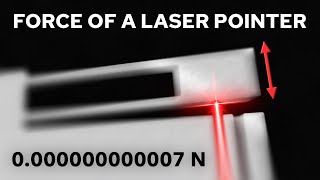
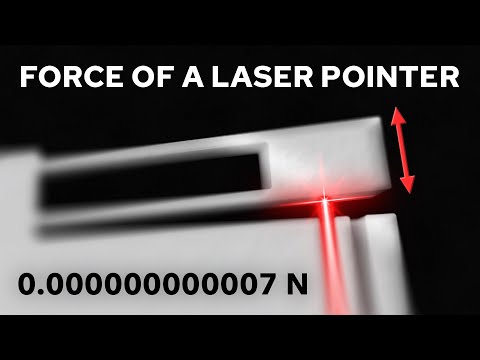
- Femtonewton Measurements and Laser Force DetectionSmallest ForcesThe smallest forces confidently measured with traceability to international standards are in the femtonewton range, about one thousand times smaller than a piconewton.Sensor Design• Uses a fused silica parallelogram flexor that vibrates at a pure tone • Vibration detects very small changes in applied force • Displacement measured using laser interferometryOptical MethodA laser interferometer measures the motion of the sensor, while a tiny optical fiber delivers known laser power to create photon pressure force.Practical DetectionCan measure force from a laser pointer, demonstrating sensitivity to approximately seven piconewtons, enough to stretch DNA molecules.
- Applications and Scientific ImpactIndustrial Uses• Automotive manufacturers measure particulate mass from exhaust systems, especially diesel engines, for environmental standards • Laser power measurements calibrated using small force measurements for industrial processes • Pharmaceutical industry requires precise measurement of microgram and milligram drug dosesScientific AdvancementNew measurement capabilities push the frontiers of science, enabling new scientific discoveries which then feed back into creating even better precision measurement tools.Role of NISTNIST creates an environment where improved measurement technology directly supports new scientific research and discovery.Continuous CycleBetter metrology capabilities enable new science, which drives demand for even more precise measurements, creating a virtuous cycle of innovation.