This Unstoppable Robot Could Save Your Life
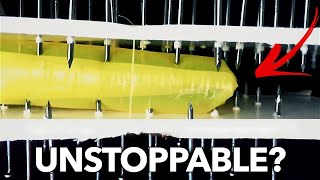
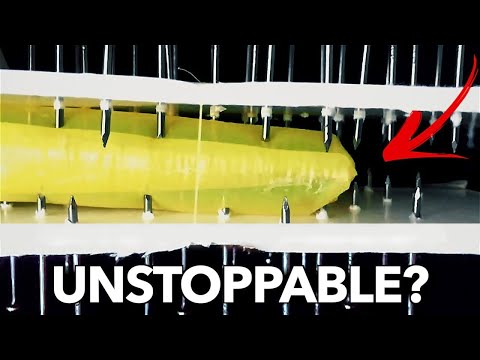
This is a robot that can grow to hundreds of times its size, and it can't be stopped by adhesives or spikes.
7 chapitres
- Introduction to Vine RobotsWhat It IsA soft robot powered by compressed air that grows from the tip and can expand to hundreds of times its original size.Key Abilities• Can pass through tight spaces easily • Not affected by sticky surfaces or spikes • Continues operating even when punctured as long as air pressure is maintainedDesign InspirationThe concept came from observing how a vine in an office grew outward toward sunlight over the course of a year, seeking light around a shelf edge.Practical ApplicationsDozens of potential uses including search and rescue, archeology, medical procedures, and space exploration.
- How the Robot WorksBasic MechanismMade from airtight tubing folded on itself that inflates with compressed air, causing it to grow outward from the tip.Growth Control• Tape applied to the outside of tubing can shorten one side to control bending direction • Can be shaped into helical patterns to create deployable antennasRetraction MethodsIn constrained environments, pulling on the tail material causes the robot to retract. In open spaces, internal rollers prevent buckling during retraction.Force CapabilityCan lift objects weighing up to 1000 kilograms with just one-tenth of an atmosphere of pressure applied over a large area, remaining soft throughout.
- Steering and Attachment SystemsCamera Mounting• End caps keep the camera at the front while being pushed by the robot • External frames interlocked with internal frames, similar to roller coaster wheel mechanisms, prevent cameras from falling off during growthActive SteeringThree pneumatic muscles with 45-degree braided ripstop nylon fabric allow directional control by shortening and lengthening the sides as the robot extends.Control PrincipleWorks like arm tendons: inflating muscles on one side turns the robot one way, deflating and inflating the opposite side turns it the other direction.Navigation AdvantageCan fit through tight spaces, doesn't get stuck on obstacles, and handles sharp objects without damage.
- Archeological ExplorationMission DetailsVine robot was deployed at an ancient temple in Peru's Andes mountains built between 1500 and 500 BC to investigate underground spaces.ChallengeArcheologists discovered small ducts and tunnels branching off from larger gallery rooms but couldn't access them due to their narrow dimensions.Solution SuccessThe vine robot successfully explored three tunnels that could not have been accessed by other means, providing complete video footage.Research ValueHelped archeologists understand the purpose and design of the underground spaces within the ancient temple complex.
- Medical Application: IntubationTraditional MethodHighly trained medical professionals use a laryngoscope to see the trachea and manually pass a tube down for patients who cannot breathe.Problems Addressed• Procedure is time-consuming and physically demanding on patients • Every second counts in emergency situations • Requires significant professional trainingVine Robot SolutionA miniature version can be inserted through the nose with simple pressurization, using passive mechanical intelligence to navigate the correct airway.Testing ResultsSuccessfully demonstrated in cadaver labs, showing that the device can move from idealized conditions to actual in-vivo situations and perform intubation.
- Burrowing in Sand and Mars ExplorationSand PenetrationCompressed air jets from the robot's front fluidize sand, making it behave like liquid and allowing the robot to extend through granular materials.Mars ApplicationNASA considers vine robots as a potential solution for exploring planetary surfaces where traditional burrowing methods have failed.Mars InSight ProblemPrevious heat probe on Mars got stuck trying to hammer its way into cohesive soil, as friction was insufficient between the probe and sand.Vine Robot AdvantageTip extension method doesn't rely on interaction with surrounding material—the robot maintains a base at the surface and simply extends downward progressively.
- Summary and ConclusionDesign EleganceThe vine robot demonstrates how nature-inspired design creates simple yet effective solutions that can be built in under a minute with basic instructions.Diverse Applications• Archeology: exploring ancient underground structures • Search and rescue: navigating collapsed buildings • Medical: intubation procedures • Space exploration: planetary surface investigationKey AdvantagesCombines soft construction with powerful lifting capability, making it safe, cheap, and resistant to damage from obstacles or punctures.Future PotentialOpen-ended possibilities for additional applications that viewers might imagine for this versatile soft robotics platform.