How Japanese Masters Turn Sand Into Swords
This is a video about how Japanese swords are made, swords that are strong enough and sharp enough to slice a bullet in half.
11 chapitres
- Introduction to Japanese Sword MakingVideo OverviewDerek introduces a comprehensive documentary on Japanese sword making, covering every step from gathering iron sand to sharpening and polishing the finished blade.Historical Significance• The method has remained virtually unchanged for hundreds of years • Japanese swords are still considered among the best in the world • A 16th century sword was appraised at $105 million, the most expensive sword ever builtProduction AccessThe crew was granted unprecedented access to film the entire process, including the rare Tatara smelting method performed only once per year.Key Features• Swords are strong enough to slice a bullet in half • Made with traditional hand-forged techniques • Production involves multiple specialized craftspeople
- The Tatara Smelting MethodAncient ProcessIn Shimane province, a smelter is lit for only one night each year to produce steel using the same method from 1300 years ago, known as the Tatara method.Historical Context• Japanese sword making dates back approximately 3000 years, initially using bronze • Steel production began 1200 years ago during the Heian period • Japan imported metals from China and Korea until the eighth centuryThe CeremonyA Shinto priest lights the fire after ceremonial prayers at 9:00 AM, and all workers remain at the smelter for at least the next 24 hours.Material SelectionSteel made through the Tatara method is reserved exclusively for the very best Japanese swords.
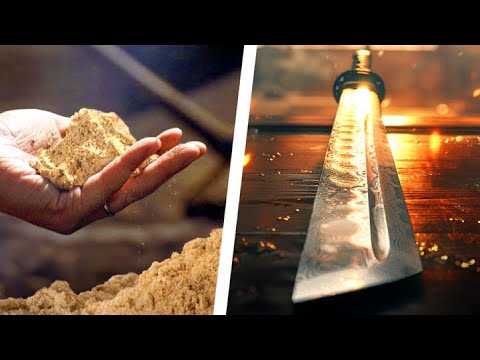
- Iron Sand Sourcing and ProcessingIron Formation• Two and a half billion years ago, cyanobacteria produced oxygen that caused iron to precipitate from the ocean • Iron accumulated in layers of sedimentary rock called banded iron formations • Most of the world's iron supply comes from these formations with up to 60% iron oxide by weightJapan's ChallengeJapan's volcanic geology contains barely any sedimentary iron oxides, making it difficult to source iron ore, which is why the country was late to steel production.Local SolutionIron oxides from igneous rocks like granite and diorite are weathered and washed downstream, accumulating in sand where the river changes direction or speed.Concentration Method• Japanese craftspeople deliberately created river diversions to increase iron concentration • Iron sand produced this way contains 80% iron oxides by weight, more concentrated than high-quality iron ore • The method has fewer impurities, making it excellent for high-quality steel
- Chemistry of Steel CreationIron to SteelHeating iron oxides above 1250 degrees Celsius breaks the bonds with oxygen to produce pure iron, but adding carbon from charcoal creates an incredibly strong alloy: steel.Atomic Structure• Alloys are stronger than pure metals because they contain different sized atoms • Different sized atoms reduce the ability of atoms to slide past each other under external force • Pure iron is actually softer than bronze and provides no advantageCarbon's RoleJust a small amount of carbon added to iron creates an incredibly strong alloy, and charcoal provides both the heat and the carbon needed.Process OverviewThe smelting process is fundamentally a chemical process, not merely a heat process, transforming raw materials into steel.
- The 24-Hour Smelting ProcessPreparation Phase• Iron sand is mixed with water to prevent it from flying up when heated • Too much water risks creating steam that could cause the kiln to explode • The mixture must be clumpy, determined entirely by feelCharcoal RequirementsA strong, steady supply of oxygen is needed to achieve high temperatures. Historically provided by huge foot-operated bellows requiring around-the-clock full-body effort by many men.Operating TemperatureThe temperature inside reaches 1500 degrees Celsius, just below iron's melting point of 1538 degrees, keeping iron soft and malleable while preventing complete liquefaction.Slag Management• Impurities like sulfur, phosphorus, and silicon oxides combine with carbon and become liquid slag • Slag flows to the bottom and is periodically removed through the smelter's bottom opening • 614 kilograms of iron sand and 670 kilograms of charcoal are added over 24 hours
- Extracting the Steel BlockSmelting CompletionAfter 24 hours of continuous operation, the smelting process concludes at 9:00 AM the next morning.Extraction MethodTraditionally, the smelter had to be broken apart to remove the steel. Modern methods use a crane to disassemble the smelter and extract the resulting block.Final OutputThe result is a 100-kilogram block containing steel, iron, and slag mixed together.Quality Control• Only approximately one-third of the block is high enough quality for sword making • Steel is sorted by quality and carbon content by eye • This visual inspection is one of the exams required to be certified as a swordsmith
- Steel Forging FundamentalsSwordsmith IntroductionOnly 30 of 300 swordsmiths in Japan work full-time at the craft. One master swordsmith, Akihara Kokaji, demonstrates the forging process.Initial Flattening• Steel is heated in a coal oven with hand-pumped bellows until soft and malleable • Traditionally, a master swordsmith set the rhythm with a small hammer while three apprentices used big mallets • Modern methods now use electric hammersFolding TechniqueAfter flattening, the steel is bent back on itself and hammered again to press it into a solid block.Purpose of Folding• Spreads impurities like silicon, sulfur, and phosphorus uniformly throughout the steel • Gives the steel a grain that reinforces it in the direction of combat impact • Oxidation creates darker colored steel that produces beautiful patterns when folded
- Layering and Steel CompositionLayer Formation• Some swords contain more than a billion layers • Every fold doubles the number of layers, requiring only about 30 folds for a billion layers • Typically, swords are folded 10 to 13 times, resulting in a few thousand layersCarbon's Impact• Higher carbon percentage makes steel harder and more rigid • Carbon atoms fit inside the iron crystal lattice and apply outward stress • High carbon steel is harder but becomes brittle, prone to chipping and shatteringComposite Blade DesignDifferent carbon percentages are used in different blade parts to balance hardness and flexibility.Strategic Composition• The edge is made of high-carbon steel to maintain sharpness • The spine is made of lower-carbon steel to allow flexing without breaking • Pieces are welded together using different carbon contents
- Heat Treatment and QuenchingClay Application• The forged straight blade is covered with a thick layer of clay on the spine • A thin layer of clay is applied to the blade edge • The sword is heated in the furnace and rapidly cooled in water, a process called quenchingDifferential Cooling• Different clay thicknesses create different cooling rates • The blade edge cools faster than the spine due to thinner clay coverage • This controlled cooling produces different steel structures in different partsSteel Transformation• The spine forms perlite, a combination of ferrite and cementite that is soft and ductile • The blade forms martensite, an incredibly hard steel with a tetragonal crystal structure • The tetragonal lattice takes up more space, causing the blade edge to expand and curve the swordVisual Result• The iconic curve of a samurai sword comes from martensite formation • The boundary between different steel types is visible by color difference, called hamon or edge pattern • About one-third of all blades shatter during quenching
- Final Finishing StepsTempering Process• The sword is placed back in the forge to evaporate remaining water • This heating loosens some crystal structures, making the sword less brittle • Japanese swordsmiths maintain a much harder edge than Western sword makersPolishing and Sharpening• Done by hand with whetstones of different coarsenesses • Can take an entire month to sharpen and polish a single sword • Water and residue flow downhill on a sloped work surfaceArtistic EnhancementSome swords are engraved with beautiful patterns, though this is quite rare and adds to their artistic value.Craftsmanship Philosophy• Each step from gathering iron sand to final polishing requires immense time and skill • All techniques were discovered through trial and error • The result is artifacts of such high quality they remain prized centuries later
- Sword Mastery and LegacyHistorical Legend• Miyamoto Musashi was the 10th-generation ancestor in a legendary lineage • He killed his first opponent in single combat at age 13 • He fought in more than 60 duels to the death and won every oneMastery DemonstrationDuring a snowstorm duel, Musashi held his katana so still and calm that snowflakes accumulated on the thin edge of the blade.Training Experience• A sword lesson with master Takara Takanashi focuses entirely on drawing and resheathing the blade • Actual sword use requires deep preparation and mastery of fundamentals • The experience demonstrates the complexity hidden behind simple sword movementsArtistic Appreciation• Japanese swords represent the pinnacle of craftsmanship and care • Each step requires expertise and attention to detail • The craft exemplifies doing something with deep love for the work itself