
34 Years Of Strandbeest Evolution
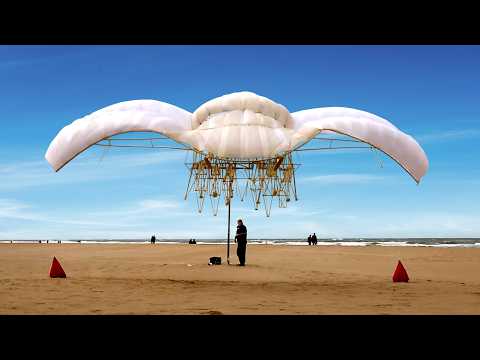
This is a Strandbeest. It's a walking skeleton that's powered only by the wind, created by Dutch inventor Theo Jansen.
14 chapitres
- Introduction to StrandbeestsWhat They AreWalking skeletons powered only by wind with no motors or electronics, created by Dutch inventor Theo Jansen.Materials UsedMade from unconventional materials including tape, glue, snot, and screws that transfer force effectively.Cultural ImpactThe Strandbeest has become notable enough to appear on The Simpsons, blurring the line between science and art.Origin StoryTheo Jansen promised himself to spend one year on the tubes in 1990, but the project grew far beyond that initial timeline.
- Overcoming Structural ChallengesInitial ProblemEarly Strandbeests could only lie on their backs with moving legs due to weak connections made with Sellotape.First SolutionJansen replaced tape with zip ties, creating a much stronger and cleaner connection system.Material RestrictionsJansen restricted himself to only a few basic materials to maintain simplicity and elegance in his designs.Remaining GoalsFive additional hurdles remained to achieve Jansen's vision of Strandbeests surviving independently on the beach.
- Finding the Perfect FootpathThe ChallengeThe path traced by the foot must be mostly flat at the bottom for the Strandbeest to maintain balance and walk properly.Computational ApproachJansen wrote a computer program in 1990 to calculate footpaths, but brute force testing would take 100,000 years.Evolutionary Method• Started with 1,500 different combinations of tube proportions • Selected combinations with flatter footpaths to reproduce with slight variations • Ran simulation for months until discovering 13 holy numbersGenetic CodeThe 13 holy numbers describe the proportions and placements of all tubes, forming the genetic code used by nearly every Strandbeest for over 30 years.
- Achieving Smooth LocomotionLeg CoordinationThree legs connect together, each offset by 120 degrees from the others, ensuring continuous contact with the ground.Walking PhysicsThis offset arrangement produces a continuous smooth walk rather than a rigid robotic movement pattern.Critical PrecisionAdam Savage's experience building a Strandbeest showed that even small errors in linkage lengths can prevent proper walking.Success RecognitionWhen proportions are correct, the Strandbeest walks smoothly; when adjusted properly, it transforms from non-functional to perfectly mobile instantly.
- Adapting to Beach ConditionsSand ProblemFluffy sand easily buries thin feet, causing Strandbeests to get stuck and unable to move.Foot Evolution• Developed large surface area feet instead of simple sticks • Added wires to increase contact time with the ground • This prevents feet from sinking while ensuring smooth transitionsFlexible LinkageFlexible joints between ankle and foot allow proper weight distribution and smooth gait without excessive pressure on the structure.Sand CoverageExtended stationary periods allow sand to cover Strandbeests, inspiring the evolution of flying variants that lift slightly to let sand pass underneath.
- Collective Survival StrategiesStorm ResilienceIndividual Strandbeests blow over easily in strong winds, but groups holding each other together provide mutual support and strength.Pulling DesignSome Strandbeests were designed to be pulled by other Strandbeests, allowing the group to move as a coordinated unit.SynergyWorking together, Strandbeests can overcome challenges that would be impossible for individuals to survive.Beach WalkingDerek personally pulled a Strandbeest up a Dutch beach with another one following, demonstrating the practical application of this design.
- Energy Storage and ActivationWind Dependency ProblemStrandbeests can only walk when wind is present; they become immobile when wind dies down, limiting their effectiveness.Energy Collection• A sail catches wind and turns a crankshaft • The crankshaft pushes a piston that compresses air • Pressurized air stores in plastic bottles at up to 5 barsEnergy ReleasePressurized air connected to pumps creates artificial muscles that can push or pull, enabling movement independent of current wind.Muscle VarietiesDifferent applications include crawling, walking with self-propulsion, and tail wagging, mimicking biological muscle functions.
- Developing Sensory SystemsAwareness GapStrandbeests are blind and deaf, unable to sense their surroundings or prevent themselves from walking into the water.Water Detection• A water feeler hovers at ground height and continuously sucks in air • When touching seawater, the device swallows water and detects resistance • This sensory input can trigger course correctionInformation ProcessingStrandbeests need a nervous system to process sensory inputs, make decisions, and command muscles to respond appropriately.Nerve CellsTheo constructed pneumatic nerve cells that function like logic gates, using pistons and valves to switch air flow on and off, mimicking binary computation.
- Building a Mechanical BrainLogic SystemPneumatic valves can invert signals, switching zeros and ones just like computer logic gates for processing information.Brain ComplexityOnly about 20 nerve cells would be needed for a Strandbeest to detect water and turn away from it.Implementation ChallengeSand creeping into mechanical components makes construction extremely difficult despite the relatively simple logic required.Evolutionary PatternEach challenge overcomes pushes Strandbeests closer to animal-like biology, following similar evolutionary patterns that life on Earth experienced.
- Degradation and SustainabilityNatural WearStrandbeests gradually lose color and parts break off over time due to exposure to beach elements.Environmental ImpactSmall amounts of microplastic pollution result from this degradation, though not on the scale of global concerns.Reuse Strategy• Almost all parts are reused in new creations • Damaged pieces are sold as fossils to collectors • Broken Strandbeests go to a graveyard for historical preservationLegacy CreationOne person's decades-long obsession has created an entire ecosystem of machines that continue to evolve and inspire.
- The Original MotivationClimate CrisisDuring the late 1980s, rising carbon dioxide levels made it clear that sea levels would rise by 2.2 meters by 2100.Threat to NetherlandsAbout a third of the Netherlands lies below current sea level, making rising sea levels an existential threat to the nation.Sand Building SolutionTheo's idea was to use wind-powered Strandbeests to kick up sand while walking, pushing it toward dunes to heighten them and protect coastlines.Public AnnouncementJansen published his concept in de Volkskrant newspaper under the name Strandbeest, Dutch for beach beast.
- From Vision to ObsessionProject ScopeA newspaper article about protecting the Netherlands evolved into a lifetime pursuit that now defines Theo Jansen's entire existence.True MotivationThe original coastal protection goal has given way to a more fundamental human need: the desire to be remembered after death.Legacy AchievementJansen's goal is for Strandbeests to eventually live independently on beaches, allowing him to die with peace of mind knowing his creation survives.Generational ChallengeJansen acknowledges he doesn't have millions of years to achieve his vision but hopes to inspire young people to continue the work through his infectious enthusiasm.
- Global Spreading of Genetic CodeViral SpreadThousands of people worldwide are incorporating Theo's 13 holy numbers into their own Strandbeest designs and variations.Diverse Adaptations• Miniature Strandbeests for small-scale displays • Rideable versions for human passengers • Walking bicycles combining human and wind powerNo RestrictionsUnlike Theo's own strict design rules, he allows others complete creative freedom to build and modify Strandbeests as they wish.Beautiful PhilosophyTheo's lack of control over others' designs represents a beautiful open-source approach where he simply enjoys seeing his creations come to life globally.
- Future Vision and LegacyUltimate GoalStrandbeests may one day achieve complete independence, roaming world beaches and kicking up sand along coastlines.Ecological PurposeThese artificial creatures could potentially protect coastlines from rising sea levels, fulfilling Theo's original vision from 30+ years ago.New SpeciesThe vision is of Strandbeests becoming a new form of life on Earth, distinct from biology yet alive in their own mechanical way.Lasting ImpactWhat began as one person's creative obsession has evolved into a distributed global phenomenon with potential real-world environmental benefits.