
The Real Reason Robots Shouldn’t Look Like Humans | Supercut
13 chapitres
- Introduction to Non-Humanoid RobotsCommon PerceptionPeople typically imagine robots as metallic and humanoid like Boston Dynamics robots when thinking about robots.Future DirectionRobots in the future might not look humanoid at all, as daily-use robots should prioritize being safe rather than sharp, delicate, and heavy.Better DesignAdvanced robots are more likely to be soft, flexible, and come in various shapes and sizes.Inspiration SourceThe design philosophy moves away from Sonny from I, Robot toward something like Baymax from Big Hero 6.
- Vine Robots: Inflatable Growing MechanismsBasic Design• Powered by compressed air and grow from the tip • Can pass through tight spaces and navigate over sticky surfaces • Continue functioning even when punctured if air pressure is sufficientInspirationThe design was inspired by a vine in Dr. Elliot Hawkes' office that grew out a tendril toward sunlight over the course of a year.Technical Features• Made from airtight tubing folded in on itself, similar to water wiggles • Can be steered using pneumatic muscles connected to controlled air supplies • Can be modified to bend at specific spots by taping the tubing on the outsideLifting CapacityA tenth of an atmosphere applied over a large area like a square meter can lift approximately one thousand kilograms while remaining soft.
- Vine Robot ApplicationsArchaeology DiscoveryThe vine robot was successfully deployed in Peru to explore three underground tunnels in an ancient temple built between 1,500 and 500 BC that were too small for humans to access.Medical Use• Can be used for intubation by inserting through the nose with minimal training • Emergency medical practitioners achieved 90% success rate in intubation with only five minutes of training • Procedures can fail and restart in 20 seconds without prolonged attemptsSpace ExplorationCould address Mars exploration challenges by using tip extension instead of hammering, making it more effective at burrowing into granular materials than previous methods like the Mars InSight heat probe.Additional Ideas• Clearing landmines by detonating them to create safe passages • Spacecraft docking by growing through tubes to create airtight seals • Future medical deployments with AEDs for comprehensive emergency response
- Jumping Robots Record-Breaking AchievementWorld RecordA tiny robot weighing less than a tennis ball can jump 31 meters high, far exceeding the previous record of 3.7 meters and enabling jumps from the Statue of Liberty's feet to eye level.Jump Criteria• Motion must be created by pushing off the ground • No mass can be lost during the jump • Quadcopters and rockets do not qualify as true jumpersDesign Features• Incredibly light at just 30 grams with small motor and battery • Hybrid spring design using both rubber bands and carbon fiber for almost flat force profile • Provides double the energy storage of typical springs where force is proportional to displacementWork MultiplicationUnlike animals that jump with single muscle strokes, the engineered jumper stores energy from many motor revolutions through a latch system, allowing small motors to accumulate massive energy over time.
- Biological Jumping and Lunar ApplicationsAnimal Comparison• The galago or bush baby dedicates 30% of its entire muscle mass to jumping and can leap over two meters from standstill • Sand fleas use a torque reversal mechanism with two muscles: a power muscle and a trigger muscle • Spider monkeys and slingshot spiders use branch bending to accumulate energy through multiple muscle strokesLunar PotentialOn the moon with one-sixth Earth's gravity, this robot would reach 125 meters high and half a kilometer forward, allowing it to explore terrain that rovers cannot access.Efficiency AdvantageJumping allows kinetic energy to be stored back in the spring on landing, achieving near-perfect efficiency and making it ideal for space exploration missions.Development Status• Team building fleet with self-righting capabilities for immediate subsequent jumps • Some variants have steerable three-leg systems for directional control • NASA collaboration underway with focus on reliability for moon deployment
- Micromouse Competition HistoryOrigins• In 1952, mathematician Claude Shannon created Theseus, an electronic mouse that could solve mazes using trial and error • Theseus registered maze information and could navigate directly to goals without false turns, pioneering early machine learning • IEEE heard about the contest but misunderstood, leading them to launch the first official Micromouse Maze Contest in 1977Competition LaunchThe 1977 announcement attracted over 6,000 entrants, but only 15 reached finals in 1979, gaining nationwide broadcast interest on evening news and spreading globally as a competition.Competition Rules• Mice must be fully autonomous with no internet, GPS, or remote control • Must fit all computing, motors, sensors, and power supply within 25 centimeter frame • No climbing, flight, or combustion allowed • Half-size category introduced in 2009 with mice under 12.5 centimeters and nine centimeter pathsMaze ChallengeThe maze is a square about three meters on each side subdivided into corridors only 18 centimeters across, with final layout revealed only at competition start.
- Maze-Solving AlgorithmsInitial Strategies• Wall following method where mice follow walls with one hand eventually reaching the goal, but limits competition after goal moved away from edges • Depth-first search where mice run deep into maze and turn back only at dead ends, finding eventual path but not necessarily shortest • Breadth-first search checking every option through extensive backtracking, often taking longer than full maze searchOptimal AlgorithmFlood-fill algorithm where mice make optimistic journeys assuming no walls, updating their mental map when hitting walls and recalculating shortest path to goal.Path Optimization• Mice mark distance from every maze square to the goal • Follow numerical trail of least resistance with decreasing numbers • Use return journey to search additional paths and likely discover true shortest pathModern InnovationRed Comet winning mouse chose a five and a half meter longer path that was faster due to fewer turns, demonstrating that fastest path differs from shortest path.
- Micromouse Design InnovationsDiagonal Movement• Mitee 3 first implemented diagonal movement through mazes, transforming jagged turn sequences into single straightaway paths • Requires chassis width reduced to less than 11 centimeters or five centimeters for half-size variants • Demands new algorithm essentially guiding mouse as if blinded since walls approach rather than running alongsideTurning InnovationMice evolved from stopping and pivoting through two right turns to smooth U-turn motions, combined with diagonals creating exponentially more possible turns.Technology Upgrades• Tall wall-finding arms replaced by smaller infrared sensor arrays • Precise stepper motors traded for continuous DC motors with encoders • Gyroscopes added orientation sensing, making turning based on gyro readings more reliable than wheel pulse countingFriction ManagementCompetitors commonly tape wheels between rounds to gather dust specks that alter friction enough to ruin runs at the precision these robots operate.
- Vacuum Fan TechnologyControl ProblemBy early 2000s, micromice's limiting factor shifted from speed to control, as they had to slow during turns and maintain low center of gravity to avoid slipping or flipping.Fan Solution• Mokomo08 first used spinning propeller to vacuum mouse to ground, preventing slipping without flying since rules only forbid flying • Vacuum fan often built from handheld drone parts generates downward force five times the mouse's weight • Blocks air intake preventing high motor current draw common with quadcopter motorsPerformance ImpactWith vacuum fans, micromice achieve centripetal acceleration approaching 6 Gs during turns, matching F1 cars and allowing speeds up to seven meters per second, faster than most people can run.Future Development• Continued experimentation with four, six, and eight wheeled designs • Exploration of omnidirectional movement capabilities • Computer vision integration under investigation
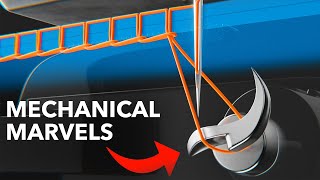
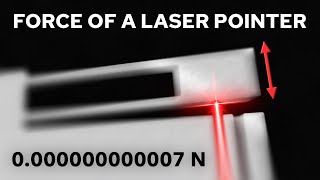
- Compliant Mechanisms and Soft RoboticsMechanism Advantages• Reduced part count since bendable components replace hinges, bearings, and separate springs • Single piece plastic gripper achieves similar result to complicated vice grips with 30 to 1 force amplification • Can be produced through injection molding at cents per unit and extruded then choppedNuclear Safety• Used for safing and arming nuclear weapons with components as small as human hair made from hardened stainless steel • Ensures no random vibrations from earthquakes inadvertently disable safeties • Operates at 72 hertz with rotor wheel making two complete revolutions per secondSpace Applications• NASA collaboration created titanium hinge with 180 degree deflection replacing bearings for solar panel deployment • Thruster application using two motor inputs to direct thrust in any direction from single titanium piece • Allows use of one thruster instead of two while eliminating pinch points for fuel and electrical linesPrecision Benefits• No backlash from hinges as in traditional mechanisms • No wear or need for lubricant • Can achieve very precise motion despite flexible components • Tested mechanisms endure over one million cycles without failure
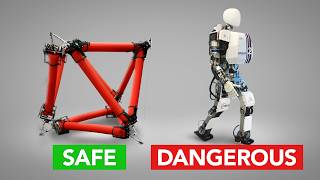
- Soft Robot Structure and SafetyBasic Design• Main structural members are fabric tubes inflated with air to about six PSI above atmospheric • Each tube passes through pairs of rollers connected to motors • Rollers pinch tubes causing bending like a pinched straw • High friction material wrapped around rods prevents slipping when coupled with pressurized tubeShape Configuration• Four inflated tubes connected to motor pairs form triangular sides in octahedron shape • Can dramatically change shape from very tall to short and squat • Isoperimetric robot maintains overall perimeter length as all edges combined stay constantSafety Advantages• Inherently safe for human interaction due to compliant fundamental structure limiting maximum exertable force • Can withstand being beaten, stomped on, and stood on without damage • Soft robot falling on a person causes minimal harm compared to rigid robotsOperational Reliability• No electronics required, using pneumatic circuitry entirely • Suitable for mines where electronics could spark explosions • Can operate in strong magnetic fields around MRI machines • Requires only compressed air supply for operation
- Soft Robot Capabilities and FutureShape Changing• Can become tall to go over obstacles or short to fit under obstructions • Compliance of tubes allows bending around disturbances without damage • Can shrink volume drastically, valuable for rocket transport where space is premiumSpace Deployment• NASA considering deployment under ice sheets through small diameter holes • Robots can be disassembled and reassembled to form larger structures through tight spaces • Large robots able to fit through constrained passages and access difficult areasManipulation Skills• Natural ability to grasp objects through tube compliance and bending • Tubes bend slightly during manipulation increasing contact area and distributing forces evenly • Can pick objects off ground and wrap body around objects similar to octopus tentaclesVulnerability• Major drawback is leaks or punctures require continuous compressed air to maintain structure • Mitigation solutions include onboard small compressors to maintain pressure during minor leaks • Robot becomes inoperable without air pressure unlike rigid robots
- The Future of Specialized RobotsHumanoid LimitationHumanoid robots built for all tasks humans do sacrifice specialization in any single skill, becoming generalists that overlap with human capabilities rather than expanding them.Specialized Approach• Best possible shapes and materials maximize specific abilities • Robots save lives, leap tall buildings, move with super speed, protect valuables, and shapeshift • Robots likely enter lives as precise specialized tools rather than multipurpose humanoidsIntegration Pattern• Specialized little things slowly infiltrate lives without being recognized as robots • Things like shoes, watches, cars, and thermostats become smarter gradually • Humanoid maid robots will arrive last rather than firstProblem-Solving FocusThe most important skill for bringing robots into daily lives is problem-solving, a capability anyone can develop through learning critical thinking and applying concepts to real-world situations.