The Most Important Material Ever Made
Glass has transformed how we live, launched numerous scientific revolutions, and forever altered how we think about our place in the universe.
9 chapitres
- Glass Brittleness and the iPhone ProblemThe ChallengeGlass is inherently brittle and fragile, yet modern devices require it to be transparent, scratch-resistant, thin, flexible, and unbreakable.Steve Jobs' RequestIn 2006, Steve Jobs needed glass for the first iPhone because plastic screens scratched too easily, but regular glass would also scratch and shatter.Gorilla Glass SolutionCorning's CEO Wendell Weeks created Gorilla Glass in six months, which has since been used on billions of devices for 17 years and continues to improve in durability.Key InnovationGorilla Glass demonstrated superior scratch resistance compared to polycarbonate plastic through direct comparison testing.
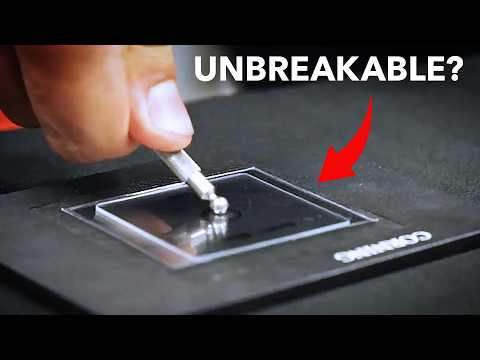
- Breaking Glass: Physics and DemonstrationsFracture RequirementsBreaking glass requires two things: a flaw on the surface and stress applied to that flaw, which causes cracks to propagate.Demonstration SetupCorning demonstrated glass durability by sandblasting to create flaws, then applying stress to compare regular soda lime glass, strengthened soda lime, and Gorilla Glass.Results• Regular soda lime glass broke with moderate pressure • Strengthened soda lime required significantly more force to break • Gorilla Glass resisted breaking even under extreme force, with the stylus bending insteadReal-World RelevanceThe slapper demo simulated dropping a phone on asphalt, showing competitive glass breaking while Gorilla Glass survived even from extreme heights.
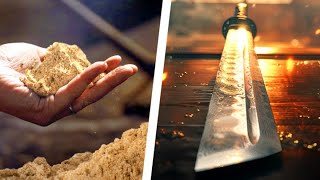
- Natural Glass and Historical UsesNatural OriginsGlass exists naturally, formed by meteorite impacts, lightning strikes, and volcanic eruptions, creating obsidian and other natural glass types.Ancient Applications• Obsidian was used for cutting implements, arrowheads, and spear tips as early as 1.2 million years ago • Modern surgical scalpels still use obsidian tips sharpened to three nanometers, being superior to any other materialManufacturing TimelineHumans started making glass only around 5,600 years ago, much more recently than using natural glass for 1 million years.Basic CompositionMost glass is composed of oxygen and silicon, the two most abundant elements in Earth's crust, found naturally as quartz sand.
- Glass Formation and PropertiesManufacturing ProcessGlass is made by heating sand to about 1700 degrees Celsius until it melts, then rapidly cooling it so atoms remain disordered rather than forming crystals.Amorphous StructureDuring rapid cooling, atoms don't have time to arrange into periodic crystal structures, creating an amorphous solid that is frozen in place like a flash-frozen liquid.Brittleness ExplainedGlass is brittle because its amorphous structure lacks regular arrangement, preventing stress relief; when stress is applied, small cracks form and grow rapidly, eventually shattering the glass.Solid State ClarificationGlass is a solid at room temperature, not a liquid, because atoms are fixed in place and cannot flow past each other like in a liquid.
- Glass Composition VariationsSoda Lime GlassAdding sodium carbonate (soda) and calcium oxide (lime) lowers the melting temperature from 1700 to around 1000 degrees Celsius, making soda lime glass account for 90% of all manufactured glass.Borosilicate GlassAdding boron trioxide creates borosilicate glass with very low thermal expansion, allowing it to handle drastic temperature changes without shattering, used for laboratory equipment like beakers.Gorilla Glass RecipeGorilla Glass is based on a secret combination of silicon, aluminum, magnesium, and sodium, with scientists constantly testing new formulations for improved durability and scratch resistance.Glass OriginsThe earliest human-made glass was likely accidental, formed when sand entered metal-working furnaces, but glass making soon became its own art form for decorations, containers, and tableware.
- Color and Transparency in GlassOpaque BeginningsAll historical glasses were opaque until glass makers discovered they could change color by adding elements like cobalt oxide for blue or cuprite for red.Semi-Transparency BreakthroughAround 100 AD, Alexandrian glass makers added manganese dioxide to create semi-opaque glass that let light through, leading to its use for windows.True Transparency DiscoveryAngelo Barovier invented clear glass centuries later in Venice by burning seaweed rich in potassium oxide and manganese, then adding the ash to glass, creating the first truly transparent glass.Light Interaction Science• Transparent glass allows visible light photons to pass through because their energy is too low to excite electron transitions • Glass absorbs ultraviolet light because UV photons have higher energy to push electrons to higher energy levels • Colored glass is created by adding impurities that change electron energy levels • Window glass appears greenish because soda lime glass contains iron oxide impurities
- Glass and Scientific RevolutionEyeglasses InnovationIn the early 1300s, transparent glass was ground, shaped and polished into lenses to correct farsightedness, becoming essential after the printing press (circa 1440) increased literacy rates.Microscope Development• Hans and Zacharias Janssen invented the first microscope around 1590 by putting two lenses in line, magnifying objects 20 times • Antony Van Leeuwenhoek improved the microscope by grinding lenses himself, achieving 200x magnification to see human cells • Robert Hook published 'Micrographia' with beautiful sketches of the microscopic worldTelescope RevolutionHans Lippershey invented the spy glass in 1608 for warfare; Galileo Galilei adapted it to study the sky, magnifying objects 30 times and observing moon craters, Venus phases, and Jupiter's moons.Cosmological ImpactGalileo's observations definitively proved the heliocentric model by seeing moons revolving around Jupiter, not Earth, and observing Venus phases, disproving the geocentric universe model.
- Modern Glass and Optical FibersTransparency AchievementModern optical fibers are orders of magnitude more transparent than water, so transparent that a column as deep as the Mariana trench would be completely visible through it.Ion Exchange Process• After making glass from an aluminosilicate base, it is submerged in potassium salt solution at 420 degrees Celsius • Potassium atoms replace sodium atoms in the glass surface • Larger potassium atoms squeeze together in the rigid glass, increasing compressive strengthDurability EnhancementThe ion exchange process makes glass significantly more durable and scratch-resistant without any visible difference in appearance, demonstrated by breaking untreated glass while treated glass survived.Continuous ImprovementCorning's team conducts bending tests, scratching tests, and drop tests with heavy steel balls, using replica phones to test glasses at increasing heights to develop even more durable versions.
- Glass as Essential MaterialTransformation ImpactGlass has transformed how humans live, launched numerous scientific revolutions, and forever altered how we think about our place in the universe.Modern DependenceWindows, glasses, and screens are ubiquitous in daily life, providing light, vision correction, and displays; losing them would be profoundly disruptive.Ongoing ProgressGlass remains imperfect and still cracks, but scientists continue working on ways to make the material progressively more durable and resistant to damage.Future AppreciationDespite current limitations, glass is an amazing material worthy of appreciation, even as research continues improving its durability for everyday devices.