
Les différents formats des données d’émissions de gaz à effet de serre
Les inventaires de gaz à effet de serre (GES) ont pour objet de quantifier (en masse de substances émises par an) les GES émis au sein d’un pays, et de relier ces émissions à des activités humaines. Les inventaires rapportés par les États à la Convention Cadre des Nations Unies sur les Changements Climatiques (CCNUCC) constituent la référence en matière d’inventaire d’émissions de GES. Ces inventaires sont encadrés par des règles de comptabilisation et de contrôle partagées à l’échelle internationale. Le Groupe Intergouvernemental sur l’Évolution du Climat (Giec) a la responsabilité d’encadrer les règles de calculs et l’évaluation des procédures d’estimations. La France développe en parallèle d’autres formats d’inventaire.
GHG emission inventories aim to quantify (in mass of substances emitted per year) the GHGs emitted within a country and link these emissions to human activities. Inventories reported by States to the United Nations Framework Convention on Climate Change (UNFCCC) constitute the reference for GHG emission inventories. These inventories are governed by accounting and control rules shared internationally. The Intergovernmental Panel on Climate Change (IPCC) is responsible for establishing calculation rules and evaluating estimation procedures. France develops additional inventory formats in parallel.
7 chapters
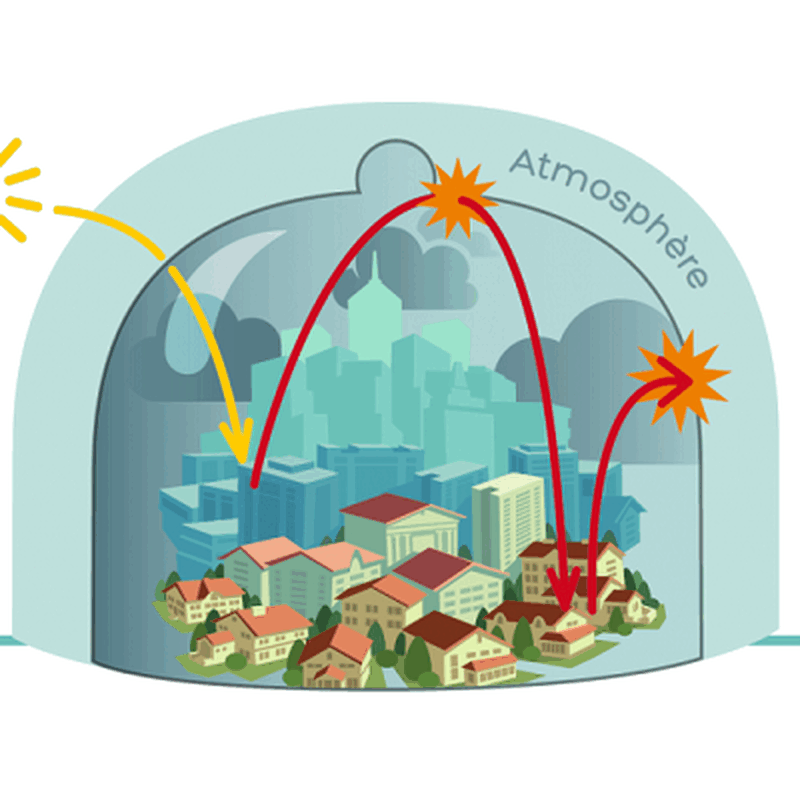
- Measuring greenhouse gas (GHG) concentration in the atmosphereMeasurement and expressionThe presence of GHGs is measured in the atmosphere. Their concentration is determined by sampling and measuring their atmospheric presence. This concentration is expressed in parts per million (ppm).Global atmospheric observationThe World Meteorological Organization (WMO), which coordinates the Global Atmosphere Watch Programme, regularly reports on changes in GHG atmospheric concentration, reflecting the atmosphere's capacity to return solar energy to Earth. These observations provide insights into the greenhouse effect's evolution, which allows for modelling global climate warming (i.e.: what is the mean additional surface temperature increase induced by GHG introduction into the atmosphere?).
- Estimating GHG emissions and their sourcesEmission sources• Knowledge of atmospheric GHG concentration, based on scientific observations, is complemented by data on their atmospheric releases. This emissions data specifies the source and quantity of GHGs emitted over a defined time period. • The origin (chemical, physical, biological process) and emission quantity estimation are identified by science. • GHGs can be of natural origin (H2O, CO2, CH4, N2O, O3). Natural emission sources are offset by absorption phenomena (sinks) that are also natural (e.g.: photosynthesis).Anthropogenic emissions• Climate change results from additional GHG emissions from human activities. These anthropogenic GHGs are emitted during: • fossil fuel combustion, namely coal, gas and oil (CO2) • biomass combustion (CO2 and CH4) • deforestation (CO2) • fossil fuel extraction (CO2 and CH4) • industrial processes (CO2, CH4, N2O and fluorinated gases) • enteric fermentation (CH4) • agricultural cultivation (N2O and CH4) • waste (CH4) • refrigeration systems and aerosols (fluorinated gases) • CO2 is the dominant GHG (3/4 of global emissions) and is primarily (88%) emitted during coal, oil or gas combustion.Emission attributionClimate change studies focus on GHG emissions from human or natural activities. Emissions quantification is based on scientific knowledge and statistical data. Attribution of emissions to geographic areas, uses, economic actors, consumer goods, activities, etc., relies on conventions based on methodological choices. To whom should emissions from burning one litre of petrol be attributed? To oil producers? To car manufacturers? To the transport economic sector? To drivers?
- GHG emission inventoriesFramework and developmentIn France, several inventory formats coexist (UNFCCC format, SECTEN format, NAMEA format, etc). The Ministry for Ecological Transition entrusted the development of inventories in different formats to the Technical Inter-professional Centre for the Study of Atmospheric Pollution (Citepa). The development of these national inventories is governed by procedures described in the National System for Emission Inventories and Atmospheric Balances (SNIEBA). Emissions estimation methods are described in the Ominea report.Uses of different formats• Citepa inventories numerous substance emissions. This single database meets various international agreements or public policy needs: • UN Framework Convention on Climate Change (UNFCCC): GHG inventory UNFCCC format / Convention • Kyoto Protocol: inventory UNFCCC / Kyoto format (KP) • National public policies: inventory SECTEN format • European statistical regulations: inventory NAMEA-AIR format • Other inventory formats for atmospheric pollutants • These inventories are identical in total emission mass. However, emission distribution by economic sector may show slight differences.Inventories versus Carbon Balance©Carbon Balances© or 'carbon footprints' are based on concepts different from GHG inventories. They provide different results. Carbon Balances© or carbon footprints account for indirect emissions, that is, emissions outside the country or activity. Conversely, inventories focus on emissions physically occurring in a defined geographic area.Callout• Download GHG inventories in UNFCCC format: • UNFCCC website • Citepa website. • Citepa website. • Eurostat website (atmospheric emission accounts; env_air_aa) • SDES website.
- National GHG inventory in "UNFCCC" formatInternational reference and emission sources• The GHG inventory in UNFCCC format is the international reference. It is the official document submitted by States under international political commitments to combat climate change (UNFCCC, Kyoto Protocol). France reports annually to various international bodies its national GHG inventory in UNFCCC format. Emissions are allocated according to 6 emission sources (themselves broken down into sub-sectors, CRF nomenclature categories): • Energy combustion • Industrial processes • Agriculture • LULUCF (Land Use, Land Use Change and Forestry) • Waste • OtherConvention and Kyoto scopes• The UNFCCC format "Convention" inventory covers metropolitan France and overseas departments and communities. • The UNFCCC "Kyoto" format inventory covers metropolitan France and the outermost regions of the European Union (Guadeloupe, Martinique, Reunion, Mayotte, French Guiana and Saint Martin); scope called "Kyoto" as retained under the Kyoto Protocol.
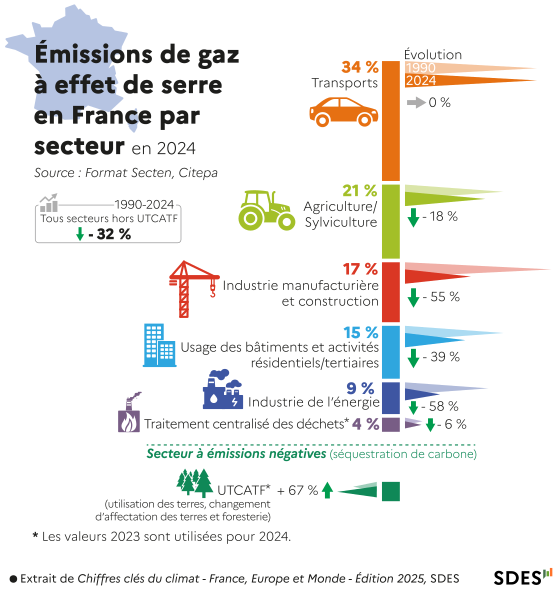
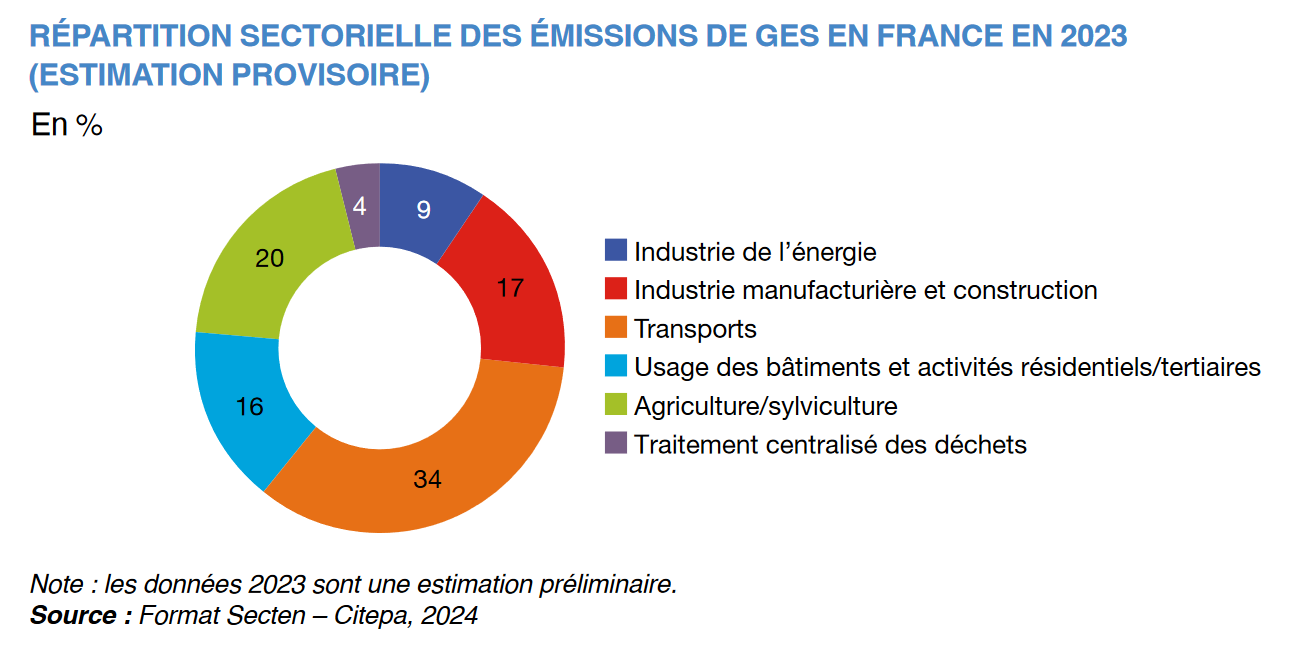
- National GHG inventory in "SECTEN" formatPurpose and accounting rulesThe SECTEN format inventory (for SECtors economiques et de l'ÉNergie / Economic Sectors and Energy) was developed by Citepa at the Ministry's request to provide more accessible information. SECTEN format is used for defining and evaluating national climate public policies. Emissions accounting rules in SECTEN format are identical to UNFCCC format inventory. However, distribution of emissions by economic sectors and sub-sectors differs slightly. Total national figures for UNFCCC and SECTEN format inventories remain identical.SECTEN inventory sectors• GHGs in SECTEN format inventory are allocated to economic sectors or activities that emitted them. The inventory comprises 7 sectors (themselves broken down into sub-sectors): • Energy industry • Manufacturing • Residential/Commercial • Transport • Agriculture • Waste • LULUCF
- Comparing UNFCCC and SECTEN format inventoriesSectoral distribution differencesAlthough equivalent in total mass, UNFCCC and SECTEN format inventories show slightly different sectoral distribution. UNFCCC format reports emissions strictly to the activity that is their source (e.g.: vehicle air conditioning emissions come from "industrial processes"; agricultural machinery emissions are inventoried under "Energy" not "Agriculture"). SECTEN format prioritizes sectoral consistency (e.g.: vehicle air conditioning emissions are reported under "Transport"; agricultural equipment fuel emissions are assigned to "Agriculture").Time coverageUNFCCC and SECTEN format inventories cover years 1990 to N-2 and are updated annually; these updates may result in minor revisions to previously provided values.Emissions excluded from national totals• The following GHG emissions are excluded from UNFCCC and SECTEN format inventories but are nevertheless calculated and reported outside national totals: • international transport emissions (only emissions occurring between two national ports or airports are counted) • LULUCF emissions/absorptions • emissions from biomass combustion • Inventory data are not corrected for climate variations and are expressed in kg of substance and/or CO2 equivalent.
- NAMEA-AIR inventoryNAMEA-AIR format principleCitepa also produces an inventory in NAMEA-AIR format. NAMEA-Air accounts, or air emission accounts (AEA, for Air Emissions Accounts in English) rely on conventional national inventories but classify emission sources into 64 economic branches, consistent with the Statistical Classification of Economic Activities in the European Community (NACE or NAF for the French version). This breakdown is consistent with that used in national economic accounting and allows cross-referencing atmospheric physical flows with various economic aggregates (production, value added, final demand components...). Furthermore, NAMEA-air format inventories identify emissions from households from private vehicles and heating in homes (excluding electric heating, counted in the "electricity production" branch).Scope and residency principleGHG inventories in NAMEA format cover metropolitan France and outermost regions of the European Union. For transport, emissions are counted using the residency principle: emissions from French nationals abroad are included and those from foreigners in France are excluded.Callout• Precautions for reading GHG emission data Emissions data, even for a given format, can be presented using different scopes. Emissions inventory or carbon footprint (or Carbon Balance©)? Footprints or carbon balances correspond to approaches different from GHG inventories. Carbon Balance© concepts aim to count, for a territory, an organization, a good or an activity all emissions related to "consumption". GHG inventories, conversely, link emissions to "production" sources. In a carbon footprint or Carbon Balance© context, indirect emissions are thus considered (i.e. indirectly necessary for production of a consumed good or service). (e.g.: electricity production emissions are allocated to the final consumer in a carbon footprint or Carbon Balance© while the inventory allocates these GHGs to the electricity producer. GHGs taken into account The data may relate to: • only CO2 from energy combustion • only CO2 (from energy combustion and industrial processes) • the 3 main GHGs (CO2, CH4 and N2O) • all GHGs: CO2, CH4, N2O, NF3, SF6, PFCs and HFCs. • LULUCF • Climate correction • GWP • Units