Les émissions françaises de gaz à effet de serre
Entre 1990 et 2023, la France a diminué ses émissions de gaz à effet de serre de 31 %, hors gaz émis ou absorbés par les sols et les forêts. Pour être en ligne avec l’objectif d’atteindre la “neutralité carbone” d’ici 2050, la France doit poursuivre cette réduction et atteindre en 2030 -50 % par rapport à 1990. La diminution déjà observée résulte de la baisse significative des émissions des secteurs de l’industrie manufacturière et de l’industrie de l’énergie, tandis que celles des transports ont augmenté. Tour d’horizon de la situation à travers les objectifs de réduction des émissions, la contribution des activités humaines et des secteurs économiques, et les différents gaz en cause.
Between 1990 and 2023, France reduced greenhouse gas emissions by 31%, excluding gases emitted or absorbed by soils and forests. To meet the "carbon neutrality" goal by 2050, France must continue this reduction and reach -50% by 2030 versus 1990. The reduction so far reflects sharp cuts in manufacturing and energy industry emissions, while transport emissions have risen. An overview of the situation through emission reduction targets, human and economic sector contributions, and the gases involved.
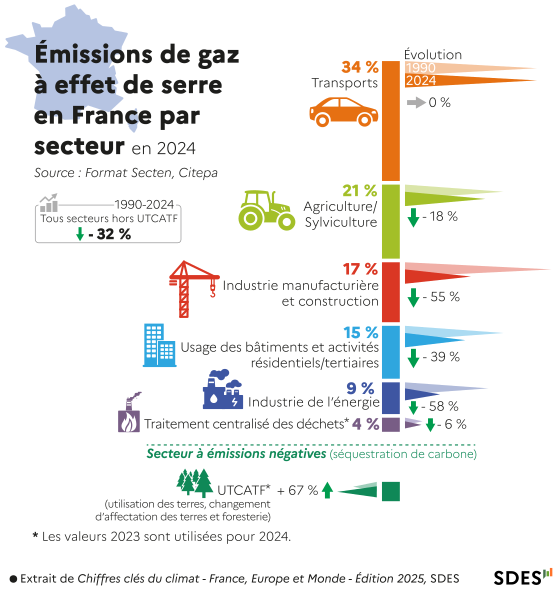
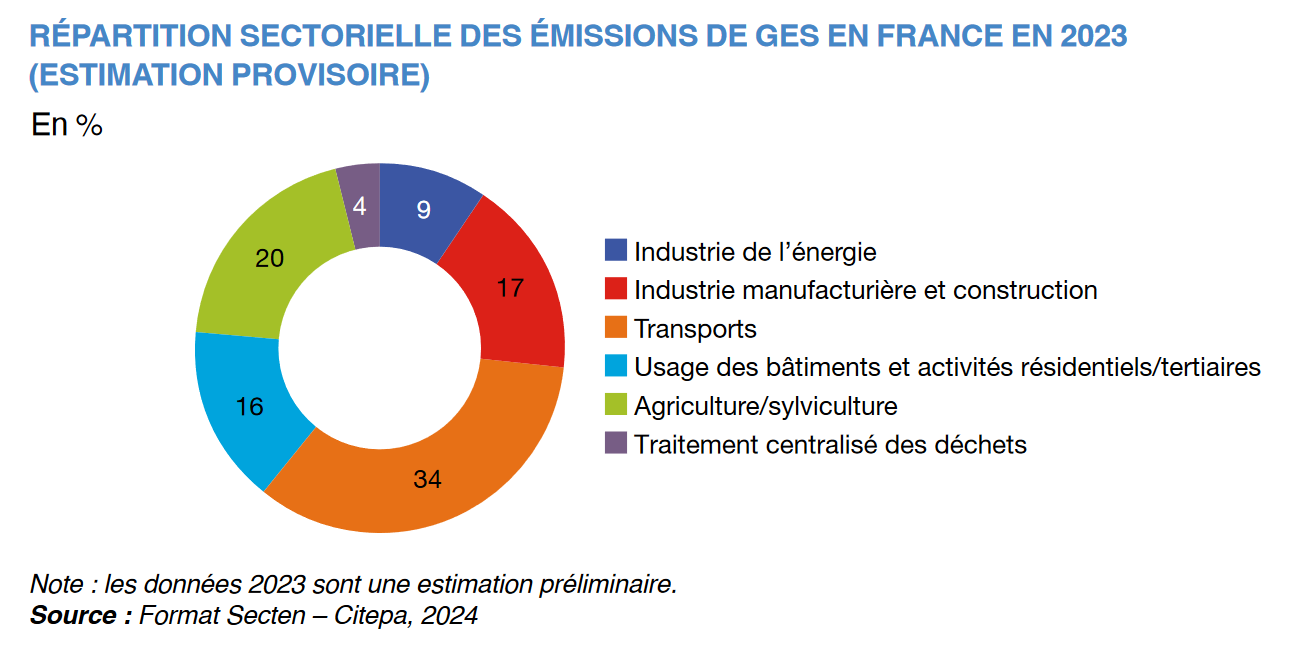
- What human activities emit greenhouse gases in France?5 main sources of human emissions• French greenhouse gas (GHG) emissions come from five different sources: • combustion of fossil fuels (oil and oil products, gas, coal) for transport, heating, energy transformation industry and manufacturing. Burning fossil products primarily emits carbon dioxide (CO2). • agriculture (livestock and crops) which produces methane (CH4) through ruminant digestion and livestock effluent, as well as nitrous oxide (N2O) linked to nitrogen fertilizer use; agriculture accounts for 71% of total methane emissions and 86% of total nitrous oxide emissions. • industrial processes and solvents generate emissions: carbon dioxide notably from industries producing cement, lime, plaster, terracotta, ceramics, glass; fluorinated gases from solvent use, foams and aerosols; emissions from air conditioning and refrigeration systems; semiconductor industry, food industry and cold chain operations. • waste treatment and recovery produce emissions: methane from waste degradation (storage, landfilling, sewage sludge treatment); carbon dioxide from incineration. • land use, land use change and forestry (LULUCF) are sources of greenhouse gas flows, mainly CO2, from soils and forests, which naturally store or emit carbon. Though naturally sourced, these flows are influenced by human activities affecting tree growth, mortality or harvesting in forests, cultivated soil quality, or space left for natural environments due to deforestation, afforestation or soil artificialisation.National inventory of GHG emissions: what does it mean?• France produces an annual inventory of greenhouse gases. It estimates gas quantities from national territory and tracks emission changes against international and national commitments. It accounts for all emissions from human activities in France. • By convention, this inventory excludes from the national total emissions linked to: • international air, maritime and river transport (only emissions between French ports or airports count), • biomass combustion, meaning plant, animal or waste-derived organic matter used for energy. • The national emission total is "gross" when excluding land use, land use change and forestry (LULUCF) or "net" when this sector is included. • The national GHG inventory also differs from France's carbon footprint, which estimates greenhouse gases associated with French final demand. The carbon footprint excludes export emissions and includes import emissions.How are emissions distributed in France in 2023?• 34% transport, • 20% agriculture, • 17% manufacturing industry and construction, • 16% building use and residential/service activities, • 9% energy industry, • 4% centralized waste treatment.
- France's targets and greenhouse gas emission trendsFrance's international commitments to reduce GHG emissions• In 1997, France committed to stabilizing six greenhouse gas emissions including carbon dioxide and methane at 1990 levels for 2008-2012. By end 2012, France achieved this with cumulative GHG emissions 11% below 1990 levels. • In 2015, signatories of the UN Framework Convention on Climate Change, including France, met at COP21. They set a target to limit global average temperature increase to 1.5 to 2 degrees by 2100 compared to pre-industrial times: the Paris Agreement. This matters because even 1.5 or 2 degrees average means significant atmospheric change in little time, multiplying extreme climate events worldwide. • According to the UN Intergovernmental Panel on Climate Change (IPCC), limiting warming to +1.5 degrees requires reducing global CO2 emissions 45% by 2030 versus 2010 and achieving carbon neutrality—the balance between greenhouse gas emissions and absorption—by 2050.France's national GHG reduction targets• Aligned with international commitments, France targets achieving "carbon neutrality" by 2050. This requires reducing gross greenhouse gas emissions by at least six-fold from 1990 levels. • A French energy and climate strategy was adopted to reach the 2050 carbon neutrality goal while ensuring society adapts to climate change impacts. • Quantified emission reduction targets for the next 15 years were set: carbon budgets. These are emission caps not to exceed, expressed as annual averages per five-year period in million tonnes CO2 equivalent (Mt CO2 eq). They apply by activity sector and gas type. • Carbon budgets not to exceed: • Average annual emissions in Mt CO2 eq: 2nd Carbon budget(*): 3rd Carbon budget(*): 4th Carbon budget(*) • 2019-2023: 2024-2028: 2029-2033 • Total (excl. LULUCF): 420: 357: 299 • (*): Source: Decree no. 2020-457 of 21 April 2020 on national carbon budgets and national low-carbon strategy, technically adjusted in 2024 by the High Council for the Climate. • The national strategy, under development, will significantly raise carbon budgets to account for the EU's 55% gross emission reduction target by 2030 versus 1990.How are France's GHG emissions trending?• At the end of 2015-2018, France exceeded its first carbon budget (442 Mt CO2 eq) with an average of 453 Mt CO2 eq annually. Average emissions for 2019-2023 reached 400 Mt CO2 eq, below the target for that period (422 Mt CO2 eq). • 2023 emissions are estimated at 373 million tonnes CO2. This represents a 31% reduction from 1990. Aligned with the EU target of at least 55% emission cuts by 2030 versus 1990 levels, France set a 50% reduction target by 2030. This requires 4.5% annual cuts over seven years. That's lower than 2023 versus 2022 (-5.8%), but double the rate since 2010. Acceleration is needed to meet targets. • To reach carbon neutrality by 2050, 2050 greenhouse gas emissions must be offset by forest and land absorption plus technological storage and capture, still experimental. About 67 Mt CO2 eq annual storage by forests and lands is projected for 2050, which seems difficult to achieve.
- French emissions by greenhouse gasWhat are the different GHGs and their sources?• Greenhouse gases include: • carbon dioxide - CO2 (76% of national emissions) from fossil fuel combustion and industrial processes like cement production. • methane - CH4 (15% of emissions) from livestock and waste treatment. • nitrous oxide - N2O (7% of emissions) from agricultural practices. • fluorinated gases (3% of emissions) used in air conditioning and refrigeration.CO2 emissions in France• Nearly all human activities like heating, transport, industry, agriculture and services emit CO2 from fossil fuel consumption. French emissions fell 31% between 1990 and 2023. This results from: • replacing coal and oil with natural gas and electricity in manufacturing, power generation and buildings. • greater energy use efficiency. • reduced emissions-intensive activities like steel and refining. • Rising road traffic, despite vehicle efficiency gains, prevented transport emissions cuts unlike other sectors.Methane and nitrous oxide emissions in France• French methane and N2O emissions fell 26% and 52% between 1990 and 2023. The methane drop reflects ended coal mining and use plus reduced cattle numbers. N2O reduction stems from chemical industry efforts in manufacturing substance production. • Methane is a potent GHG due to high "global warming potential." Methane's warming potential is 28 times higher than CO2 over 100 years. Over 20 years, it's 81 times higher. This highlights short-term climate urgency from global meat consumption.Fluorinated gas emissions in FranceFrench fluorinated gas emissions overall fell nearly 16% from 1990 to 2023. Some family members destroying ozone were banned under the 1987 Montreal Protocol. The 2016 Kigali Accords plan eliminating another category by 2047. Other fluorinated gas families dropped 93%, 79% and 68% since 1990.GHG emissions by sector in France
- Emissions by sector in FranceTransport, one-third of national GHG emissions• The 31% reduction in French GHG emissions between 1990 and 2023 was driven by major cuts from manufacturing and energy industries. • Transport is the top national emissions contributor (34% in 2023). Cars represent about half of transport emissions, heavy trucks about a quarter and light commercial vehicles 15%. • It's the only sector with rising emissions, up 3% since 1990. CO2 per kilometre fell 24% between 1990 and 2023 from engine efficiency gains and hybrid/electric vehicles. Yet improvements were offset by increased traffic, heavier vehicles, aging vehicles and rising petrol engines, which emit more CO2 than diesel.Agriculture's share of GHG emissionsAgriculture emits 20% of national GHG emissions in 2023. It's the main source of national N2O (86%) and methane (71%) emissions. N2O comes from fertilizer spreading and animal waste. Methane comes from livestock (59% of farm emissions), mainly cattle. Since 1990, French farm emissions dropped 18%.Manufacturing and construction drove major emission cutsManufacturing, construction and food industry make up 17% of national emissions. This sector cut emissions 54% between 1990 and 2023, accounting for 45% of France's total emission decline. Reductions come from process improvements, energy efficiency gains or reduced activity.Building use, energy industry and waste treatment: falling emissions• Building GHG emissions represent 16% of 2023 national emissions. Two-thirds from housing stem mainly from heating and hot water systems. They fell 37% since 1990 through home thermal renovation and energy decarbonization. These emissions fluctuate with energy prices and winter conditions. • The energy industry covers power generation (41% of sector emissions), heat production and fossil fuel refining (30% of emissions). This sector's emissions dropped sharply since 1990 (-55%) due to increased nuclear and renewable power. In 2023, it represents 9% of total French emissions. • Waste treatment, storage, incineration, composting and wastewater treatment produce emissions, particularly methane from organic matter breakdown. It contributes 4% of 2023 national emissions. Since 1990, it's down 7%.
Further reading
- Qui calcule les émissions de gaz à effet de serre en France ? En 2011, le Ministère de la Transition écologique a confié au Centre Interprofessionnel Technique d’Études de la Pollution Atmosphérique (Citepa) l’élaboration des inventaires nationaux d’émissions de polluants atmosphériques et de GES.citepa.org
- Les émissions de gaz à effet de serre des transportsnotre-environnement.gouv.fr
Détail des émissions de gaz à effet de serre du secteur des transports en France et de leur évolution, selon le mode de transport (voitures, poids lourds, aérien…)
- Les émissions de gaz à effet de serre de l’agriculturenotre-environnement.gouv.fr
L’agriculture a émis 19% des émissions de gaz à effet de serre (GES) de la France en 2019, soit le 2ème poste d’émissions national.
- Les émissions de gaz à effet de serre du secteur de l’industrie manufacturièrenotre-environnement.gouv.fr
Le secteur de l’industrie manufacturière est le quatrième contributeur d’émissions de gaz à effet de serre (GES) en France.
- Les émissions des gaz à effet de serre du secteur résidentielnotre-environnement.gouv.fr
En 2017, les résidences des ménages sont à l’origine de 58 Mt CO2e, soit 12% du total national.
- Consommation d’énergie et émissions de gaz à effet de serre du secteur résidentielnotre-environnement.gouv.fr
Après avoir légèrement augmenté entre 1982 et 1992, la consommation finale d’énergie du secteur résidentiel est globalement stable jusqu’en 2010.
- Les émissions des gaz à effet de serre du secteur tertiairenotre-environnement.gouv.fr
En 2017, le secteur résidentiel-tertiaire est le deuxième poste d’émissions de GES de la France (20 % du total national).
- Les émissions des gaz à effet de serre du secteur du traitement centralisé des déchetsnotre-environnement.gouv.fr
Le traitement centralisé des déchets contribue aux émissions GES. En 2017, le traitement des déchets, par stockage ou incinération, ainsi que le traitement des eaux usées représentent 3 % du total des émissions de GES de la France.
- Chiffres clés du climat - France, Europe et Mondestatistiques.developpement-durable.gouv.fr
Datalab - Service des données et études statistiques - novembre 2024
- L’inventaire d’émissions de gaz à effet de serreecologie.gouv.fr
Ministère de la Transition écologique - juillet 2022
- Emissions nationales de gaz à effet de serrestatistiques.developpement-durable.gouv.fr
Service des données et études statistiques
- La Convention-cadre des Nations unies sur les changements climatiques (CCNUCC)unfccc.int
ONU Climat
- La Stratégie nationale bas carbone (SNBC)ecologie.gouv.fr
Ministère de la Transition écologique - octobre 2024
- Rapport Secten sur les émissions de GES en Francecitepa.org
Citepa, juin 2024