
Les émissions des gaz à effet de serre du secteur tertiaire
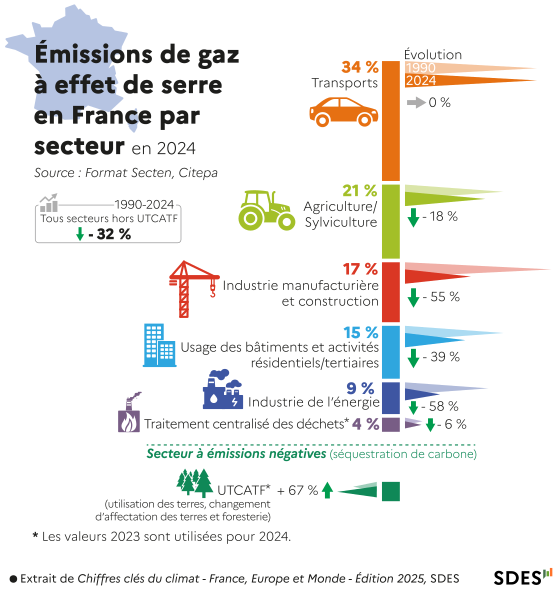
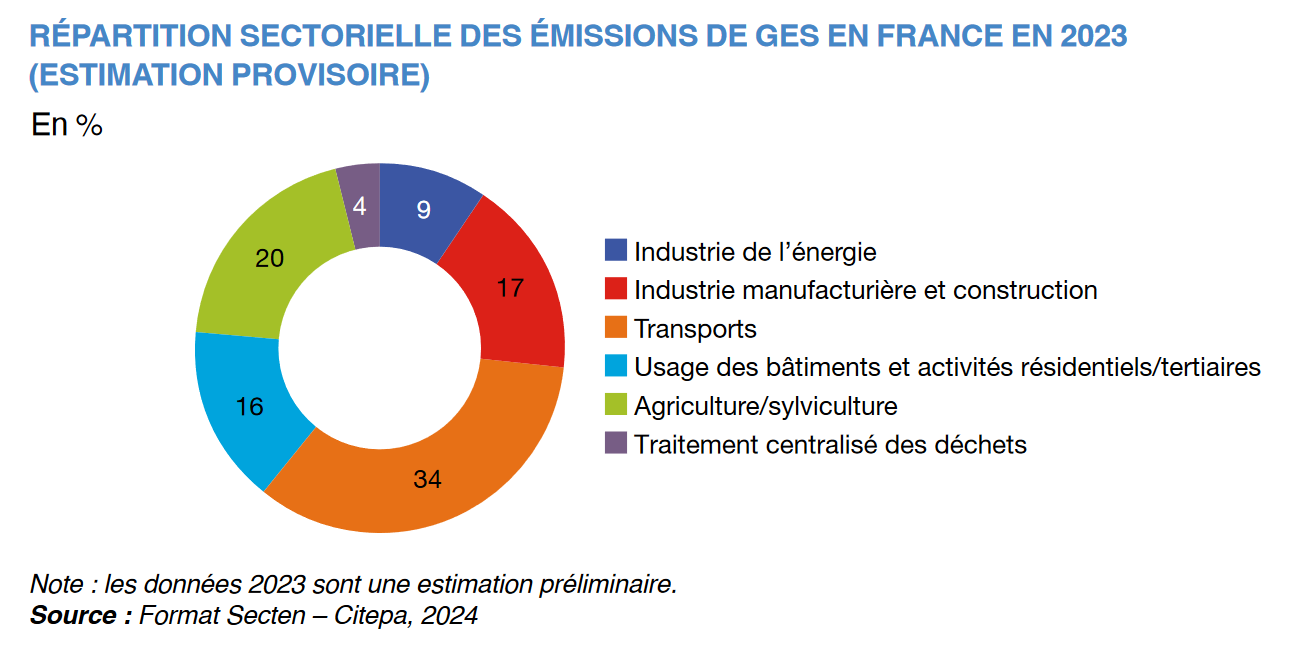
En 2017, le secteur résidentiel-tertiaire est le deuxième poste d’émissions de GES de la France (20 % du total national). Un tiers des émissions de ce secteur proviennent des bâtiments du secteur tertiaire, soit 34 Mt CO2e. Entre 1990 et 2017, les émissions de GES issues des bâtiments du secteur tertiaire ont augmenté de 8 %. Toutefois, après avoir fortement progressé entre 1990 et 2009 (+ 1,3 % en moyenne annuelle), elles diminuent depuis au rythme moyen de -2 % par an.
In 2017, the residential-tertiary sector was France's second-largest source of GHG emissions (20% of the national total). One-third of this sector's emissions came from tertiary buildings, or 34 Mt CO2e. Between 1990 and 2017, GHG emissions from tertiary buildings increased 8%. However, after rising sharply between 1990 and 2009 (+1.3% average annually), they have declined since at an average rate of −2% per year.
2 chapters
- GHG emissions from residential-tertiary sectorSector contribution• Between 1990 and 2008, the sector was France's third-largest source of GHG emissions behind manufacturing and transport, and since 2009, the second source. In 2017, it accounted for 20% of France's GHG emissions, or 91 Mt CO2e. • Overall, during 1990-2017, two-thirds of the sector's emissions came from residential buildings. Thus, in 2017, residential emissions were 58 Mt CO2e and those from tertiary buildings were 34 Mt CO2e.GHG breakdown• CO2 is the primary GHG emitted by the residential-tertiary sector. It comes from fossil fuel consumption (mainly oil and gas) by boilers to produce heating or domestic hot water. • By convention, CO2 emissions from biomass are not reported in inventories. Thus, emissions from wood heating are not counted. These emissions from fireplaces, stoves, or wood boilers represented approximately 30 Mt CO2 in 2016, or about one-third of the sector's GHG emissions. • The residential-tertiary sector is also characterized by high HFC emissions: 11% of the sector's GHG emissions versus 4% of total national emissions. HFC emissions are linked to building air conditioning and domestic (refrigerators) and commercial cooling production. At 10 Mt CO2e, the sector's HFC emissions represent 54% of national HFC emissions.Emission trends• Between 1990 and 2017, France's GHG emissions fell by 15%. They stood at 466 Mt CO2e in 2017. Those from the residential-tertiary sector did not follow the same trend; 2017 emissions equaled 1990 levels at 91 Mt CO2e. • GHG emissions from the residential-tertiary sector show strong year-to-year variations linked to climatic conditions, particularly winter weather. Indeed, especially in residential buildings, they mainly come from heating installations. • To analyze emission trends in the residential-tertiary sector without considering weather variables, energy statistics provide climate-adjusted energy consumption data. Climate variation corrections use a climate severity index accounting for annual temperature fluctuations. The climate severity of 1990 was equivalent to 2017, so weather conditions did not affect the comparison of GHG emission levels calculated for 1990 and 2017.
- Tertiary sectorEmission trends• In 2016, the tertiary sector comprised 972 million m² of tertiary economic buildings, including office buildings (23%), retail (22%), educational facilities (19%), healthcare facilities (12%), cultural and sports facilities (7%), and restaurants and hotels (7%). Since 1990, these building surfaces have increased 46% and the sector's energy consumption has grown 29%. One-third of tertiary building surfaces are air-conditioned. • Rising from 30 to 33.5 Mt CO2e (7% of the national total), the tertiary sector's GHG emissions increased 8% between 1990 and 2017. However, since 2009, despite continued growth in building surfaces, they have declined approximately 2% annually on average due to improved energy efficiency and lower-carbon energy use. The 19% reduction from improved building energy performance is offset by increased emissions from building cooling: while negligible in 1990, tertiary building HFC emissions reached 8 Mt CO2e in 2017. • Per m² of built space, the tertiary sector emits more GHG than residential: approximately 34 kg CO2e/m²/year versus 22 for homes.GHG breakdown• Using a 100-year GWP, CO2 accounts for 76% of the tertiary sector's total emissions. These come from natural gas or petroleum product combustion in heating installations, domestic hot water production equipment, or cooking appliances. HFCs make up 24% of the tertiary sector's GHG emissions, coming from building air conditioning systems and refrigeration equipment found notably in retail and food service. • HFC emissions from the tertiary sector represent 41% of total national HFC emissions.Energy consumption• Tertiary building energy consumption increased 29% between 1990 and 2016. This growth is less than that of built surfaces (+47%). This increase was accompanied by changes in energy sources for building operations. In 2016, 46% of buildings use natural gas heating, 29% use electricity (including heat pumps), and 15% use oil. 34% of buildings are air-conditioned. • Total consumption distribution today differs: electricity represents 51% of total consumption, up 76% between 1990 and 2016 (gas up 48% while oil consumption fell 44%). Increased electricity consumption results from strong growth in electricity-specific uses: lighting, electrical equipment operation, and air conditioning. • Office buildings (26%), retail (23%), healthcare facilities (12%), educational facilities (12%), and hotels and restaurants (10%) contribute most to energy consumption.