
Les émissions de gaz à effet de serre de l’agriculture
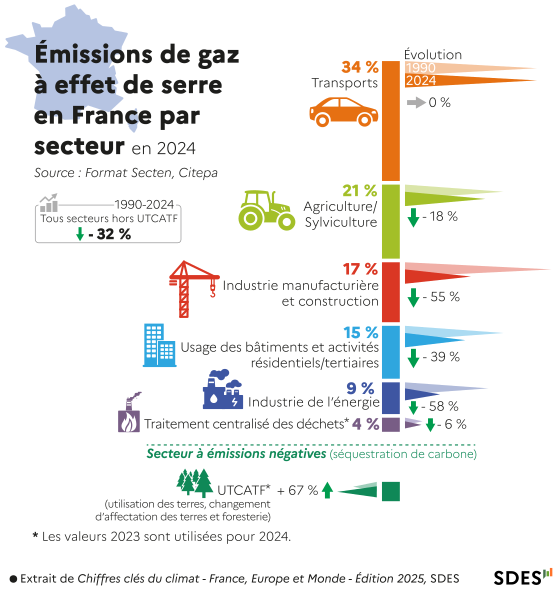
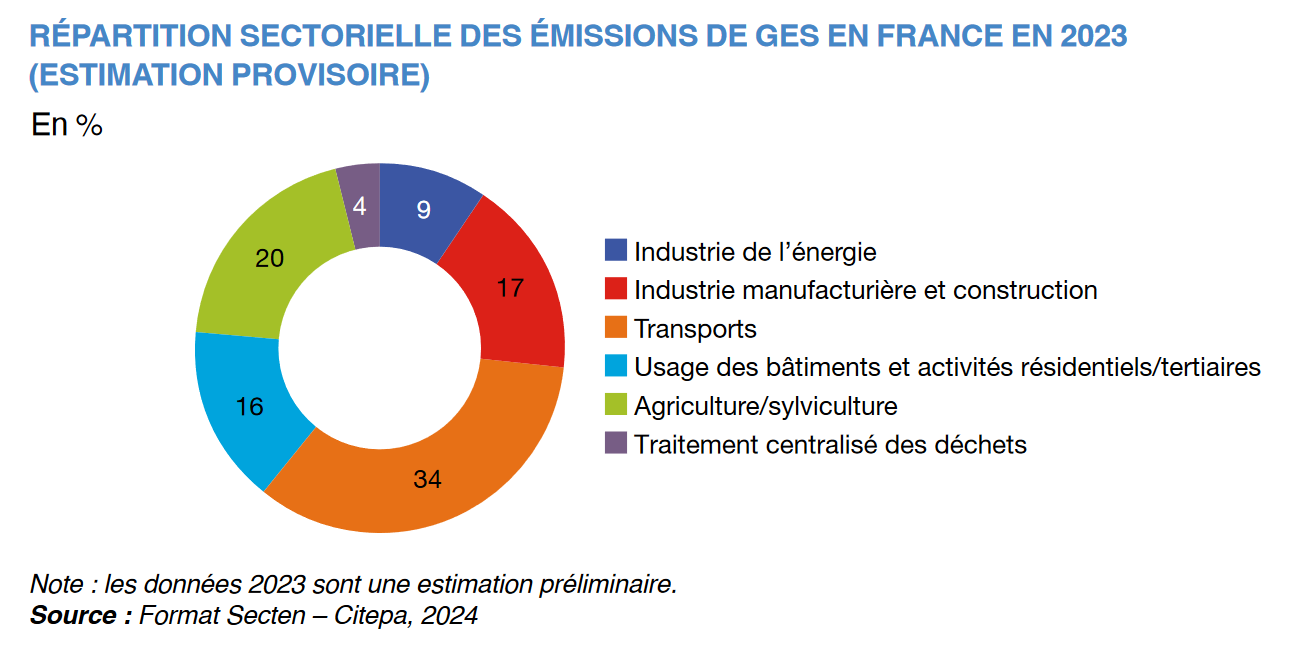
L’agriculture est le deuxième poste d’émissions de GES de la France (19 % du total national et 85 MtCO2 eq. émis en 2019). Les émissions de GES de l’agriculture sont caractéristiques, car majoritairement composées d’autres molécules que le CO2 et issues de processus biologiques. L’élevage (fermentation entérique et gestion des déjections) est la source de 68 % des émissions nationales de méthane (CH4) et la culture des sols (fertilisation minérale et organiques) de 80 % des émissions nationales de protoxyde d’azote (N2O). Le secteur de l’agriculture intègre également environ 11 Mt de CO2 eq. liés à la consommation d’énergie par les engins agricoles et sylvicoles. Les émissions de GES de l’agriculture ont diminué de 8 % entre 1990 et 2019. Les GES associés à l’usage des sols ou leur changement d’usage ne sont intégrées au secteur de l’agriculture mais à celui de de l’utilisation des terres, changement d’affection des terres et foresterie.
Agriculture is France's second-largest GHG emissions source (19% of national total, 85 MtCO2 eq. emitted in 2019). Agricultural GHG emissions are distinctive because they consist mainly of molecules other than CO2 and stem from biological processes. Livestock farming (enteric fermentation and manure management) is the source of 68% of national methane (CH4) emissions, and soil cultivation (mineral and organic fertilization) accounts for 80% of national nitrous oxide (N2O) emissions. The agriculture sector also includes approximately 11 Mt CO2 eq. linked to energy consumption by agricultural and forestry equipment. Agricultural GHG emissions declined 8% between 1990 and 2019. GHG associated with land use or land-use change are integrated into the land use, land-use change and forestry sector rather than agriculture.
- Agricultural GHG emissionsEmissions composition• In 2019, agriculture accounted for 19% of France's GHG emissions, making it the second-largest national emissions source. Emissions comprised 38 MtCO2 eq. of CH4, 36 MtCO2 eq. of N2O, and 12 Mt of CO2. The main source of CH4 emissions is livestock farming (enteric fermentation and animal manure), N2O comes from crop cultivation (nitrogen inputs on cultivated soils through mineral and organic fertilizer spreading), and CO2 emissions result from fossil fuel consumption by agricultural equipment and farm buildings. Forestry emissions represent only a very small fraction of the agriculture and forestry sector's emissions, limited to combustion emissions from forest equipment (non-road mobile machinery, boilers, thermal engines), aggregated with agricultural equipment emissions.French agriculture profile• 45% of the national territory is used for agriculture, and 31% of French soils are cultivated land. France is Europe's leading agricultural producer (€69 billion in production) with fewer than 440,000 farms (compared to over one million in 1998). Crop production represents 63% of all agricultural output, with cultivated land split between major crops (cereals, oilseeds) and pasture. France has Europe's largest cattle herd (18.1 million head).Climate change vulnerabilityThe relationship between agriculture and climate change extends beyond GHG emissions from farming activities. Agriculture is particularly vulnerable to climate disruption effects. Agricultural production can be severely affected by extreme weather events, emerging diseases, water resource constraints, and other factors.Agriculture as leverage• Agriculture also serves as a tool for reducing GHG emissions. Grassland-maintained areas promote carbon storage, as do certain farming practices. The "4 per 1000" initiative launched by French research aims to increase carbon storage in soils by 0.4% annually (equivalent to global CO2 emissions at the worldwide scale) through agroforestry, soil restoration, no-till techniques, crop rotations, and legume plantations. • Agriculture is also a sector well-suited for renewable energy development: anaerobic digestion of agricultural by-products, biomass for heat production, and land use for wind turbine installation. Finally, agriculture is one element of food's carbon footprint, representing approximately 20% of the French carbon footprint, which also includes GHG from the food industry, product transport (including international), and agricultural products.
- CH4 and N2O from agricultureLimited CO2 shareAgricultural GHG emissions do not primarily stem from energy use. CO2 emissions from agricultural equipment energy consumption represent only 13% of emissions (12 Mt). In the national inventory, CO2 accounts for 74% of GHG emissions.CH4 and N2O dominanceAgricultural GHG emissions are primarily CH4 (38 Mt CO2e, or 45% of agricultural GHG emissions). 68% of the national GHG inventory's CH4 comes from livestock farming. Additionally, 36 Mt CO2e—42% of agricultural emissions—is N2O linked to crops. Agriculture (livestock effluent and soil fertilization) accounts for 89% of national N2O emissions.N2O emissions sourcesN2O emissions occur directly after nitrogen input spreading (direct emissions) or are released through biological processes related to soil nitrification/denitrification (indirect emissions). Only anthropogenic N2O emissions—resulting from increased net nitrogen in managed soils from human activity—are counted, generated by mineral and organic fertilizer spreading, grazing excretion, crop residue decomposition, sludge and compost spreading. Animal manure also contributes, in smaller amounts, to N2O emissions.CH4 emissions sources• Ruminant livestock (cattle, sheep, and goats) have a unique digestive system that produces CH4 eructation (enteric fermentation). These emissions depend primarily on animal species (cattle emit the most, averaging 62 kg CH4/year/head) and animal diet. • Managing animal waste (as manure or slurry)—rich in organic matter—also emits CH4 during fermentation. In 2018, enteric fermentation accounted for 61% of total French CH4 emissions versus 7% for waste management. Cattle are responsible for 87% of livestock CH4 emissions.
- Evolution of agricultural GHG emissionsDecline 1990–2019Agricultural GHG emissions show minimal change between 1990 and 2019: -8%. CH4 emissions fell 10%, N2O declined 9%, while CO2 emissions remained stable (-1%). The CH4 reduction is explained by decreased livestock numbers combined with improved dairy productivity. Increased slurry management partly offset the impact of herd reduction. Reduced nitrogen inputs between 1990 and 2019 contributed to N2O emissions decline.National low-carbon strategyEstablished by the law of August 17, 2015 on energy transition for green growth, the national low-carbon strategy (SNBC) is France's roadmap for climate change mitigation policy. SNBC 2, incorporated in the law of November 8, 2019 on energy and climate, sets the objective of achieving carbon neutrality by 2050 (balance between anthropogenic emissions and anthropogenic absorption through natural sinks managed by humans, particularly forests, and industrial carbon capture and storage). SNBC aims to halve agricultural sector emissions between 1990 and 2050 (-46% between 2015 and 2050, and -18% between 2015 and 2030). While other economic sectors target complete production decarbonization by 2050, SNBC does not plan total elimination of agricultural GHG. These emissions are unique in not originating from energy consumption. SNBC envisions development of agroecology, precision agriculture, and reduced energy consumption to lower agricultural emissions.
Further reading
- La statistique agricolenotre-environnement.gouv.fr
Le Service de la statistique et de la prospective (SSP), au sein du Secrétariat Général du Ministère de l’agriculture et de l’alimentation (MAA) et les Services régionaux de l’information statistique et économique (SRISE) au sein des Directions régionales de l’agriculture et de la forêt fonctionnent en réseau pour répondre à quatre grandes missions : production, études et prévisions, diffusion et coopération.
- Alim’agrinotre-environnement.gouv.fr
Site du Ministère de l'Agriculture et de l'Alimentation.
- Ministère de la Transition écologique et solidaire : Climatnotre-environnement.gouv.fr
Rubrique consacrée au climat du site du Ministère de la Transition écologique et solidaire.
- Service des données et études statistiques : Agriculture et environnementstatistiques.developpement-durable.gouv.fr
Site internet Données et études statistiques - Commissariat général au développement durable.