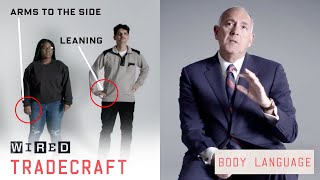

Former FBI Agent Explains How to Read Body Language | Tradecraft | WIRED
14 chapters
- Introduction to Nonverbals and FBI BackgroundDefinition & BasicsNonverbals are anything that communicates but is not a word, commonly known as body language. They include how we dress, how we walk, and other behaviors that reveal what is in the mind of a person.Speaker BackgroundJoe Navarro was a special agent with the FBI for 25 years, primarily working within the national security division. His job was to catch spies and focus on understanding targets and neutralizing threats.Real-World Application• Security is based on observing nonverbals—looking through peepholes or observing people at ATM machines • Most people select their mates based on nonverbal communication • We are constantly transmitting information through our behaviorCore PrincipleWe may think we are sophisticated, but we are never in a state where we are not transmitting information to others.
- Common Myths About Body LanguageCrossed Arms MythCrossing arms is often thought to be a blocking behavior, but this is false. Even when we dislike someone, we cross our arms as a self-soothing mechanism, similar to a self-hug. We actually do this behavior more in public than in private.Eye Direction FallacyLooking in a certain direction while thinking or processing information does not indicate deception. It simply means the person is processing information. This behavior should not be used to detect lying.Deception Indicators Debunked• Clearing the throat, touching the nose, or covering the mouth are self-soothing or pacifying behaviors, not signs of deception • There is no scientific or empirical evidence of a 'Pinocchio effect' • Claims that these behaviors indicate lying are 'sheer nonsense'Human LimitationsHumans are lousy at detecting deception based on body language alone. These myths persist despite lack of scientific support.
- Real Espionage Case: The Flower Shop IncidentThe SetupIntelligence from another country indicated that an American mole was working for a hostile intelligence service. The suspect was videographed coming out of a flower shop, and the FBI team was analyzing the footage.The DetailMost Americans hold flowers by the stock with flowers facing upward. The suspect grabbed the stock and held the flowers facing downward—how flowers are carried in Eastern Europe. This small detail revealed his true origin.The ApproachRather than directly confront the suspect, Navarro used a 'presumptive' technique. He asked the suspect if he would like to know how they figured him out, then mentioned the flowers.The OutcomeThe suspect's facial expression showed recognition, and he subsequently confessed to being a spy. This case demonstrates how a single nonverbal detail can uncover a major security threat.
- The Power of Face Time and Extended ObservationInitial MisconceptionWhen entering law enforcement, Navarro thought it was all about getting a confession. However, he discovered that success was really about face time with the person.Long-Term ResultsIn 25 years with the FBI, it was rare that a person did not eventually reveal the information needed during lengthy conversations. Patience and sustained interaction proved effective.Assessment MethodNavarro looks at behaviors to assess what a person is transmitting in relation to any stimulus. Further questioning comes from observing these behaviors rather than starting with assumptions.Key InsightStudying nonverbals is not about making judgments but about assessing what a person is transmitting in that moment.
- Reading Facial Features and Upper Body LanguageHead and Face Assessment• Hair: Look for health and grooming as indicators • Forehead: Often reveals stress and life experiences etched over time • Eyes: Check for redness or signs of insufficient sleep • Glabella: The area between the eyes reveals information early, especially discomfort signalsMouth and Jaw Signals• Compressed lips indicate something bothers the person • Sucked-in lips show severe disturbance • Tongue rubbing inside the cheek paired with attempts to hide it indicates perception managementShoulders and Neck• Head tilt suggests relaxation; when it disappears, there is usually an issue • When asked a question they don't know, both shoulders shoot up very quickly • Neck ventilation in men occurs at the instant something bothers themHand and Arm Positions• Stiffened interlaced fingers with slow hand movement indicates troubling thoughts • Steeple position suggests something is at issue • Arms akimbo with thumbs back indicates inquisitiveness rather than pure territoriality
- Full Body Analysis: Legs, Feet, and Movement PatternsLeg and Leg BrushingBrushing of the legs with hands is another pacifying behavior that communicates discomfort or the need for self-soothing.Foot Behaviors• Wiggling or kicking of feet can indicate anxiety or discomfort • When feet suddenly withdraw and cross after a question, the person may feel threatened by the questionOverall InterpretationWhen studying nonverbals, it is not about making judgments but assessing what the person is transmitting in that moment.Continuous TransmissionEveryone transmits information constantly through clothing choices, grooming, personal care, and how they carry themselves—with varying levels of energy and pace.
- Observing Behavior Changes and MinutiaeKey ObservationWhat to look for are differences in behavior down to the minutia of how an individual carries themselves and presents themselves in different contexts.Specific Details to Track• Posture while walking down the street • Whether the person is on the inside or outside of the sidewalk • Blink rate, which is typically around eight times per minute • How often someone looks at their watchInformation GatheringAll these details factor in because they transmit information. The role of an observer is to use this information to determine whether resources need to be marshaled to monitor that individual.Strategic ApplicationThese observations help law enforcement and security professionals identify when closer attention should be paid to a person.
- Handshakes and the Importance of TouchCultural SignificanceIn most Western cultures, the handshake is the first time people touch one another. This makes it a critical moment for establishing initial connection.Chemical ResponseDuring a handshake, bodies release bonding chemicals that communicate whether we like or dislike the other person. Everyone can remember a time when shaking hands with someone felt wrong.Necessity and ImportanceHandshaking is both necessary and essential in most cultures as a foundational element of human interaction.Nonverbal InformationThe handshake conveys crucial information through pressure, duration, temperature, and the overall feeling of the contact.
- Personal Space and Comfort DemonstrationSpace DynamicsBy introducing the topic of comfort, individuals unconsciously increase their distance from each other. They rock away from each other and create space when discussing personal comfort.Physical Indicators• Feet movement increases as individuals search for their optimal personal distance • A high degree of movement indicates unsettledness • Rocking behavior becomes directed away from each otherNormalization EffectBy explicitly addressing comfort and appropriate distance, individuals feel more at ease maintaining the distance that feels right for them.Observation PurposeUnderstanding how people adjust their personal space reveals their comfort level and psychological state in social interactions.
- Poker as a Laboratory for Behavior ReadingComparative ContextPoker games provide a similar dynamic to sitting across from a spy. Both situations involve reactions to stimuli and behaviors indicative of psychological discomfort used at home, work, or the poker table.Initial Observations• When a table is called for the first time, it is an opportunity to observe behaviors indicative of discomfort • Shifting in chairs, reaching to grab shoulders, and high shoulders are early indicators • Poker intelligence can be collected before the game even startsGame DynamicsAs players see their cards and the game progresses, behavioral patterns shift based on the value of their hands and their confidence levels.Strategic ValueReading poker behavior is useful because the same nonverbal indicators of psychological comfort or discomfort appear in real-world scenarios.
- Hand Positions and Card Value IndicatorsHand Placement Over Cards• Some players cage their cards while others place hands directly on top and press down • This pressing behavior occurs when the cards increase in value • Player behavior with hands indicates their engagement with the cardsDistance from BodySome players keep their hands very close to their body, while others maintain distance. These variations indicate different comfort and confidence levels.Hand Withdrawal PatternWhen players withdraw their hands from the table, it mirrors a broader principle: we move our hands forward when we like things and away when we don't like things.Chip Shuffling BehaviorPlayers who shuffle their chips are self-soothing and pacifying themselves. This behavior simply helps them get through the game.
- Arms, Thumbs, and Behavioral Shifts in PokerCrossed Arms PositionA player with crossed arms and minimal activity does not mean they are transmitting no information. Thumb position and movement are critical indicators that change as the game evolves.Speed Analysis TechniqueLooking at nonverbals at double speed makes critical behaviors jump out as though they were a caricature, making patterns more obvious.Hand Engagement Changes• When a player's hands move from held close to fully extended, it indicates engagement and interest • The progression from withdrawn to active hands shows increasing psychological involvement in the gameInformation AccessOnce the game is opened with community cards visible, 75 to 80 percent of the information needed is sitting out there in player reactions and behaviors.
- Observation Strategy and the Poker Face MythWhere to LookPlayers often look at their own cards or community cards rather than observing others. The key is to watch for reactions, because those reactions will appear again during play.The Poker Face LimitationWhile people can have a poker face, they cannot have a poker body. Somewhere the body will reveal what the person is feeling or thinking.Information DistributionMost of the information needed is transmitted through the body rather than the face, making full-body observation essential.Practical InsightUnderstanding this principle—that nonverbals cannot be fully controlled—is critical to reading people in poker and in life.
- The Importance of Nonverbal CommunicationEducational EvolutionWhen Navarro was in college in the early 1970s, there were really no courses on nonverbal communications. He realized that understanding behavior interpretation was crucial to the field.Why It Matters• Nonverbals have gravitas because they affect how we communicate with each other • This is no small matter in professional and personal contexts • Understanding nonverbals is essential for meaningful communicationPrimary Communication ModeHumans primarily communicate nonverbally and always will. Words are secondary to the messages transmitted through body language and behavior.Core TakeawayMastering the reading of nonverbals enhances every aspect of human interaction, from law enforcement to everyday relationships.