RSA ANIMATE: Drive: The surprising truth about what motivates us
8 chapters
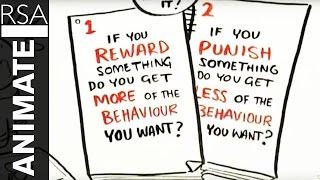
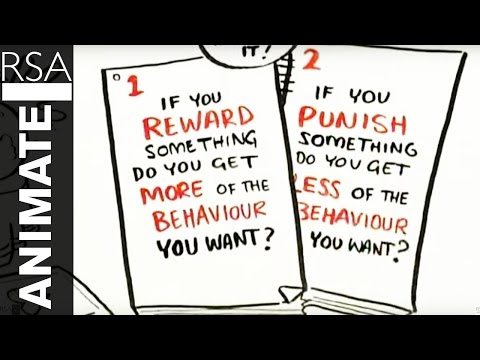
- Introduction to Motivation ScienceOpening StatementMotivations are unbelievably interesting and surprisingly different from what we commonly assume about human behavior.Key FindingWe are not as endlessly manipulable and predictable as conventional thinking suggests.Research OverviewThere are studies that challenge the idea that rewards produce desired behavior and punishments eliminate unwanted behavior.What's ComingThe speaker will present two major studies that question traditional reward and punishment motivation schemes.
- MIT Study: Rewards and Task PerformanceExperiment SetupMIT researchers gave students cognitive challenges and offered three levels of monetary rewards: small, medium, and large cash prizes based on performance.Key Results• For mechanical skill tasks, higher pay led to better performance as expected • For tasks requiring cognitive skill, larger rewards led to poorer performance • This contradicted conventional economic theoryResearch TeamEconomists from MIT, University of Chicago, and Carnegie Mellon—top tier of the economics profession—reached conclusions contrary to traditional economic principles.SignificanceThe Federal Reserve Bank financed this research, showing mainstream institutions recognizing that reward mechanisms don't work as traditionally believed for complex cognitive tasks.
- India Replication: Testing in Different ContextStudy DesignResearchers replicated the experiment in rural India where monetary rewards were more significant: low performance earned two weeks' salary, medium performance earned one month's salary, high performance earned two months' salary.Unexpected Outcome• People offered medium rewards performed no better than those offered small rewards • People offered the top reward performed worse than both groupsPattern ConfirmationHigher incentives led to worse performance, replicating the MIT findings despite substantially greater financial motivation.Broader ValidationThis finding has been replicated repeatedly by psychologists, sociologists, and economists across different contexts and populations.
- When Rewards Work and When They Don'tEffective Rewards• Simple, straightforward tasks with clear 'if-then' relationships • Algorithmic tasks requiring specific rules and correct answers • Carrot and stick motivators work outstandingly for these typesIneffective RewardsWhen tasks become complicated and require conceptual and creative thinking, traditional reward motivators demonstrably don't work.The Money Paradox• Money is a motivator, but in a strange way • If you don't pay people enough, they won't be motivated • The best use of money is to pay enough to remove money from considerationBeyond PaymentOnce adequate compensation is provided, three factors lead to better performance and satisfaction: autonomy, mastery, and purpose.
- Autonomy: Self-Direction at WorkDefinitionAutonomy is our desire to be self-directed and direct our own lives.Management Approach• Traditional management works well for compliance • Self-direction is better for engagement, which modern workers require for sophisticated tasksAtlassian ExampleThe Australian software company Atlassian gives developers one full day per quarter to work on anything they want, in any way they want, with anyone they want—only requirement is showing results to the company.Results• This single day of pure autonomy has led to numerous fixes for existing software • It has generated ideas for new products that would otherwise never emerge
- Mastery: The Drive to ImproveCore MotivationMastery is our urge to get better at stuff, which is inherently satisfying and fun.Real-World EvidencePeople play musical instruments on weekends despite economic irrationality—they don't gain money or mates, but find satisfaction in improvement.Open Source Phenomenon• Linux powers one out of four corporate servers in Fortune 500 companies • Apache powers the majority of web servers • Wikipedia demonstrates massive voluntary contribution • All created by people giving away highly skilled work for freeWhy People ContributeTechnically sophisticated, highly skilled people work on these projects during discretionary time for free because of challenge, mastery, and the desire to make a contribution.
- Purpose: The Rise of Transcendent GoalsOrganizational Shift• More organizations seek transcendent purpose • Purpose makes work better and attracts better talentProfit Without Purpose• When profit motive becomes unmoored from purpose, bad things happen • Results include crappy products, lame services, and uninspiring workplacesCompany Examples• Skype founder: 'Our goal is to be disruptive, but in the cause of making the world a better place' • Steve Jobs: 'I want to put a ding in the universe'New Business ModelFlourishing companies—whether profit, not-for-profit, or hybrid—are animated by purpose motive and blur the boundaries between profit and purpose.
- Conclusion: Treating People as PeopleCore Insight• We are purpose maximizers, not only profit maximizers • We care deeply about mastery • We want to be self-directedOld ParadigmTraditional motivation assumes people are like horses—slower, smaller, better smelling—responding only to carrot and stick incentives.New ParadigmWhen we treat people like people and move beyond carrot and stick ideology, we can look at the science and build accordingly.OutcomeBuilding organizations and work lives around autonomy, mastery, and purpose makes us better off and has the promise to make our world better.