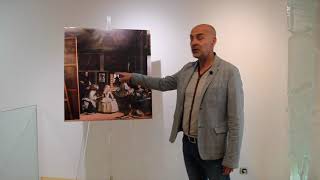
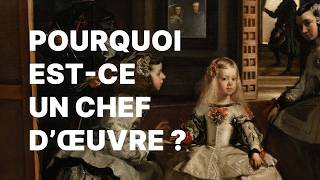
Les Ménines de Vélasquez, expliquées. (Analyse)
Las Meninas remains an enigma
9 chapters
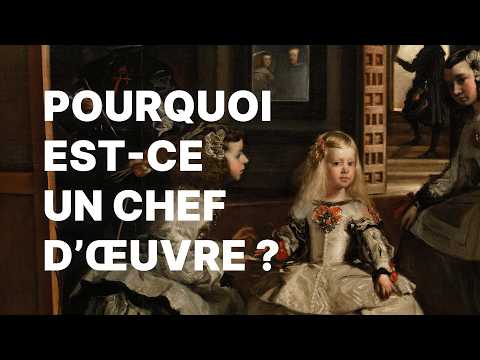
- Introduction and Context of the MasterpieceGeneral OverviewLas Meninas is considered Velázquez's masterpiece, a monumental painting with spectacular dimensions of 3.20 by 2.76 meters, preserved in the Prado.Central MysteryAlthough everything about the painting is known (location, date, figures, painter), one enigma remains: why is it a masterpiece and what makes it so special?Analytical ApproachThe video explores the profound reasons for its exceptional status beyond documented historical facts.Fundamental Questions• What is the true subject of the painting? • What is Velázquez truly looking at? • Was the painting intended for the modern viewer or for the king?
- The Life and Ambition of Diego VelázquezOrigins and StatusBorn in 1599, Velázquez came from a family claiming minor nobility but actually lived a bourgeois life. His father allows him to pursue a painting career, defying convention.Painting and Nobility• In Spain, painting was considered a manual trade unworthy of nobility • Greek philosophers associated manual labor with the lower classes • The Italian Renaissance (Leonardo da Vinci, Raphael) gradually elevated the status of artists • In Spain, this evolution was slower and more delayedDual AspirationThroughout his life, Velázquez seeks to reconcile two seemingly contradictory demands: to be recognized as a great gentleman and as a great artist.Professional AdvancementIn 1623, at age 24, he is appointed royal painter after leaving his profitable position in Seville to join Madrid, where he sought social recognition.
- Composition and Figures of the PaintingMain Figures• The Infanta Margaret at the center, surrounded by two ladies-in-waiting of high birth • Two dwarfs (María Bárbola from Germany and Nicolasito Pertusato from Italy) ranked the same as domestic animals • Marcela de Ulloa, a widow in service to the Infanta, accompanied by an unknown squireBackground and MirrorIn the background, José Nieto, the queen's steward, watches discreetly. In a startling mirror, King Philip IV and Queen Mariana of Austria appear—the only portrait of the royal couple painted by Velázquez.Artist's Self-PortraitVelázquez depicts himself standing with brush and palette facing an enormous canvas. He wears the cross of the Order of Santiago, a symbol of nobility that he was eager to immortalize alongside him.Enigmatic Structure• Impossible to know if the painting has begun • Gazes seem suspended, turned elsewhere • The real subject of the painting remains ambiguous and off-canvas
- Foucault's Thesis and Its Historical LimitsPopular InterpretationAccording to Foucault, the modern viewer stands in the king's place: all gazes converge toward the king and queen, the true subjects of the painting. This analysis has become very popular but is historically false.Historical Context• The painting was not created for the Prado or for the public • It was a royal commission intended for the king and his private court • The anachronistic idea assumes the painting was made to be contemplated in a museumThe Courtly PaintingThe work flatters the king, not the viewer. It is an act of courtesy: all gazes converge toward royal majesty, whether present or represented in the mirror.Critical ConclusionThe theory of replacing the viewer with the king is charming but works only by thinking the painting was created for the modern age, which is historically inaccurate.
- Dynastic Genesis and Transformation of the PaintingOriginal Composition• 1656 version centered on the Infanta Margaret • Absence of Velázquez himself • Presence of a large red curtain and a boy holding a baton of commandPolitical MessageThe original composition clearly designates the Infanta as the heir to the throne. Philip IV had no living male heir after Balthasar Charles's death in 1646, making young Margaret (age 5 in 1656) his last hope for succession.1659 Transformation• In 1657, Philip IV and Mariana of Austria have a son: the missing male heir • The dynastic painting no longer has reason to exist • In 1659, the king asks Velázquez to modify the workNew IntentionThe king desires a family portrait in the broader sense: the king's family with his close associates, servants, and domestic animals. Velázquez includes himself in the painting, immortalizing his nobility and privileged position near the king.
- Three Hypotheses of InterpretationClassical HypothesisThe king and queen, present off-canvas, are being portrayed. The Infanta comes to see them. The mirror reflects their faces. Velázquez reverses the action: the painting treats the sovereigns, not the daughter.Ambiguous Mirror HypothesisThe mirror does not reflect the sovereigns but the canvas being executed. The visible curtain in the reflection creates an illusion of a royal portrait. Only the bust is visible, which explains why other figures might be off-canvas.Privileged HypothesisThe princess and her companions were posing when the sovereigns enter the room, surprising them. The mirror truly reflects the king and queen present. The expression in their gazes betrays surprise, not respect.Intentional AmbiguityWithout certainty about what the mirror reflects, we cannot know what is painted on the canvas. Velázquez probably wanted to create this uncertainty, placing the viewer in an uncomfortable and mysterious position.
- Ambiguity as a Reflection of the 17th CenturyVelázquez's Visual Games• Details of intentional ambiguity placed in the background becoming central to analysis • Blur used to create illusion (hazy Venus, ambiguous spaces) • The painting within the painting or window into another room?Philosophical ContextThe 17th century is the age of doubt: Descartes, Galileo, Kepler question the order of the world. The Earth is no longer the center of the universe. Religious certainties waver.Political Chaos• Europe is a continuous battlefield • The Thirty Years' War ravages the continent • Spain loses Flanders, Catalonia, Portugal • Widespread feeling of chaos and declineArtistic ReflectionThis theatrical age of illusions necessarily appears in Velázquez's work. Uncertainty pervades the arts and culture. The ambiguity of Las Meninas is not surprising but coherent with its time.
- The Emotional Essence of the MasterpieceCapturing TimeVelázquez has stopped time like a luminous memory. The king and queen have just appeared in the mirror, the Infanta pauses, the painter suspends his gesture. Time is frozen in eternity.Melancholy of the Era• The reign of Philip IV is one of Spanish decline • Charlemagne's golden age is distant • A feeling of dignified sadness and unhappy destiny pervades the canvasVisual TestamentThe painting functions as a memorial. More than a capture of the moment, it is a profound reflection of melancholy. Light struggles to penetrate, chandeliers dim, men become ghosts emptied by etiquette.Artistic GeniusBetween restrained elegance and decline without revolt, between beauty without idealism, Velázquez captures the soul of an era with scientific impassivity. He seeks only truth, playing with space and moment as the master of time.
- Legacy and Rediscovery of VelázquezEventful End of Life• In 1660, Velázquez arranges the meeting between Philip IV and Louis XIV • He oversees logistics for the marriage of Marie-Thérèse of Austria to the King of France • Exhausted by this event, he falls ill and dies at 61 years old • His wife follows him 8 days laterContemporary IsolationAt his death, Velázquez is admired at the Spanish court but his reputation does not circulate in Europe. His work, confined to royal palaces, remains inaccessible. The Velázquez school has no true students.19th-Century Rediscovery• The opening of the Prado Museum enables rediscovery • The emergence of Impressionist painters recognizes his genius • His airy touch and imprecise contours pave the way for modernityImmortal InfluenceGoya, Picasso, Delacroix, Manet copy him. He becomes the undisputed master of painters. Although he sacrificed some of his talent decorating palaces, each act of painting marks art history. The painter of princes becomes the prince of painters.