La Naissance de Vénus de Botticelli, expliquée. (Analyse)
5 chapters
- Historical Context and Botticelli's AudacityArtistic BreakthroughIn 1484, Botticelli painted The Birth of Venus, a pagan work depicting a frontal, direct female nude measuring 1.72 by 2.78 meters. This was a remarkably bold act because for over 1,000 years, painting had not represented a naked woman.Medieval Legacy• The female nude represented lust, sin, and shame • It was reserved for a sinful Eve with an apple and serpent • Representations remained discreet and small in sizeNew DimensionThe painting marks a turning point in art history. Art is no longer merely a communication tool serving an ideology, but becomes an object of desire.Symbol of the EraThe Birth of Venus embodies the cultural, intellectual, and artistic renewal of the Renaissance, where art transcends medieval religious constraints.
- The Renaissance and Its Conditions of EmergenceIntellectual Revolution• Gutenberg introduces the printing press to Europe, spreading knowledge more widely and quickly • Humanism places man and the individual at the center of discourse • These ideas contrast with the control and authority of the Medieval ChurchRecognition of ArtistsArtists are finally recognized for their talent. Wealthy patrons like the Medici in Florence finance their work, freeing art from the Church's exclusive dominance.Artistic LiberationMedieval art preceding the Renaissance is literally flat, without perspective or emotion, making identification with figures impossible. The Renaissance creates visual and emotional freedom.Foundations of MasterpieceWithout the rediscovery of the Greco-Roman world, without Medici patronage, and without the rise of humanism, the Birth of Venus would never have been created.
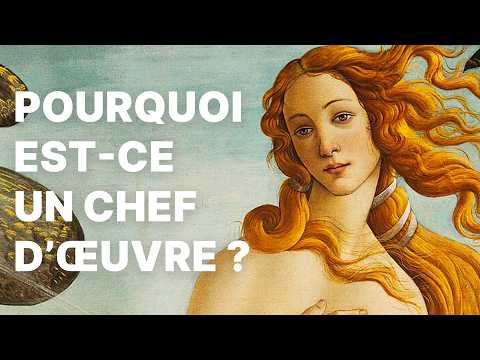
- Mythology and Symbols in the PaintingOriginal MythAccording to Hesiod, Chronos castrated his father Uranus and threw his genitals into the sea. The seed impregnated the ocean and gave birth to Venus, goddess of beauty and love. A subtle phallic reference threads through the painting as an inside joke for the educated elite.Venus Pudica• Venus stands nude on a pearlescent shell, her body drawn with sinuous lines • Her head is inclined with softness and melancholy, as if lost in an idealized past • Modest, her hands and hair awkwardly conceal her intimate partsVisual Symbolism• The shell is a sexual symbol and fertility sign due to its resemblance to the female genitalia • The flourishing vegetation around Venus signals fertility • Her pale complexion recalls her purity and she is centered, drawing all attentionDivine Retinue• Zephyr, the chubby god of wind, entwined with Chloris, nymph of flowers, creates aesthetic movement • A season of spring, a time of love and beauty returned after winter • A red cloak awaiting Venus symbolizes the transition from wild nature to the civilized world
- Idealization and Artistic ConstructionIntentional Distortion• Venus is unstable; the shell would tip over in reality • Her skin is particularly pale, marked with a subtle black contour • Her neck is too long, her shoulders slope, her arm is too elongatedRudimentary PerspectivesAll figures exist on the same plane like a tapestry. They seem weightless and cast no shadows, creating an intentional absence of spatial realism.Painter's IntentBotticelli was no novice when painting this work; he was at the height of his mastery. These distortions are not errors but a deliberate choice to remind us that these mythological paintings are products of imagination.Supernatural BeautyVenus is unreal and her beauty is almost supernatural. The painting may also represent a wedding gift meant to excite the senses and invite procreation, with a deliberately erotic character.
- Political Context and Legacy of the WorkBonfire of the VanitiesBetween 1494 and 1498, after expelling the Medici from Florence, the monk Savonarola establishes a severe theocracy. On February 7, 1497, he organizes a bonfire of the vanities where dresses, mirrors, cosmetics, jewelry, musical instruments, books, and paintings are burned.Survival of the WorkBotticelli himself allegedly brought several of his mythological night works to this bonfire. Fortunately, Primavera and the Birth of Venus were found together at Castello, a Medici villa near Florence, escaping destruction.Lasting InfluenceThough Botticelli faded into obscurity near the end of his career in favor of Michelangelo and Leonardo da Vinci, his influence remains paramount. Female nudes continue to flourish thanks to his work.Contemporary Legacy• The Birth of Venus remains a source of inspiration for countless artists today • The work embodies the celebration of the senses, idealization, and sensuality of Florentine Renaissance • It blends carnal and spiritual love, physical beauty and melancholic contemplation