Picasso, un siècle de peinture : analyse d'oeuvre, les Demoiselles d'Avignon
7 chapters
- Introduction to the Revolutionary PaintingVisual DescriptionDislocated and mutilated female bodies, faces masked with features, facets and angles like daggers characterize this painting that revolutionized modern art in 1907.Revolutionary ImpactThe work is brutal and aggressive, breaking with everything that had been done in painting until then and striking deeply those who saw it at the time.Creative ProcessThe painting is the result of 9 months of preparatory work including sketches, studies and experimentation rather than a spontaneous impulse.Artistic AmbitionPicasso, aware by autumn 1906 that he had reached the end of his pictorial research, seeks something new and feels something stirring within him.
- Influences and Artistic ContextSources of Inspiration• Ingres's The Turkish Bath displayed at the Louvre for the first time in 1905 • Primitive art from Spain and Africa • Painter Paul Gauguin during a retrospective in 1906Artistic RivalryPicasso is driven because his rival Matisse has presented The Joy of Life, an innovative painting with shimmering colors, and he wants to do better.Subject DevelopmentBy early 1907, the theme is found: the shameless display of prostitutes in a brothel, deliberately provocative for the time.Intensive PreparationFor several months, Picasso multiplies studies of the bodies and faces of those who will become the subject of his canvas.
- Reception and Initial ReactionsPublic ShockAfter being presented to close friends in June-July 1907, the painting causes a shock and few understand its revolutionary significance.Artists' Reactions• George Braque exclaims: 'Still, your painting is as if you wanted us to eat tow and drink petroleum to spit fire' • André Derain declares: 'One day we will learn that Picasso hanged himself behind his great canvas'General IncomprehensionThe extreme reactions suggest that artists of the time consider the work as mad or incomprehensible.Existential QuestionWhy are they so struck by this creation? Observing the painting allows us to discover the reasons for this shock.
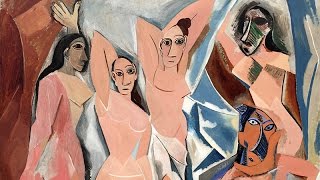
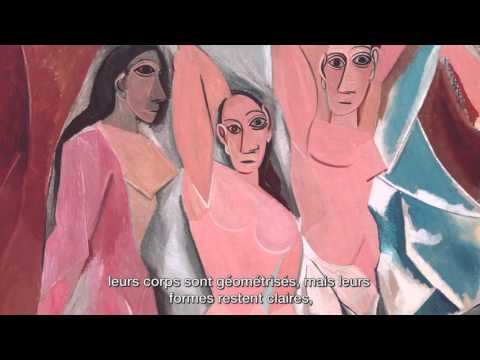
- Composition and Figure CompositionPainting OrganizationLes Demoiselles d'Avignon depicts five women before draperies who display their nudity in various positions.Compositional Influences• Picasso borrows from Ingres's The Turkish Bath the accumulation of bodies and the pose with raised arms • Originally, two male characters (a student and a sailor) were planned but removed in the final version • This removal concentrates attention on the immodest women and transforms the viewer into a voyeuristic clientTitle and ProvenancePicasso calls his work The Brothel of Avignon, an allusion to Avignon Street in Barcelona renowned for its prostitutes, renamed Les Demoiselles d'Avignon to pass censorship in 1916.Artistic EvolutionPicasso incorporated Gauguin's lesson on the massiveness of bodies, simplifying the powerful volumes of arms, thighs and torsos to the extreme to lose all realism.
- Treatment of Bodies and FacesProgressive Evolution• The three women on the left painted first have geometricized bodies but with a clear form and easily identifiable • The two women on the right painted later have the appearance of an agglomeration of flat surfaces like facetsDislocation of FormsPicasso notably dislocates the seated woman with legs spread in an impossible position, her body seen from behind topped with a head seen from the front.Facial Simplification• Picasso reduces faces to an assembly of elementary signs: eye, nose, mouth, ears • The three women on the left borrow from Iberian art with darkened eyes and prominent ears • The figure in the upper right borrows from African art with empty eye, massive nose and low mouth evoking African masks • The seated woman prefigures future research with a decomposed face seen simultaneously from front and profileFormal BreakThese simplifications and decompositions mark the total abandonment of realistic representation of human forms.
- Aesthetic Revolution and StyleAbandonment of Classical Codes• The work contains neither perspective nor shadow • The five figures are as if plastered onto the setting that surrounds them • Picasso conveys the impression of depth by overlapping bodies or making an arm disappear behind draperyBrutality of ExecutionThe work is violent both in its subject and manner: angular forms, colored surfaces in contrast, brush strokes spread brutally on the figures on the right.Prefiguration of CubismTo break with artistic conventions, Picasso adopts an unprecedented style that prefigures cubist research.Modern LegacyToday we have forgotten how revolutionary this painting was and how it shocked even avant-garde artists who were Picasso's friends. This work is the birth act of modern art.
- Destiny and Recognition of the WorkInitial IsolationExcept for a few days of presentation at a salon in 1916, the painting remains hidden from public view for a long time after being purchased by private collector Jacques Doucet.Restricted AccessArt lovers can truly discover this work only in 1937 when it is acquired by the Museum of Modern Art in New York.Current ConservationThe work remains at the Museum of Modern Art in New York, where it remains an accessible masterpiece.Proof of RevolutionThe fact that we are accustomed to this type of painting today proves that this canvas is indeed the birth act of modern art.