

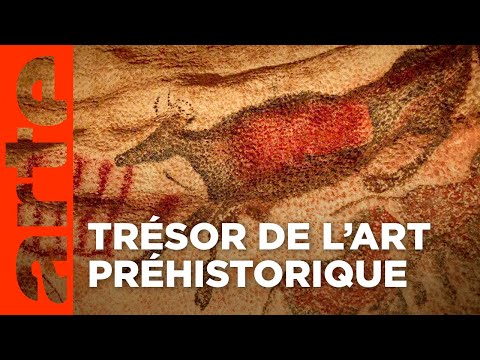
- 18 000, la grotte de Lascaux | Quand l'histoire fait dates | ARTE
12 chapters
- Prehistory Enters HistoryDefinitionPrehistory is the history of humanity without written texts, the history before writing. Writing emerged in Mesopotamia in 3300 BCE, marking the conventional beginning of history.Conceptual RuptureThe discovery of Lascaux creates an intrusion of prehistory into history. It raises the question: if art rather than writing marked the beginning of humanity, how should we redefine these periods?Human Chronology• Homo sapiens discovered: 300,000 years ago • Genus Homo: more than 2 million years ago • The history/prehistory boundary is arbitrary and reflects our inability to narrate unwritten tracesFundamental QuestionsWhat links the birth of art to the birth of man? If art rather than writing marked the beginning of humanity, does this change our understanding?
- The Geological Formation of the CaveMarine Origins86 to 89 million years ago, the current basin was an ocean. Shells, microorganisms, and skeletons of marine animals gradually transformed into limestone under compression.Formation of Cavities• At the end of the Secondary Era, the ocean recedes and geological movements elevate the rocks • Water seepage infiltrates the porous and fractured rock • Natural cavities gradually formModern EmergenceThree million years ago, the Vézère and its tributaries carved their channels and exposed the limestone rocks containing the caves of Périgord Noir.Closure and PreservationThe cave becomes a dry, stable, and sealed conduit. A few centuries after the frescoes were painted, the natural entrance becomes sealed, burying the prehistoric treasure for millennia.
- Magdalenian Culture and Its TracesSpecies and CultureThe men who decorated Lascaux are Homo sapiens like us. However, there is great variety in prehistoric cultures described by prehistorians based on available remains.Identifying Tools• Projectile points hafted on spear shafts • Flint knapped into laurel-leaf blades • Needles made of bone or ivory • Spear-throwers that increased the power of spear launchingCultural Periods• Gravettian: 30,000 to 22,000 years ago • Solutrean: 22,000 to 18,000 years ago • Magdalenian: 18,000 to 12,000 years agoIndirect DatingPainted or engraved walls cannot be directly dated. Lascaux's dating relies on archaeological context: a pink sandstone lamp containing charcoal provides a radiocarbon date of 17,000 years.
- The Well Scene: The Central EnigmaDramatic CompositionA wounded bison struck by a spear loses its entrails. A man with a bird's head is overturned, genitals erect, likely dropping his spear-thrower. It is the only human representation among 950 identified animals.Significant LocationThe scene is found at the bottom of the well, an inaccessible, confined, and hidden place. The air is saturated with carbon dioxide, producing vertigo. A lamp dated to 17,000 years ago rests at the foot of this scene.Probable SymbolismThe scene depicts the death of man at the moment he became master of animal powers. It contrasts with the rotunda showing the regeneration of the world and seasonal cycles.Supposed InitiationThe path to the well is difficult and restricted. This suggests the well's discourse warranted initiation, implying a social structure with hidden teachings for young Magdalenians.
- Artistic and Narrative OrganizationSpecialists and DivisionPerspective effects and the contrast between sharp lines drawn with a brush and the soft texture of animal coats achieved through spitting paint testify to the existence of specialists. The first division of social labor entrusted some with the practice of the imagination.Role of ImageFor Upper Paleolithic hunter-gatherer societies, the role of image as a vehicle for discourse, message, and understanding of the world was far more important than we can imagine today.Overall Staging• An imaginary unicorn opens a great cavalcade of animals in the rotunda • Horses, deer, and aurochs follow in succession • Two bison back-to-back mark anchor points • A mysterious upturned horse at the entrance to a passageGrand NarrativeThere is clearly an overall project, a grand narrative. But what is this grand narrative? That is the question that has obsessed researchers since its discovery.
- Spatial and Religious InterpretationsNarrative ArchitectureThe rotunda is the largest and most easily accessible space, capable of accommodating many visitors. This is where the gigantic animal fresco and seasonal cycles unfold.Seasonal SymbolismThe coats worn by the animals may reflect representations at certain seasons. These seasonal cycles might express the annual regeneration of nature and the world.Two Distinct DiscoursesThe rotunda speaks of regeneration and life. The well speaks of death. These are two complementary but different discourses: one offered to the eye easily, the other hidden and requiring initiation.Initiatic SpaceThe path to the well is restricted and difficult. If elements of the discourse are hidden in the most concealed parts of the cave and can only be reached by the initiated, then the discourse itself warrants initiation.
- The Discovery in 1940 and Its ContextThe DiscoverersOn September 8, 1940, Marcel Ravidat, aged 18, follows his dog into a small hole and discovers the cave's entrance. Days later, he returns with three classmates aged 13 to 17, still on holiday due to a school term delayed by war.Scholarly AuthenticationThe discoverers alert their former teacher, Léon Laval, an amateur archaeologist. He calls upon Abbé Breuil, who had sought refuge in Brive. By late September 1940, Abbé Breuil, nicknamed the pope of prehistory, authenticates Lascaux as a masterpiece of prehistoric art.National Context• Late September 1940: France's defeat, Vichy regime of collaboration • September 7, 1940: beginning of the Blitz on London • Late September 1940: Free French forces victory at Dakar • July 1940: promulgation of the Statute on JewsPolitical SignificanceThe discovery of Lascaux becomes a providential epiphany allowing defeated France to redeem itself. This idealized image of humanity's origins appearing to children announces the site's opening to the public.
- Tourist Exploitation and DestructionMassive AffluenceBetween 1948 and 1963, approximately one million visitors descend into the cave, averaging 1,000 per day. Public access lasted 15 years of intensive use.Progressive DegradationCarbon dioxide exhaled by tourists and heat irreversibly damage the frescoes. The accumulation of humidity and gas creates an environment hostile to prehistoric paintings.Permanent ClosureAfter 15 years of intensive tourist exploitation, André Malraux, minister of cultural affairs, decides to close the cave to the public in 1963. A million visitors saw it, and almost no one will see it again.Inaccessible SanctuaryThe cave closes like a sanctuary. Now, behind a heavy door that almost no one passes through, lies an artwork disappearing under the inexorable work of time's destruction.
- The Replicas: Thwarting OblivionReconstruction EffortLascaux 2 is created first, requiring 11 years of work by painter Monique Pétral. Then Lascaux 3 travels the world. Finally, Lascaux 4, a full-scale replica, opens in an international center for parietal art.Technical ProwessWe admire the artistic and technical achievement, as well as the persistence of women and men to thwart the inevitable work of time's destruction and attempt to hold back oblivion.Museum BelowThe replica is built in a museum below the true Lascaux hill. It is an effort of preservation and transmission for future generations.Time's RevengeTime takes revenge by destroying what it revealed. The replicas themselves are only substitutes, never identical to the original that continues slowly to disappear.
- Later Discoveries and DisplacementChauvet CaveIn 1994 in the Ardèche gorges, the cave bearing its discoverer's name, Chauvet Cave, is revealed. Initial dating gives over 37,000 years.New PerspectiveBetween Chauvet and Lascaux lies as much time as between Lascaux and us. Lascaux loses its privilege of being art's birth. France and even Europe lose priority in parietal art.Worldwide Discoveries• 2014 in Indonesia: decorated caves dated over 40,000 years ago • South Africa: engraved objects dating back 70,000 years • Parietal art is now known on several continentsImplicationsLascaux is no longer the birth of art. It becomes a stage in a far more ancient and geographically dispersed history of human artistic expression.
- Bataille and Modernity After HiroshimaReading BatailleIn 1955, George Bataille publishes a major work: Lascaux or the Birth of Art. He proposes an interpretation: man painted at Lascaux an animality he was losing.Postwar ContextThe world has just lived through the flash of Hiroshima. Bataille writes: I am struck by the fact that light dawns on our birth precisely when the prospect of death appears to us.Prehistory-Posthistory LinkBataille connects prehistory to posthistory. Man's capacity for destruction might precipitate his end, and earth might return perhaps to earth time, the time before man prefiguring that after man.Society of HuntersMan is master of the animal and renders a last poetic homage to the sovereign power of animal force. This is the key moment of our modernity according to Bataille.
- Lascaux Reread Through Our CatastrophesWho We AreLascaux is understood from us, from our present. We are no longer the children of 1940 but the daughters and sons after Hiroshima, after the great destructions of the 20th century.Shared ConsciousnessWe know the unimaginable power of human destruction. This consciousness changes our reading of Lascaux and prehistoric frescoes.The Well Scene RevisitedThe lone man of Lascaux who falls at the moment he became master of animal powers takes on new meaning. It may be the key to understanding what Lascaux tells us.Current MeaningWhat we see at Lascaux today is not the origin of man but anxiety about humanity's end. It is the incommensurability between human time and earth time.