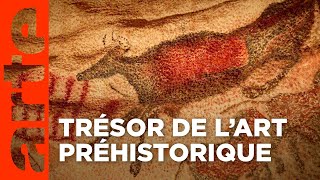


Je visite la grotte de Lascaux !
A new virtual reconstruction of the cave has just been completed, enabling an unprecedented immersive experience.
10 chapters
- Discovery and Closure of Lascaux CaveHistorical ContextIn 1940, Lascaux Cave was discovered in the commune of Montignac in Dordogne. Its paintings became world-famous through publications in every country and hundreds of books published over the past 80 years.Conservation Problems• 1960s: appearance of "white disease" caused by visitor carbon dioxide • Installation of an air conditioning system causing archaeological damage • Closure to the public on April 17, 1963 by the Ministry of Culture • Fungal proliferation in 2000 permanently closing accessReplicas and AccessThree facsimile replicas were created and welcomed millions of visitors, but their mandatory group tours did not guarantee an intimate visit experience.Technological SolutionA new virtual reconstruction using virtual reality and high-definition scanning of the walls was created at the Cité de l'Architecture et du Patrimoine in Paris.
- Geography and Archaeological Context of the VézèreGeological FormationThe cave is located in the Vézère valley, a tributary of the Dordogne. This river carved through limestone hills revealing numerous natural cavities forming corridors and chambers hollowed out by water infiltration over millennia.Site Concentration• Over a few kilometers along the river is concentrated an exceptional density of prehistoric sites • The Cro-Magnon shelter where fossil remains of Homo sapiens were discovered in the 19th century • Habitats, burial sites and about a dozen decorated caves • Lascaux is located in the north of the valleyRediscovery in 1940The cave entrance had collapsed in Prehistory. It was rediscovered in September 1940 thanks to Marcel Ravidat, a young man from Montignac, whose dog explored an opening during a walk.First Scientific RecordsAbbé Breuil, nicknamed the "pope of Prehistory" and professor at the Collège de France, visited the cave on September 21, 1940 and conducted the first surveys of the paintings.
- Inhabitants and the Magdalenian PeriodHomo sapiens CharacteristicsIn the Upper Paleolithic, Homo sapiens was alone in Europe after Neanderthal's disappearance. The humans who painted Lascaux were identical to us in every way; 20,000 years is extremely short for evolution with the same brain and intelligence.Way of Life• Small groups of hunter-gatherers • Tool making from flint • Settlement in rock shelters widely open to the outside • Caves served as sanctuaries, not dwelling placesDating and ClimateLascaux is dated to the Magdalenian period (19,000 to 14,000 BCE), frequented around 17,000 BCE. This era corresponds to a slight warming of global climate during glaciation. This milder period was officially named the "Lascaux interstade."Lighting EquipmentOver a hundred rudimentary lamps were found in the cave. They consisted of simple limestone slabs on which tallow, a residue of animal fat, was burned. A "burner" lamp shaped like a spoon carved from pink sandstone was also discovered.
- Prehistoric Life and Painted FaunaAnimal Species• Horses: 355 specimens • Aurochs: 87 specimens • Deer: 68 specimens • Ibex: 35, Bison: 20, Felines: 7 • One reindeer, one woolly rhinoceros, and one bearSignificance of FaunaThe majority of animals are deer, horses, and aurochs, fauna of temperate climates. Animals emblematic of cold periods are practically absent, confirming the mild climate context of the era.Symbolic ArrangementThe great bulls are located at the cave entrance, as if to greet the visitor and warn that he is entering a sacred place. Horses and aurochs form the essential pair present in all caves of this period.Archaeological InterpretationContrary to Abbé Breuil's hunting magic theory, excavations show that Magdalenians hunted mainly reindeer, yet this animal is poorly represented at Lascaux with only one specimen among 570 painted animals.
- Painting Techniques and Artistic PerspectiveMaterials and Colors• Red or yellow ochres used as crayons directly on the wall • Colorants reduced to powder and mixed with water • Black color obtained from iron oxide and manganese • Colored powders and small pigment blocks found on the cave floorApplication MethodsColorants were applied directly with fingers or brush-like tools. Flat areas were also created with the mouth, the painter spraying the mixture by blowing it to cover the wall more effectively. Outlines could be engraved with flint to make them stand out.Perspective and CompositionArtists used perspective by superimposing animals to indicate that one is in front of the other. They also employed distorted perspective sometimes showing animals from two or three different viewpoints simultaneously, with heads, horns, and hooves sometimes deformed.Abstract SignsThousands of abstract signs called "blazons" are found in the cave, apparently representing the entire palette of colors used. These abstract symbols accompany the animals on the walls.
- The Well Scene and Its MysteriesScene DescriptionThe "Well Scene" is found in a passage perpendicular to the main long corridor called the Nave. It depicts a wounded and disemboweled bison facing a schematically depicted horizontal human figure, one of the very rare human representations of the Paleolithic.Human Particularities• The man has a bird-headed figure reminiscent of a stick topped by a bird positioned near him • Figure shown in erection • The man has four fingers • This representation has often suggested a dream, a normal manifestation of paradoxical sleepNarrative CharacterThis scene possesses an undeniable narrative character showing that humans told a story. It could be a simple dream or a mythological episode of great importance, but we will likely never know.Artistic SingularityThis scene clearly stands out from other Paleolithic representations, testifying to a desire to tell a complex and symbolic story.
- Interpretations of Prehistoric PaintingsHunting Magic TheoryAbbé Breuil believed these animals had a magical function to help hunters kill them. Excavations refuted this idea, with reindeer poorly represented despite their importance as the Magdalenians' favorite game.Religious InterpretationAndré Leroi-Gourhan believed animals and abstract signs should be understood as religious symbols, ordered according to their masculine or feminine character. He developed a general theory for interpreting signs, though his message is not entirely clear.Shamanic Hypothesis• Georges Bataille (1955) suggested the prone man was in full shamanic trance • Jean Clottes believed shamans used hallucinations provoked by carbon dioxide • This hypothesis was refuted: hypercapnia causes headaches and panic, not hallucinations • This interpretation is considered unverifiable and outdatedOther Contemporary Theories• Creation myth of the world with animals symbolizing different clans • Pedagogical function: initiation of young people to recognize animal behavior • Connection to stars and astronomical rituals, the "Hall of Bulls" serving as a primitive planetarium • Consensus: the cave is a sanctuary where works have sacred value
- Virtual Exploration: The Sistine Chapel of PrehistoryRichness of the Axial DiverticulumThe Axial Diverticulum is the richest area of the cave, deserving the expression "Sistine Chapel of Prehistory." Paintings completely cover the walls, with an exceptional density of animal representations.Natural TechniquesArtists took advantage of the cave's natural reliefs to draw. They positioned animal outlines precisely according to the wall's geology, creating perfect integration between the work and the rock.Artistic Details• Exceptional fineness of ears and horns • Use of natural hollows and reliefs to enhance realism • Depiction of a black cow with black head, a red cow with black head • Details of multiple horses with superimposed heads showing movementAccess and ExplorationThe Terminal Passage is a steep speleological area very difficult to access, visited extremely rarely even by scientists. Virtual reality exploration now allows easy access to previously inaccessible zones.
- Virtual Technology in Service of ResearchRevolutionary PotentialThe software developed by Dassault Systèmes presents revolutionary potential for the public and researchers. It allows spending more time in the cave without worrying about carbon dioxide emissions and working together as a group.Technological Powers• Ability to see inside and pass through walls • Enhanced understanding of certain alignments and three-dimensional works • Free movement at full scale, life-size • Collective interaction for group discussion and exchangeScientific BenefitsScientists and the team of Muriel Mauriac, the cave's conservator, had 3D data for years. The major breakthrough was finally being able to enter this data at full scale and all meet together for immersive working sessions.New DiscoveriesVirtual access allows researchers to visit places they don't usually go, note forgotten details, and trigger immersive working sessions before returning to archive documents to verify and compare hypotheses.
- The Future of Virtual Cultural MediationNew AccessibilityVirtual reality makes accessible to the general public areas of Lascaux that were previously completely off-limits. Places become accessible to visitors rather than the reverse.Virtual SuperpowersAll visitors have "superpowers" in virtual reality, allowing unlimited experience free of physical or conservation constraints. This freedom completely transforms the approach to cultural discovery.Future Applications• Exploration of medieval and ancient cities • Visits to disappeared buildings • Discovery of extraordinary past landscapes • Access to the greatest number without restrictionsPromising PerspectivesThis technology should soon allow more people to freely explore virtual reconstructions of world heritage, transforming access to history and archaeology.