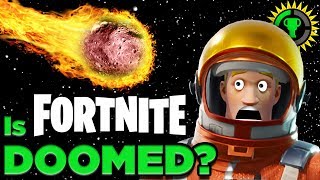

Game Theory: How DEADLY is the Fortnite Meteor? (Battle Royale)
The Meteor that's about to strike Tilted Towers, TOMORROW!!!
6 capitulos
- Introduction to Battle Royale Week and the Meteor MysteryContextThis episode is part of Battle Royale Week, following a previous episode examining whether games like Fortnite cause violence.The EventA meteor is about to strike Tilted Towers, transforming this iconic map location into rubble on April 18th.Research FocusRather than theorizing about the meteor's existence or trajectory, the analysis focuses on calculating the destruction it should cause using space science, chemistry, and physics.Central QuestionIs Tilted Towers the only affected area, or should players expect the entire map to become one giant crater?
- In-Game Evidence and Community CluesObservable Signs• An unusual object appeared in the sky, growing larger each day as it traveled closer to the Fortnite Island • The object displays a blue tail and is technically classified as a comet until it enters the atmosphere, when it becomes a meteorPlayer Discoveries• Telescopes appeared at various map locations including Fatal Fields and Pleasant Park, all pointing at the comet • Controllers vibrated at specific locations and times in sequences forming hidden Morse code messagesDecoded MessageThe Morse code message 'SOS D5 418' translates to a distress call for location D5 (Tilted Towers) on April 18th, marking the end of Fortnite season three.Epic Games' PlanEpic Games is altering the Fortnite map by replacing Tilted Towers with a new location, timing the change with season three's end to create hype while updating the game world.
- Calculating Meteor Mass Using Color AnalysisDensity Determination• Real-life meteors have varying densities from 2 to 8 grams per cubic centimeter depending on composition • Comet tail colors indicate chemical composition: red indicates nitrogen, yellow indicates iron, and blue indicates magnesiumComposition AnalysisFortnite's meteor displays a blue tail, indicating magnesium composition with a density of 3.32 grams per cubic centimeter based on asteroid research.Size Measurement• A Reddit user found the meteor's 3D model under Tilted Towers using the replay functionality • Using the grounded battle bus as a scale reference, the crashed meteor measures approximately 20 meters long, 12 meters high, and 4.8 meters wideMass ResultUsing the volume formula for an ellipsoid, the meteor's volume is 603 cubic meters, yielding a total mass of approximately 200,000 kilograms or 200 metric tons, equivalent to a jumbo jet or the Statue of Liberty.
- Calculating Meteor Velocity Using Angular MeasurementsAngular Radius Method• Parallax measurement used in astronomy is impossible in Fortnite because the angle doesn't change based on player location • Instead, angular radius was calculated using the in-game compass at the same map location and time of dayMeasurement Data• Day 1: The meteor had an angular radius of 0.184 degrees • Day 10: The meteor had an angular radius of 0.8 degreesFragmentation Factor• Meteors lose 50-60% of their mass during atmospheric entry through fragmentation • The meteor's pre-atmosphere mass would be approximately 4 metric tons with a length of 25 metersVelocity ResultThe meteor traveled 12,000 meters in 10 days (864,000 seconds), resulting in a velocity of 0.013 meters per second, which is approximately 6 times slower than a sloth's top speed of 0.08 meters per second.
- Impact Analysis and Destruction AssessmentKinetic Energy CalculationUsing the formula 0.5 × mass × velocity squared, the meteor's kinetic energy is 19 joules, equivalent to the energy of an average person jumping.Crater Size PredictionUsing Purdue University's impact crater calculator, a 20-meter meteor with 3.32 grams per cubic centimeter density traveling at 0.013 meters per second would create a crater only 1.6 meters wide and 30 centimeters deep.Real-World ComparisonThe impact is equivalent to dropping a pickup truck from just a few dozen feet up, causing minor pavement cracks but no significant structural damage.ConclusionThe meteor is scientifically too slow to pose any threat to Tilted Towers; it would practically bounce off the location, creating only a minor inconvenience of a giant boulder in the middle of the battlefield.
- Final Theory and Expected OutcomeMost Likely ScenarioEpic Games will update the map on April 18th, replacing Tilted Towers with a new location called something like Cavernous Crater, while the rest of the map remains completely intact.Scientific PredictionIf the meteor followed the calculated physics, it would land in Tilted Towers and cause virtually no damage whatsoever, creating an ironic outcome to all the in-game hype.Broader ContextSpace rocks in video games are consistently less threatening than media portrayal, with Mario Odyssey's moon being notably more dangerous than the Fortnite meteor or Majora's Mask space rocks.ClosingThe analysis demonstrates how scientific calculations reveal that despite dramatic in-game storytelling, the meteor is ultimately harmless based on observable parameters.