Game Theory: How Pidgey "Proves" Darwinian Evolution
13 capitulos
- Introduction and PremiseOpening HookThe episode explores whether Charles Darwin's theory of evolution can be found in the Pokemon universe, particularly in how Pokemon species adapt to their environments.Background Context• Previous episode debunked creationist claims that Pokemon indoctrinated children into evolution theory • New perspective reveals potential evidence of Darwinian evolution within the Pokemon world itselfExpert CollaborationHost brings in Alex from The Dex Poké Podcast to examine whether individual Pokemon metamorphosis reflects broader evolutionary patterns.Core QuestionWhile individual Pokemon evolution is metamorphosis, the Pokemon world as a franchise may show evidence of true Darwinian evolution.
- Darwin's Evolution Theory ExplainedCore Principles• All life stems from one common ancestor • Small genetic mutations create changes over time that help or hurt an organism's survival chances • Beneficial traits increase reproductive successNatural Selection ExamplePeacocks demonstrate natural selection: females prefer males with large bright tails, so over thousands of years, males without impressive tails became less likely to mate and their numbers diminished.Key MechanismOrganisms with traits best suited to their environment survive and reproduce more successfully, passing advantageous traits to offspring.Scientific TermThe process of selecting traits that aid survival is called natural selection.
- Mew as Common AncestorCritical EvidenceMew shares DNA with every Pokemon in existence, making Mew the potential common ancestor of all Pokemon species.Source References• Pokedex entries in Silver and Crystal explicitly state scholars believe Mew may be the ancestor of all existing Pokemon • Mew appears in practically every type of Pokemon movementEvolutionary ImplicationIf Mew is the common ancestor, then all different Pokemon species came into being through descent with modification driven by natural selection.ApplicationModern Pokemon are the result of Mew's offspring adapting to their surroundings to best survive, similar to Darwin's finches.
- Darwin's Finches and Island AdaptationGeographic IsolationThe Galapagos Islands act like Alcatraz for animals with no easy way in or out, allowing different species to evolve independently.Environmental Variation• Different island regions had different food sources: some had seeds and nuts, others had bugs • Finches had differently shaped beaks depending on their island locationAdaptive SelectionNatural selection favored beaks suited to each location's food source: wider beaks for cracking nuts, thinner longer beaks for picking bugs from trees.Pokemon ConnectionPokemon examples should show features that better enable creatures to live in their respective regions, demonstrating Darwinian evolution.
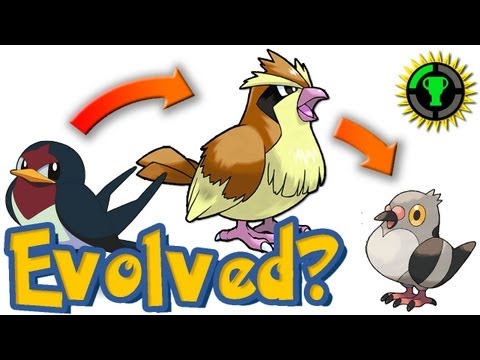
- Pidgeot: Ground-Dwelling AdaptationRegional EnvironmentPidgeot is found in Kanto, which consists mostly of plains and grasslands, forcing the species to dig and pick at the ground for food.Physical Features• Large feet perfect for digging in dirt • Long nails suited for ground foraging • Oversized feet as valuable survival assetDefense MechanismWith many trees to hide in, Pidgeot's main defense strategy is kicking up dirt and dust, making its oversized feet instrumental for survival.Evolutionary EvidencePidgeot's design directly reflects environmental pressures of its Kanto habitat, exemplifying natural selection.
- Taillow: Long-Distance Migration SpecialistMigration BehaviorTaillow flies over 180 miles per day during cold season migration to search for warm climates, covering huge distances.Habitat DemandsTaillow is found in Hoenn, which features much more water than other regions and consists of small islands, providing few rest stops for migration.Specialized Anatomy• Enormous wingspan compared to other flying Pokemon • Very small body that keeps weight low • Large wings increase lift ability with each flapAdaptive AdvantageThe combination of small body and large wings creates a Pokemon perfectly suited for the long distances it must fly to survive in its island habitat.
- Pidove: Urban CoevolutionUrban EnvironmentPidove thrives in the urban environment of Black and White, with habitats around cities and bank complexes rather than natural settings.Coloration Adaptation• Mostly gray and black coloring suited to urban camouflage • Loud vocalizations help it survive in noisy urban settingBehavioral TraitDespite low intelligence that seems disadvantageous, Pidove's heart marking and relative stupidity make it adorable and helpless, encouraging humans to feed it.Coevolution TheoryPidove appears to have coevolved with humans where traits in one species result in evolution in another; preying on human love of cute animals, Pidove evolved to exploit human behavior.
- Armor and Heatmor: Coevolutionary Arms RacePredator-Prey RelationshipHeatmor is the only Pokemon able to eat Armor by using its fire to melt through Armor's thick armor plating.Defensive AdaptationArmor developed thick armor plating as a defense mechanism against predators.Offensive CounteradaptationHeatmor evolved fire-based abilities specifically to overcome Armor's defensive adaptation.Evolutionary CycleThis represents coevolution where predator and prey continuously adapt to each other's traits in an evolutionary arms race.
- Pollution and Artificial PokemonInitial AssumptionIt seemed logical that trash and pollution Pokemon like Grimer sought out sewers because they were more comfortable there.Evolutionary ExplanationUnder natural selection theory, these creatures evolved in those environments rather than choosing to migrate there; the environment produced them.Magnemite Case• Magnemite tends to be found around power plants • Man-made structures don't have much food • Magnemite evolved into a form better able to take advantage of available electricityEnvironmental PressureHuman-created environments like sewers and power plants became new selective pressures that shaped Pokemon evolution.
- Counterargument and ResolutionHistorical ChallengeCard game depictions show Magnemite appearing in ruins 1,500 years before generation one, long before humans built factories or power plants.Source ReliabilityNon-game sources are sketchy; if they were reliable, Sonic would still be faster than the speed of light.ReassessmentThe initial analysis that modern human structures drove Magnemite's evolution appears misguided based on this historical evidence.ConclusionDespite this counterargument, Darwinian evolution does exist in the Pokemon universe with multiple valid examples of natural selection and adaptation.
- Conclusion and TributeFinal VerdictEvolution exists in the Pokemon universe through demonstrated examples of natural selection and environmental adaptation across multiple species.Darwin RecognitionCharles Darwin is posthumously awarded the title of loyal theorist of the first degree for theorizing about video game mechanics before video games existed.Hypothetical ReflectionIf Darwin had a web series, Game Theory is what it would have looked like, continuing his legacy of analytical research.Closing StatementEvolution remains theoretically sound despite abundant evidence, reinforcing that scientific theories require more than just supporting examples to be definitive.
- Outro and Fan AppreciationGratitudeThanks to viewers for taking time to watch Game Theory.Previous Milestone• Last episode was a Draw My Life video to thank audience for reaching 500,000 subscribers • That episode's N card tournament winner chose Mass Effect's ReapersCurrent PollViewers are voting to choose between Charmander, Squirtle, or Bulbasaur for the next collaborative episode.Closing InvitationContinuation of unique blend of education and witty banter on the channel.